Shipwrecks as archaeological sites provide valuable insights into the past. They have been considered as “time capsules” containing objects being used at the time of the sinking. Because of the precipitous nature of the sinking there was often no opportunity to remove objects and they remain as they were while in use at that time.
One such example is the wreck of the Mary Rose; flagship of Henry VIII’s Vice Admiral of the Fleet. The Mary Rose sank in the Solent on 19 July 1545 with the loss of hundreds of lives. Despite attempts at salvage by Venetian salvors, much of the Mary Rose sank into the soft sediments of the seabed and was eventually covered by hard mud and protected from erosion. Following the re-discovery of the wrecksite in the 1960’s the wreck was systematically excavated and mapped until it was raised in 1982. The wreck has revealed a remarkable collection of objects and a substantial part of the hull as well as the bodies of the men who died during the sinking.
Wooden wrecks like the Mary Rose may be preserved for many years allowing such recovery. This is illustrated by the recent discovery of the wreck of a Greek vessel in the Black Sea, which is thought to have sunk 2400 years ago (https://www.bbc.co.uk/news/world-europe-45951132 accessed 09/01/2019). However iron and steel wrecks are not preserved in seawater and decay much more rapidly. Reports of the condition of the Titanic indicate it is decaying due to a combination of several factors including the effects of ocean currents, chemical reactions between sea water and the iron and steel, and the effect of marine organisms. (eg https://news.nationalgeographic.com/news/2010/08/100818-titanic-3-d-expedition-shipwreck-science-collapsing/)
Similarly the less high profile, but popular dive site, the wreck of the Thesis in the Sound of Mull, Scotland, is similarly decaying. Following a major collapse of the bow of the wreck a few years ago, a survey in 2015 by the Scottish maritime archaeology project, SAMPHIRE, concluded this was due to the “fragile and highly corroded nature of the surviving elements of the bow structure” (http://blogs.wessexarch.co.uk/samphire/2015/07/06/defending-the-thesis/).
The artefacts recovered by projects such as the Mary Rose Trust provide an insight into the functioning of the ancient ship and life on board at that time. However if the iron and steel wreck decay as they appear to do, there will not be a similar archaeological record for these.
Amateur divers regularly dive the wrecks of iron and steel vessels in relatively shallow, coastal waters. Some of them do this as part of systematic investigations of the wreck, but most are informal almost “sightseeing” trips to the wreck. These latter divers often take objects from the wrecks as souvenirs and build up small, unsystematic collections. For many wrecks these collections may soon be all that remain as the iron and steel decay.
Wreck Policies and Legislation
There is legislation regarding the removal of objects from wrecks. Under the Merchant Shipping Act 1995, all wreck material regardless of size or significance must be reported to the Receiver of Wreck if it is recovered from within UK territorial waters or recovered outside the UK and brought within UK territorial waters. Reporting requires completion of a Report of wreck and salvage form which is then sent to the Receiver of Wreck within 28 days of the recovery of the object.
The National Governing body for Sport Diving, The British Sub-Aqua Club, BSAC) has a policy to remind divers about the legal position, “Respect our Wrecks” ( https://www.bsac.com/advice-and-support/respect-our-wrecks/respect-our-wrecks-policy/). This BSAC policy also however promotes that divers should explore wrecks but not damage or disturb them and take photos rather than souvenirs. Because many wrecks have an important history, reporting finds to the Receiver of Wreck, enables such information to be passed to archaeological experts.
Archaeological Interpretation
The systematic exploration of an archaeological site depends on the careful recording of where precisely each object was found. In this way the spatial relationship of one object to another is recorded and from that spatial information, function may be inferred.
An example of this is that of a shaving mirror recovered from the Mary Rose.
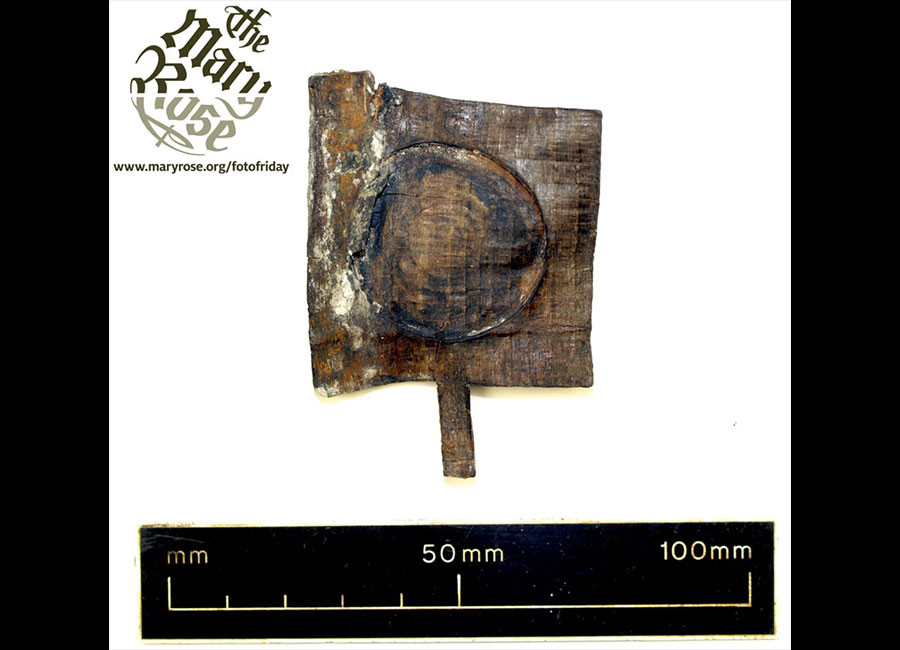
This was found in a chest outside the carpenter’s cabin, possibly indicating who it belonged to and their social status. There was no glass in the mirror when found, but fragments found nearby indicating that this object, which in itself does not look like a it, was indeed a mirror. Alongside it was a razor and shaving brush indicating it was likely to be a shaving mirror rather than some other type. This wealth of knowledge about a small, apparently unassuming object has only been pieced together by knowing the spatial context of the object and what surrounded it.
The objects recovered by amateur divers as “souvenirs” lack this context and therefore are unable to contribute to knowledge about their use or the wrecksite more generally.
It is the lack of contextual information about the objects in these collections and their isolation and separation from their origins which I want to try and capture in my Project. By so doing I hope to highlight the importance of recording and declaring finds to the Receiver of Wreck so that an effective record of this aspect of nautical history can be recorded.

 Andrew Procter