During my brief stay in Venice I visited the Peggy Guggenheim Collection. This is a museum of modern art principally based on the personal collection of Peggy Guggenheim who collected the artworks mostly between 1938 and 1946. Works on display include those of American and European artists largely working in the first half of the 20th century, and include works of Cubism, Surrealism and abstract expressionism.
I am not familiar with this style of art and I hoped my visit would extend my knowledge and expose me to different forms and styles of visual expression.
There was a lot of material in the collection and I made notes as I visited. To try and put this experience into a manageable form I have decided to write here three things I believe I learned from this visit. I am sure that there were more, and I may recognise these as I progress through my OCA course, however I will add to that account from my notes as I need.
1. Rayographs by Man Ray
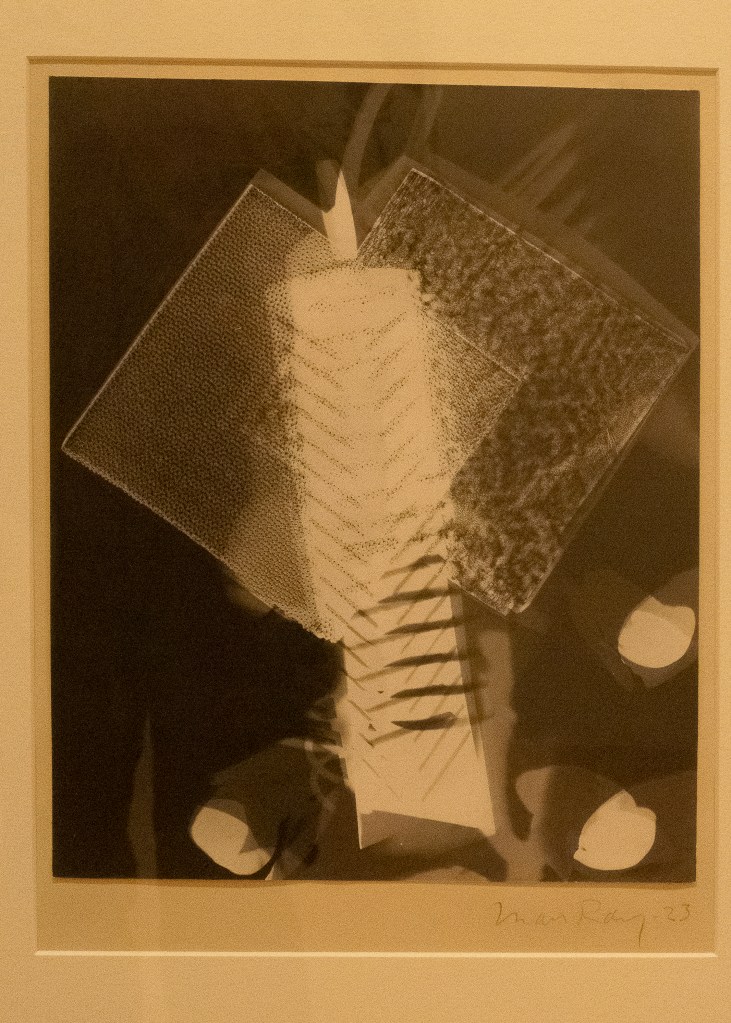
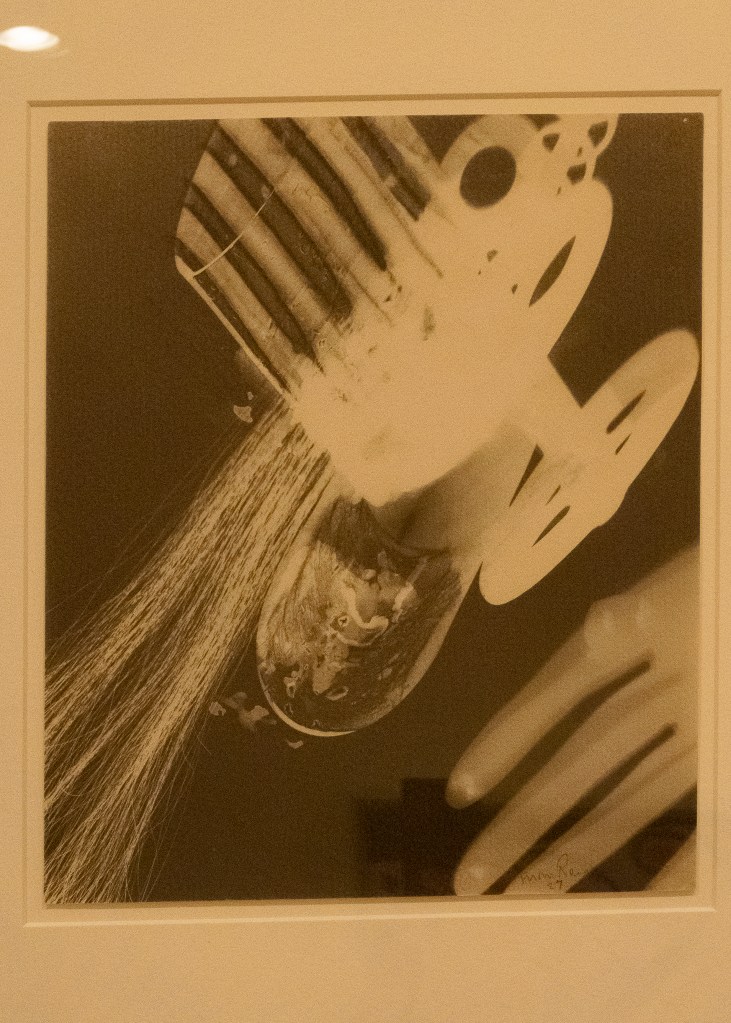
The collection includes two examples of Rayographs made by Man Ray.
Man Ray is described as a painter, filmmaker, photographer and sculptor, active in Paris from 1921. His work is considered influential in the development of Surrealism. As a photographer he is also noted for technical experimentation with techniques such as solarisation, grain enlargement and the production of camera-less prints, “Rayographs” (Photography the Whole Story (2012) Hacking J (Ed.) Thames and Hudson.)
These rayographs were made by placing objects directly on a sheet of photosensitized paper and exposing it to light. The resulting image becomes more abstract and representational.
2. Abstract art and Surrealism
I had never really considered the massive differences in styles of “modern art”. Going round the gallery I could see how the styles evolved through Cubism to abstract. The work of the surrealist artists I found particularly interesting as these employed imagery based on the principles of psycho-analysis. Symbolism is widely used based on classical Freudian theory and later artists such as Max Ernst, employing Jungian principles.
3. The work of Jackson Pollack
I have never understood the work of this artist. However the notes from the collection helped me to begin to do so.
The concepts of line, form and colour in creating an image began to be explored in our coursework, exercises 1. However seeing the abstract images in this collection made me understand to what extent these can be separated and function independently. Pollack takes this to an extreme and does not appear to depict any realistic description.
The exhibition notes also referred to the principle that some of the key feature of some of these works is the process of creating the image, rather than the image itself.
These are relatively new concepts for me, but I think this visit has started me on a different path of understanding art works.
This section of my learning log really documents my development of different visual appreciation and understanding.

 Andrew Procter
3 thoughts on “Peggy Guggenheim Collection, Venice December 2018”