“Where Land meets Sea” 11/05/2019
Royal Photographic Society meeting “Where Land meets Sea – A Talk about Coastal Photography by Rachael Talibart
Prior to the meeting I searched for Rachael Talibard’s work on the internet and found her website: https://rtalibart.photium.com/about.html (accessed 1/05/2019)
Her website describes her biography:
About:
One of ‘the best outdoor photographers working in the UK today’ Outdoor Photography Magazine June 2016
Rachael grew up on the south coast of England. Her first career was as a solicitor in the City of London. During the City years, Rachael’s friends and colleagues were used to seeing her return from trips with bags full of exposed film; the developing sometimes cost more than the trip! In 2008, she converted to digital and she says that is when the obsession really set in. In 2000, Rachael left her City career and, after obtaining two more degrees, she now works full-time on her photography.
Much of Rachael’s early childhood was spent at sea. This has left her with a life-long fascination for the ocean in all its forms, but especially in stormy weather. For Rachael, nothing beats a day on an empty shore, the wilder the weather the better. This is reflected in her work.
Rachael’s photographs have been published in books and both print and online magazines, have been exhibited widely in the UK as well as Barcelona, New York, and Massachusetts, and they feature in private collections in the UK and USA. She is owner of f11 Workshops, providing photography day workshops in the South of England and runs residential photography workshops for international, fine art photography business, Ocean Capture. Rachael is an experienced public speaker and writes for photography magazines. A member of Parhelion Group.
I also looked at the published portfolios on her website:
Sirens, Ocean, Coast, Ice, Chalk/Sand, Freshwater, Black and White, Traces, Perigee
On reviewing the work on her website I formed the impression that there are two predominant styles to her work.
The first is of images of the sea, either in a calm, tranquil setting such as this

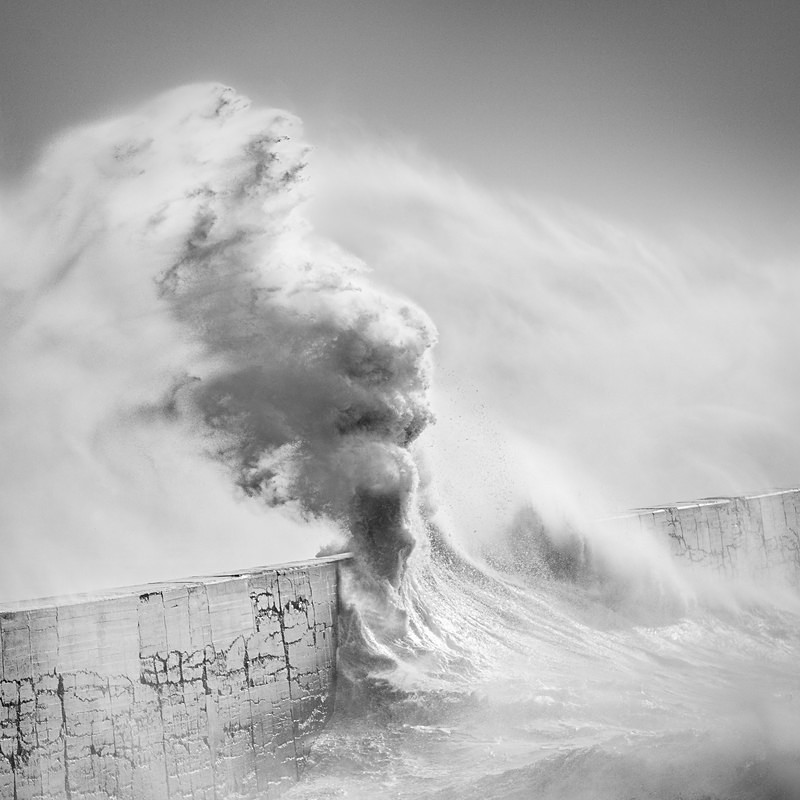
Or more stormy
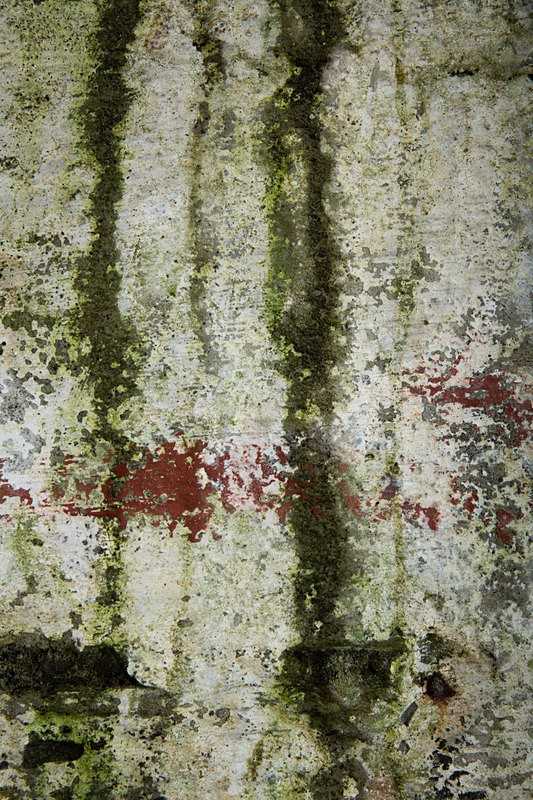
The other major style is of almost abstract images of detail from her surroundings, perhaps best exemplified by those in “Traces”, images of the walls of a derelict fish factory in Iceland
(Read about Traces: “In a forgotten corner of Iceland’s remote West Fjords stands an abandoned herring factory. In this unlikely place, beautiful works of art have formed. The concrete was mixed using sand from local beaches, and the minerals and organisms within have emerged through the structure leaving traces that are abstract yet also seem strangely to echo the landscape beyond the factory walls. Thus I feel that these photographs have two authors, myself and the sea.”)
Images such as
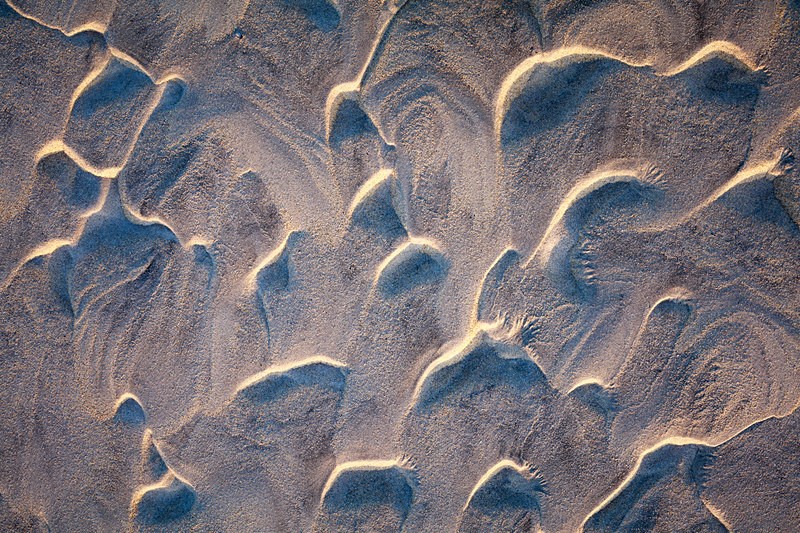
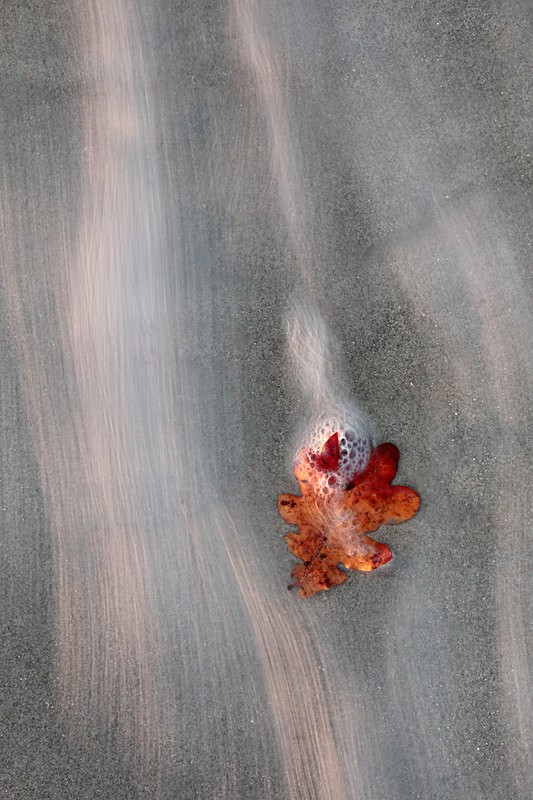
But she also finds abstract images in the sea and shore like those in “Chalk/Sand”
Her talk:
Rachael spoke for over two hours in all and presented a great deal of material. Her talk concentrated, as the title would suggest, on coastal photography, exemplified by her portfolios “Sirens” as well as images from “Ocean”, “Coast” and many others.
In addition to describing the technical aspects of her work, from the visualisation of the planned image, through the techniques of shooting the image (often in challenging environments) to the processing of the RAW files and printing the image and her selection of paper stock for various types of image.
I learned many things from this comprehensive presentation, but will attempt to concentrate on three major learning points, as I have done for other experiences like this in the past.
Photography as Art
Rachael Talibart describes herself and colleagues in the Parhelion Group, as “artists”. She desscrbed a conversation with a visitor to an exhibition who was surprised to see the photographer described as the “artist”. She then had a brief discussion about her view of photography as art. She suggested that as photography as a technique is well suited to produce documentary representations of reality, it is often seen primarily as this rather than a art medium which may be used to represent the artist’s own expression.
She suggested that as soon as an image is presented in black and white it becomes an art form. She suggests that because humans do not see in black and white, such a representation is not a representation of our perception of the scene but is influenced by the artist’s interpretation.
She went on to describe how the black and white image can be used to assist composition and be removing potentially distracting colour, can allow other underlying attributes of the image to be better seen.
Techniques
Rachael Talibard described a number of techniques she uses in the production of her images.
Ones which I found particularly interesting and valuable suggestions were the use of black and white visualisation of the scene at the time of shooting to help composition and the focussing of attention.
Others included some Lightroom and post-processing techniques such split toning, and the use of linear gradients for vignetting. The other technique is the manipulation of individual colour channels in transforming a black and white image.
I will explore these more in later posts.
Use of video
During her presentation she had a number of slide shows, these included video clips.
The use of video is a learning theme which has interested me over the last year, but this is a subject for future posts.
I was interested to see how she interspersed still images with video clips. Her clips were generally taken with a static camera position, so they appeared “moving pictures”.
I think my interest in this was to see how the two media can be used in juxtaposition, and the final presentation justifies the use of video.
My Future Work as a Result of this Talk:
She mentioned the concept of “kindly vacancies” in composition, introduced by John Ruskin in his work “On Modern Painters”. I plan to look at this work.
Other artists she mentioned who I will research include:
Warren Keelan ( https://www.warrenkeelan.com/) a seascape and ocean photographer using waterproof housings for his camera to get a different perspective on the ocean than that of Talibart.
Mark Littlejohn (http://marklittlejohnphotography.com/about/) a Lake District based landscape photographer whose work she commends for his use of split toning.

 Andrew Procter
3 thoughts on ““Where Land meets Sea” Rachael Talibart”