Project 2 A Durational Space
This project seems to be about ways of leaving a trace of movement within the frame as a way of depicting the sense of movement in a still image. The first example the course notes cite of this is Robert Capa’s image of an American soldier wading ashore under fire on Omaha Beach in Normandy, France on D Day, June 6, 1944.
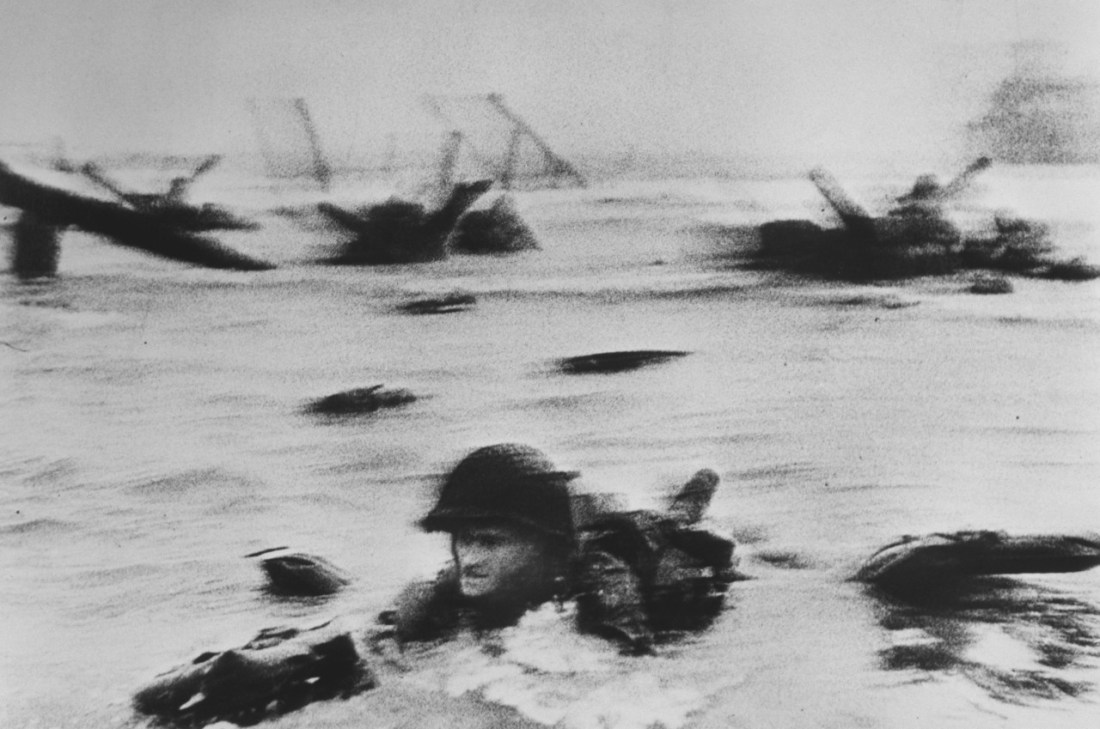
The notes also suggest that “the grain and blur seems to lend a sense of authenticity to the shot”, and ask why has this image become the iconic image of D Day. One element of this image which I think may be of significance is that in spite of the graininess and blur, we can see the face and expression of the soldier in the water. I have previously suggested this as an important technique in producing documentary photographs in the work of Willy Ronis and Don McCullin. By seeing the soldier (fairly) clearly, an observer can empathise with him and his position lying in the water, under fire.
I examined other images by Capa of the D Day landings and others on the Magnum website. (Capa founded Magnum Photos In 1947, with Henri Cartier-Bresson, David Seymour, George Rodger and William Vandivert. https://www.magnumphotos.com/photographer/robert-capa/ Accessed 17/6/2019)
There are, as the course notes suggest, other sharp images of that day, and other images which seem to show movement and dynamism such as this image of Trotsky, which is sharp and seems more “polished”.
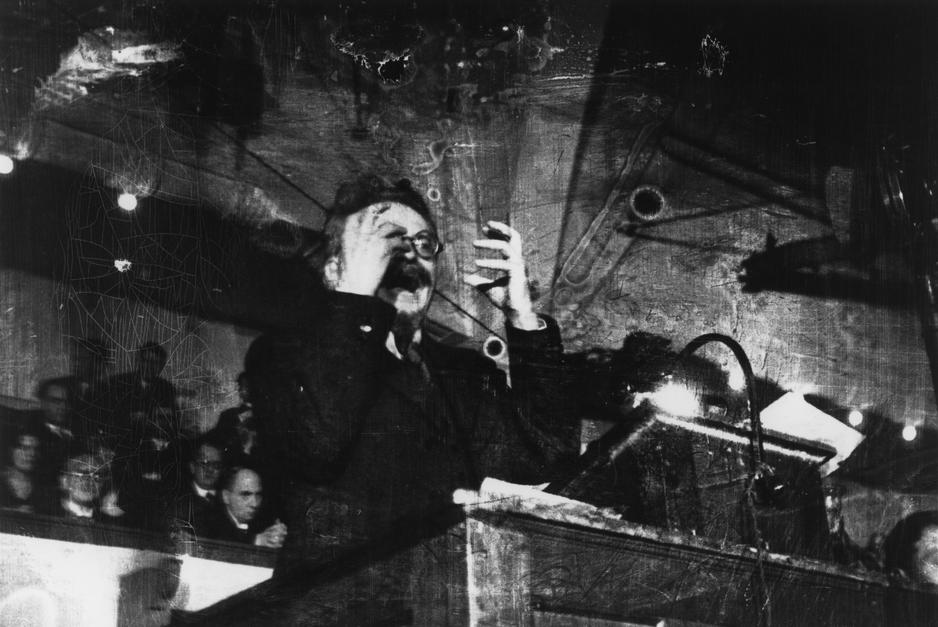
The position of his hands in this image give me a sense that they are in motion – not being held static in that position. His curled fingers give a sense of tension and the emotion with which he is speaking. There is some graininess present but this gives the sense of the low light illuminating the scene.
On the Magnum site, there are others which also have the same blur and grainy effect such as this taken several years before D Day during the Spanish Civil War.
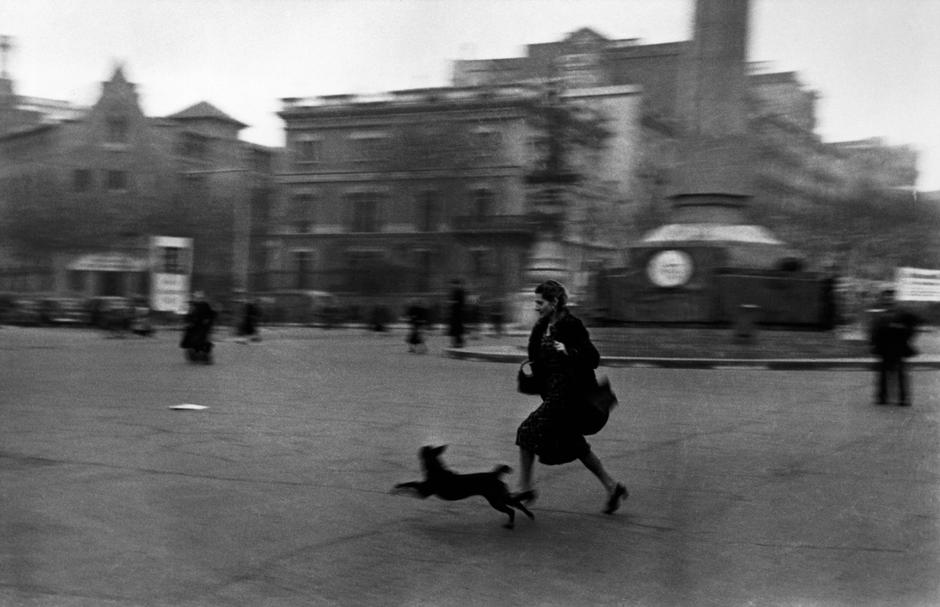
The background and dog is blurred, but the face of the woman is sharp giving a sense of her rush to get to the shelter.
However several of the images of D Day do show grain and blur to a great degree, like that of the soldier wading ashore. In addition there are some which include the image of the sprocket holes on the edge of the film:
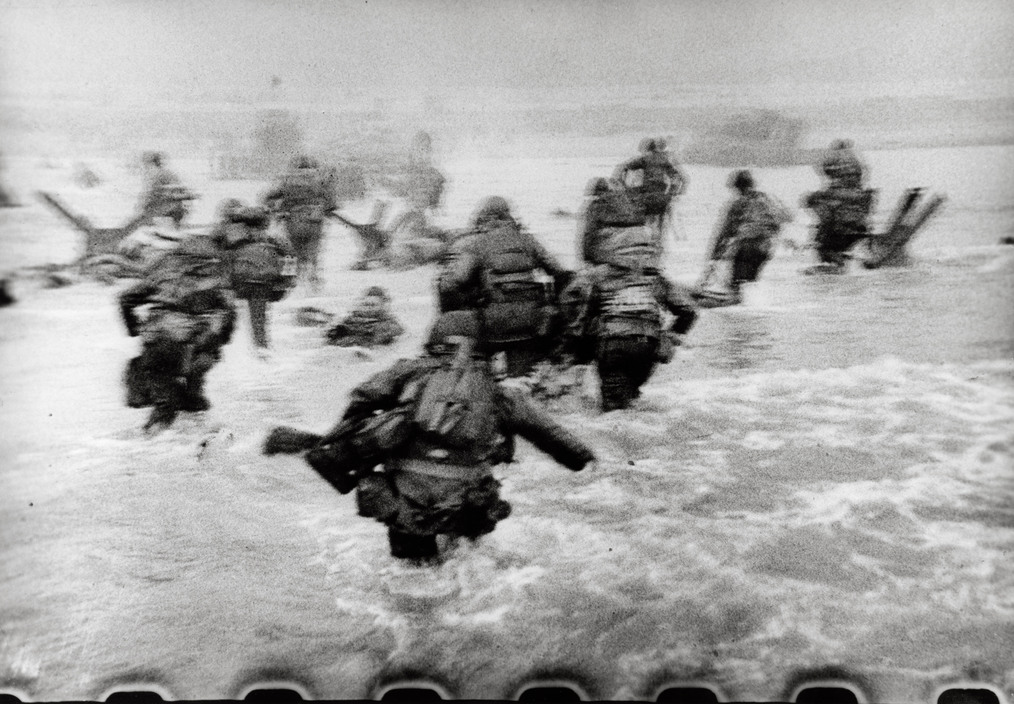
It is unclear to me why Capa does this. It seems as if he is deliberately making the image look amateurish and unpolished. An explanation is suggested. “In the rush to develop the images at the Life bureau in London, a 15 year old darkroom assistant made an error: he set the dryer too high and melted the emulsion in the negatives.” Photography the Whole Story. Ed Hacking J. Thames and Hudson (2012) pp 316 -317.
However the fact that these images were published in this state is important and I think of significance. I started looking at these images around the time of the 75th anniversary celebrations of the Day Landing. On 31 May 2019, on the Today Programme BBC Radio 4, Jonathon Dimbleby was interviewed regarding the D Day landings and coverage by the BBC and his father, Richard Dimbleby. (Today BBC Radio 4, 31/05/2019. https://www.bbc.co.uk/sounds/play/m0005f8m Accessed 17/6/19).
In this interview Jonathon Dimbleby made the point that around the time of the D Day landings, the BBC and Allied broadcasters expanded their broadcasts and their team of war correspondents. He said this was because:
“in a democracy broadcasting accurately from the frontline was widely acknowledged to be of real importance, especially with the Nazi media doing its clever best to distort the facts and to lower morale.”
It is in this context that I think Capa’s coverage should be considered. His images needed to be seen to be genuine and produced under the conditions of real combat. More technically perfect images may be seen by an observer as constructed and false. What is the point of falsifying an imperfect image!
In my reading of Capa’s biography I noted that Capa had a history of creating illusion. He was born Andre Friedmann to Jewish parents in Budapest in 1913. He moved to Paris in 1933 and met the journalist and photographer Gerda Taro. Together, they invented the ‘famous’ American photographer Robert Capa and both began to sell their prints under that name. (Gerda Taro: the blonde of brunete. N L Diu The Telegraph 09 Dec 2007)
The persona “Robert Capa” who has created a large body of work, and was introduced in December 1938 by Picture Post as “The Greatest War Photographer in the World” based on his images of the Spanish Civil War, is therefore a creation! (https://www.magnumphotos.com/photographer/robert-capa/ Accessed 17/6/2019)
A further theme that I have eluded to in my description of the work of another “war photographer”, Don McCullin, is the effect of war on the photographer. Capa’s partner, Gerda Taro, was killed in 1937, hit by a tank as she escaped a sudden attack near Brunete, and is now regarded as ‘probably the first female reporter who ever died in action’. Capa (Friedmann) was killed when he stood on a landmine while photographing for Life in Thai-Binh, Indochina, on 25 May 1954.

 Andrew Procter