The Decisive Moment Part 1 – My First Thoughts
Having looked ahead in the course notes I saw that “The Decisive Moment” was a topic for research and the basis of the third assignment. I have been thinking about the meaning of this for a while, prior to having the opportunity to read the suggested sources about this. This post reflects those initial thoughts.
As I had not read the notes for the course I initially believed I had had a unique and novel insight into the nature of this concept. That is, in making an image, the photographer moves his camera in the three spatial dimensions: to the left or right of the subject, near or far away, and from a high or low view point. In addition there is a fourth dimension of time, and the photographer chooses to open the shutter at a particular moment. The uniqueness of this fourth dimension is that whereas if he moves too far in one of the spatial dimensions, he can always move back, but this is not possible with time. There is a further consideration regarding time, and that is how long the shutter is open when creating the image, and therefore we might better think of the “Decisive Moments” rather than a moment.
Having read more about this I now realise my insight is the principle described by Flusser.
“The photographer moves within specific categories of space and time regarding the scene: proximity and distance, bird- and worm’s-eye views, frontal- and side-views, short or long exposures, etc.” (Flusser, 2012)
Examples of images where this is prominent include this by André Kertész..
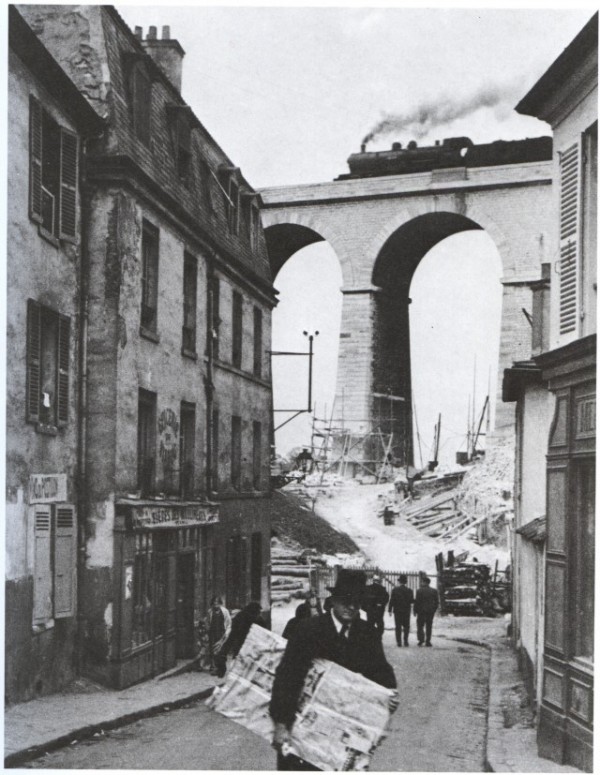
The image was created when the train was positioned at a compositionally pleasing place on the viaduct, AND the man with the package is prominent in the foreground. Kertész may have planned this with the aid of railway timetables, but the position of the man is probably outside his control.
Another image where advance planning has been important is this by Willy Ronis.
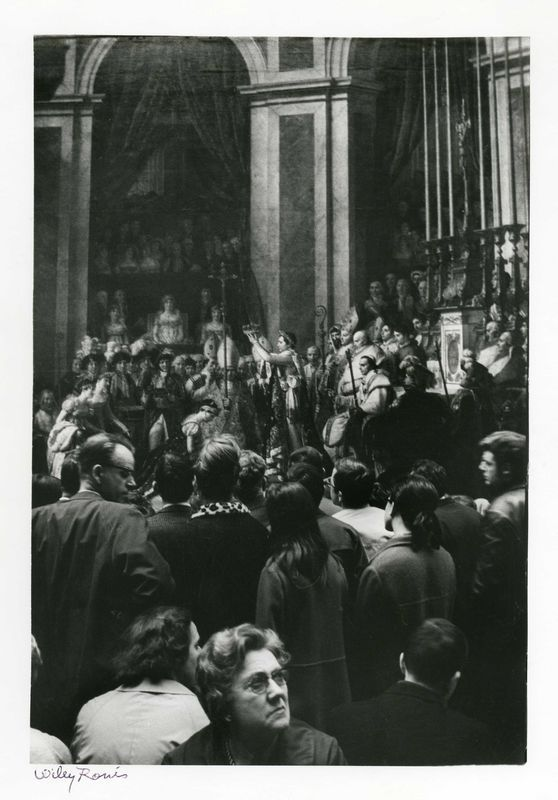
He has made this image at a time when the lighting in the room matches the direction of the lighting in the painting, and there are sufficient people in the gallery to make a crowd hiding the frame of the painting. As a result it is difficult to determine which are figures in the painting and which are the viewers in the gallery.
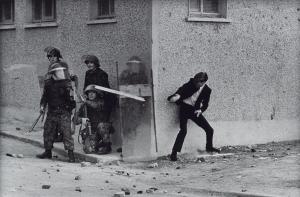
The importance of the duration of shutter opening is exhibited by this image by Don McCullin.
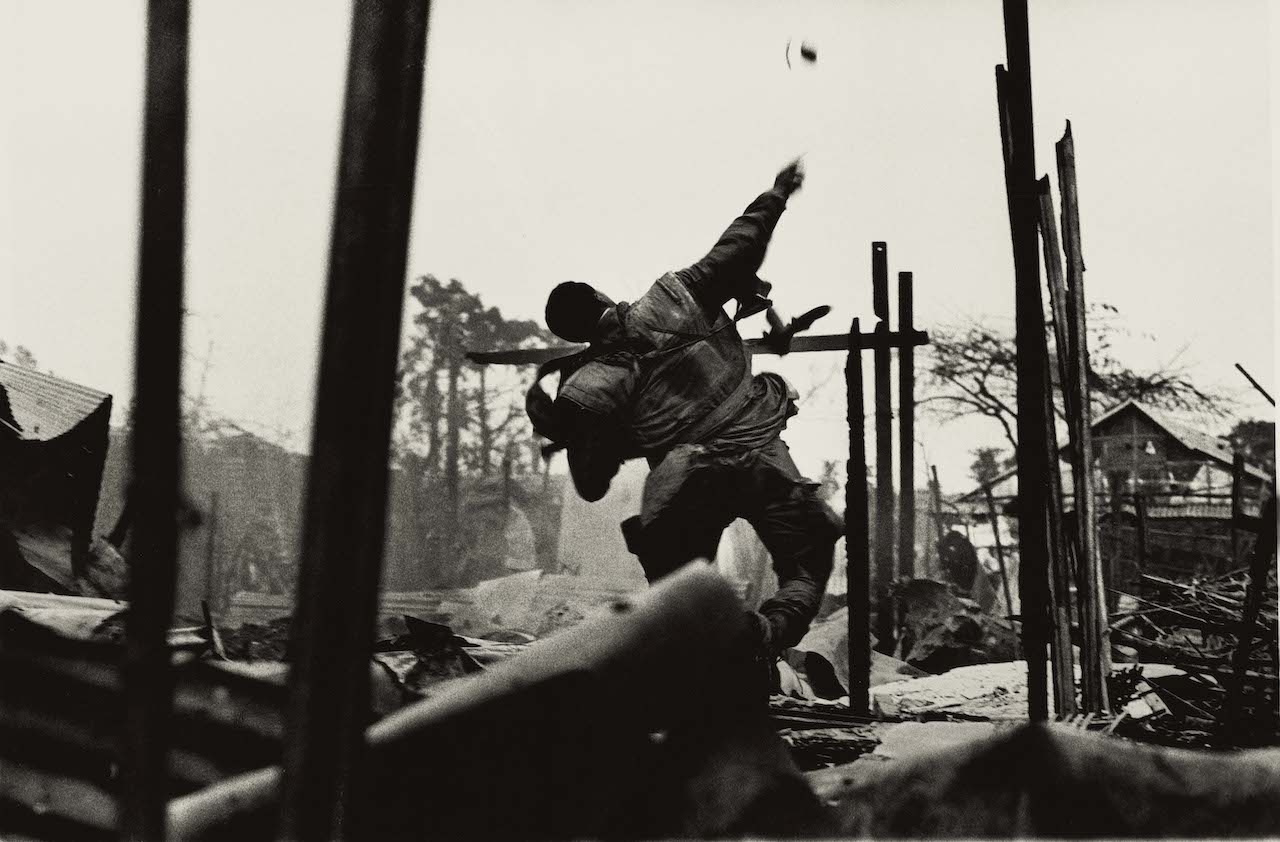
The slight blur of the soldier’s arm emphasises the sense of movement and dynamism in his posture. McCullin has made the image at the decisive moment To create that composition.
However this image illustrates another aspect of decisiveness about this. The description of this image demonstrates this:
“He looked like an Olympic javelin thrower. Five minutes later this man’s throwing arm was like a stumpy cauliflower, completely deformed by the impact of a bullet.” Don McCullin as quoted (Baker and Mavlian, 2019).
The moment that the image was made may have been the moment his position was identified by the sniper who shot off his hand.
Thus I would suggest that there is compositional decisiveness and a narrative decisiveness. The former is illustrated by the position of the train in the image of Meudon, all the elements are arranged. But there is also a moment which is important in telling a story or hinting at it, like the position of the man with the package in the same image.
These images by Don McCullin each capture a moment, and are decisive both compositionally and in terms of the narrative.

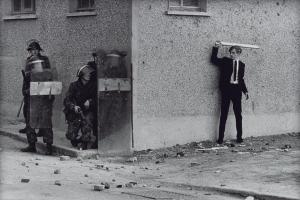
But what they really seem like to me, are stills from a video that McCullin did not make and each show the development of the interaction, and as such have a narrative quality.
References
References to the works cited in this post are found in my separate post “References”

 Andrew Procter
2 thoughts on “Part Three/Project 3 What Matters is to Look”