Project 3 ‘What matters is to look’
The course notes say:
“Watch the Henri Cartier-Bresson documentary ‘L’amour de court’ (‘Just plain love’, 2001)
Write a personal response to the film in the contextual section of your learning log,”
I watched this video of the documentary film:
Henri Cartier-Bresson: L’amour tout court
Directed by Raphaël O’Byrne (2001) (O’Byrne, 2014)
This film consists of a series of interviews with Henri Cartier-Bresson (HCB) in which he describes influences on his work and his approach to his work. It is illustrated with some of his images and his description of these and the background to them.
There were a number of themes in the documentary which I noted and considered.
The first of these was early in the film he used the phrase “what matters is to look” and elaborated this by saying “you have to be receptive, that’s all”.
By this I understand that his work comes from an intense awareness of what is happening around him and being able to record this. He emphasised, perhaps somewhat self-deprecatingly, that “it’s always luck” and that the relationship between elements in his images are a “matter of chance”.
I suspect that even if it was a matter of chance as to whether he captured the elements in an arrangement he found satisfactory, his selection of the images for publication was actually very carefully performed. He explained that the basis of many of his images is the geometry and his arrangement of the elements is based on the Golden Number. He illustrated this with the image of Scanno, Italy 1951.
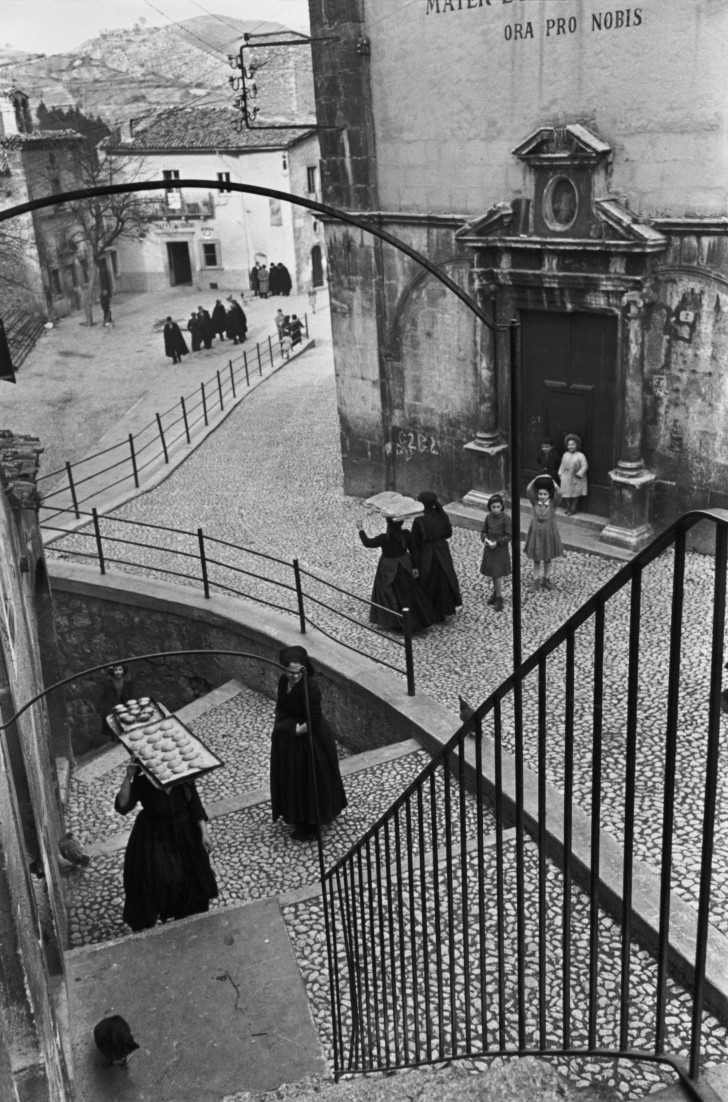
(But when I researched more of his images it seemed clear to me that prominent geometric forms are a common feature of many of these). Consistent with this was his emphasis that “form more than light” is important to his work.
Another prominent theme related to his principle of “being receptive” was his approach to travel; and the importance of being part of the world.
This was illustrated by consideration of his image “Funeral of a Kabuki actor, Japan”.
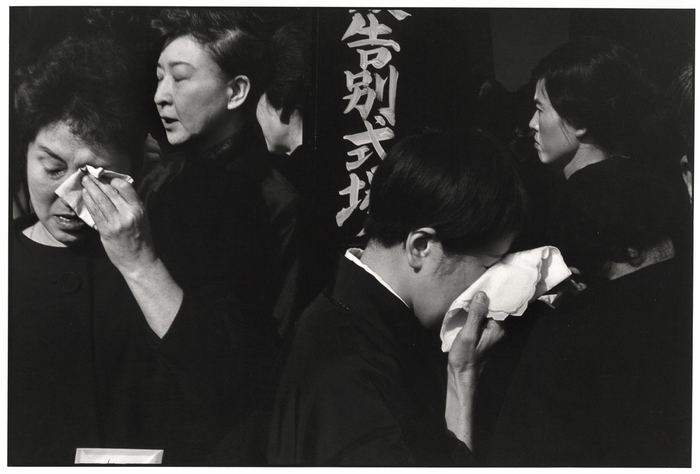
The commentary of the film suggested that HCB “likes those that he photographs not to realise what he is doing”. This was illustrated by the comment that he painted the shiny parts of his camera black to make it less obvious (and presumably setting a fashion for all black bodied cameras which became popular in the 1970s for “serious” photographers).
It is suggested in the film, that only in this way would those whom he photographed act normally and be spontaneous, and thereby the grief shown in this image was more genuine. However I was struck by a comparison with the image by Don McCullin, Turkish Village 1964 and McCullin’s account of making it.
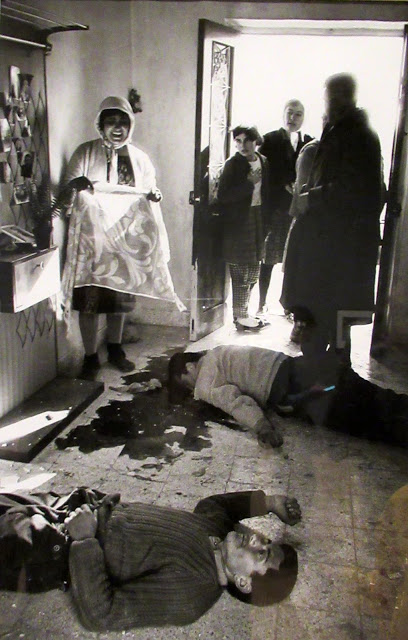
“A woman entered screaming. One of the dead was her new husband. I was standing just by him… I was looking for their blessing to continue… I started quietly taking photographs with great respect. I was allowed to continue.” Don McCullin (As quoted in Baker and Mavlian, 2019)
I think that there is little doubt that the grief shown by the woman in McCullin’s image is genuine and clearly shown. What this suggests to me is that it is less important that the subjects do not realise what the photographer is doing, but that the photographer is empathetic to the subjects and, in the same was as was emphasised in the HCB documentary, “part of the world”.
References
References to the works cited in this post are found in my separate post “References”

 Andrew Procter
One thought on “Part Three/Project 3 ‘What matters is to look’: L’amour tout court”