I have recently become very aware of how ubiquitous sources of artificial light are in our environment. I have recently re-started developing and printing film. As I was about to load a film into a developing tank, I saw that I was wearing fitness tracker on my wrist which lit up as I moved, and had a green light displaying all the time, my phone was on the worktop and would light up if I was called. All round my darkroom were battery chargers and other items with LED displays.
This prompted my to do two things. The first very practically, was to remove all the light emitting objects and put them in a metal box, and cover up others with black tape; before loading my film…
The second was to remember images of “Rayographs” which I had seen in the Peggy Guggenheim collection. His technique for producing these is described on the Metropolitan Museum website. https://www.metmuseum.org/art/collection/search/265487 (Accessed 1/08/2019).
“Man Ray made his “rayographs” without a camera by placing objects-such as the thumbtacks, coil of wire, and other circular forms used here-directly on a sheet of photosensitized paper and exposing it to light.”
Another Rayograph is shown from their collection, here with those from the Peggy Guggenheim collection:


I wondered how a similar technique might be applied to modern everyday objects which themselves emit light.
Method
I selected some of the common objects which had so concerned me in the darkroom (including mobile phone, “Fitbit”, bluetooth earphones, phone charger) and arranged them on a sheet of photographic paper (Ilford Multigrade IV). I made sure the displays and LEDs were illuminated, and then exposed the paper with the objects to the light from a tablet. I then developed the paper normally.
I conducted a series of test exposures to ensure the exposure from the tablet light gave a mid-grey tone, and left the objects in place for long enough to produce a darker tone. (I was surprised as to how sensitive the paper was to the light of the tablet display (it only required a 4 second exposure from a distance of 120cm).
The final images are shown below:
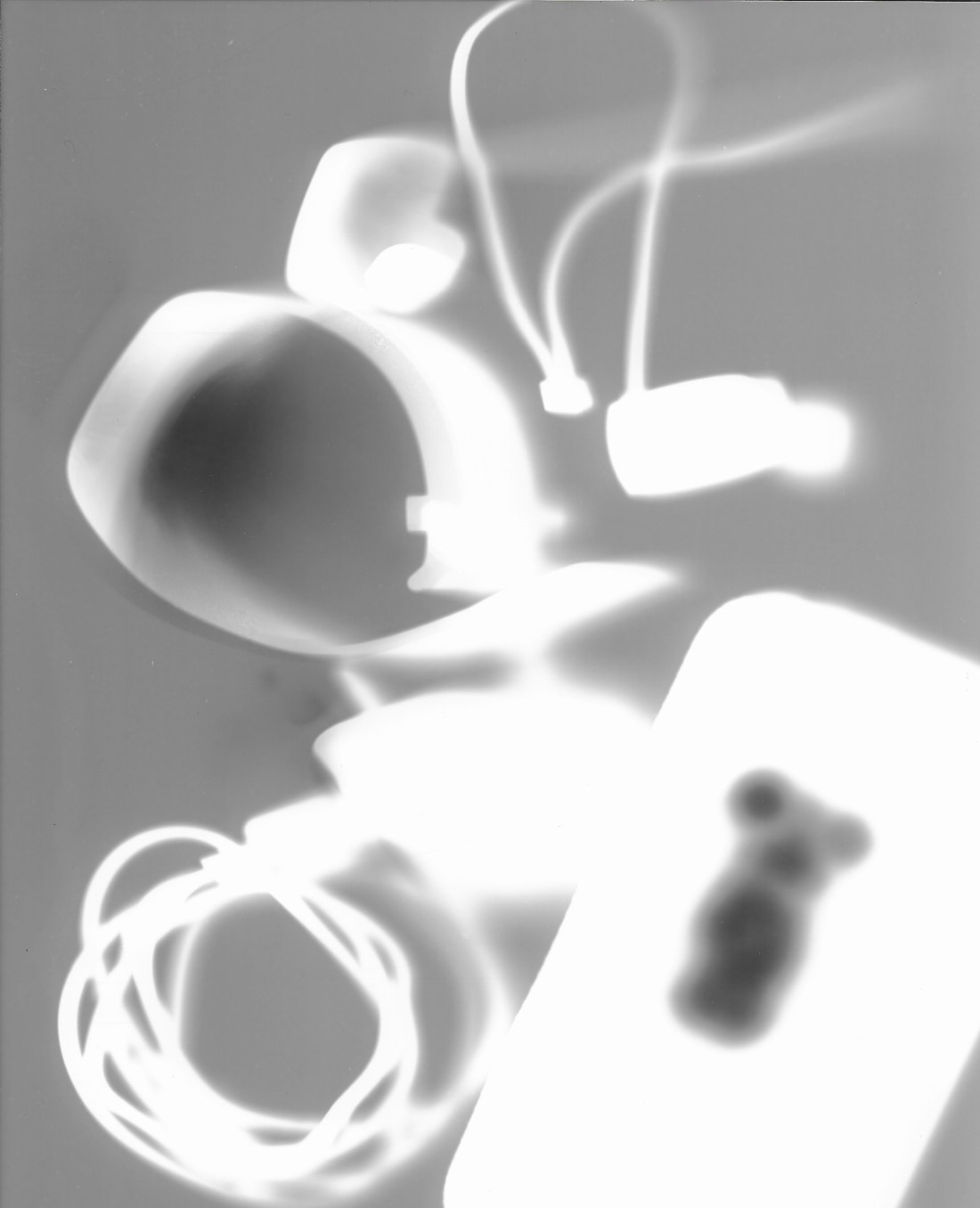
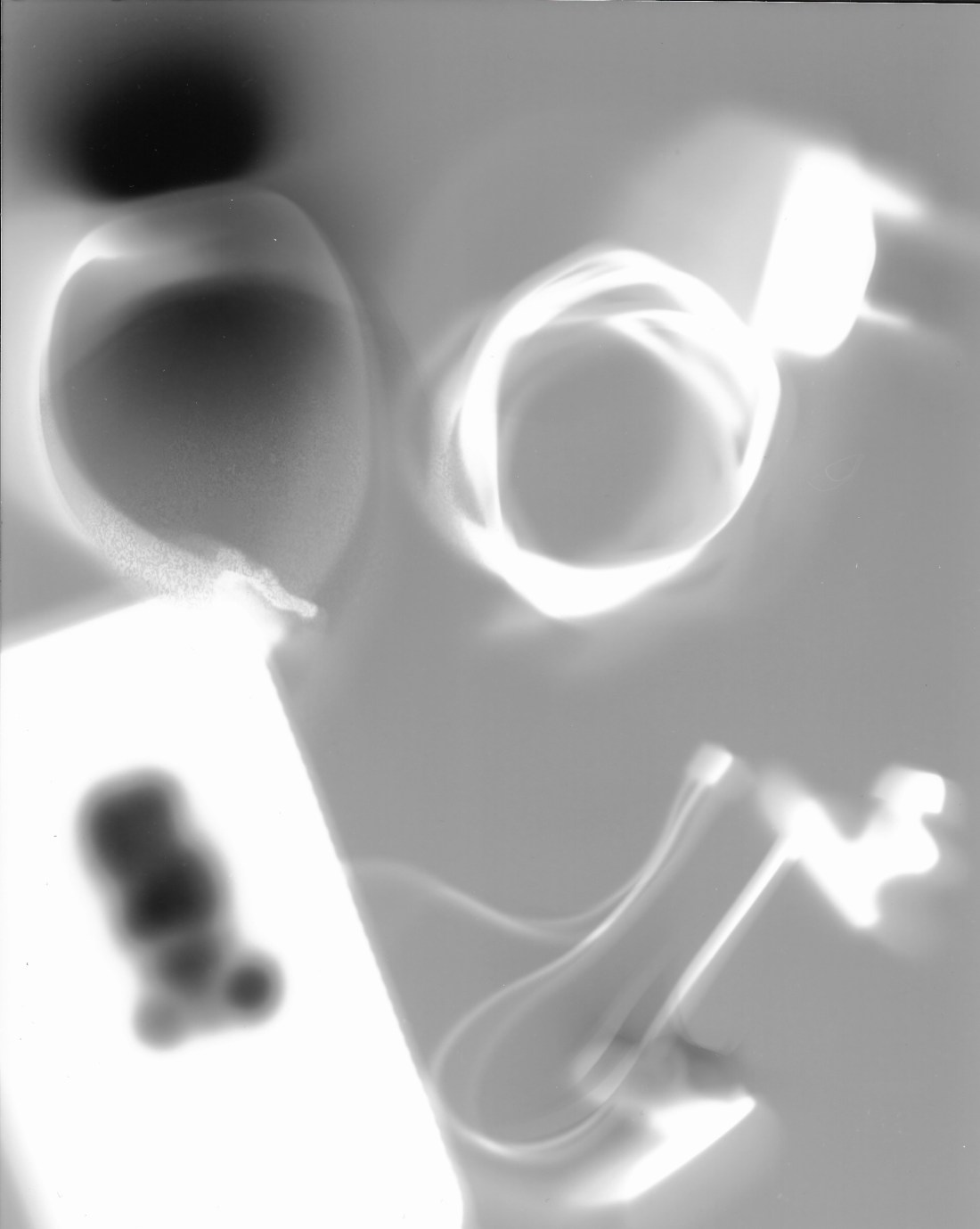
Overall I think these show an interesting contrast to the approach by Man Ray, and show the effect of the intrinsic light of the objects. The images of Man Ray have much sharper edges to the shadows, and I think this is due to them being closely in contact with the paper. If I try this technique again, I might try to put the objects closely in contact to the surface of the paper, perhaps by pressing them down with a sheet of glass.

 Andrew Procter
4 thoughts on “The Beauty (?) of Artificial Light – first thoughts”