Zoom Meeting 29 December 2019 – Wabi Sabi
Led by Robert Bloomfield
My notes for this meeting and my reading before it, are from my Rocketbook notebook
19-12-29 Zoom Wabi Sabi Wabi Sabi Reading
Before the meeting:
Prior to the meeting I briefly researched the concept of “Wabi Sabi”, with which I was previously unfamiliar. My research was fairly brief and based largely on Wikipedia (https://en.wikipedia.org/wiki/Wabi-sabi accessed 08/08/2020).
This suggested that the concept of Wabi Sabi has its origin in the Buddhist concepts of the “three marks of existence”
- Impermanence
- Suffering
- Emptiness/absence of self nature
The characteristics of the Wabi Sabi aesthetic include
- Roughness
- Asymmetry
- Simplicity
- Economy
- Modesty
- Austerity
- Appreciation of the integrity of natural objects and processes
Western artists who have incorporated the principles include John Connell and Jesse Richards.
I looked at some of the work by Jesse Richards, who the Wikipedia article indicates also used the concept of Mono no aware – an empathy towards things and acceptance of their impermanence.
Jesse Richards (https://www.jesserichardsfilm.com/ accessed 08/08/2020) is “a New England based filmmaker, photographer and artist. Former member of the Stuckists, founded the Remodernist Film Movement, co-founder of Cine Foundation International, founder and artistic director of Art Secession Cabal”.
His work includes images created with “toy” cameras including pin hole cameras. I found this image particularly striking.
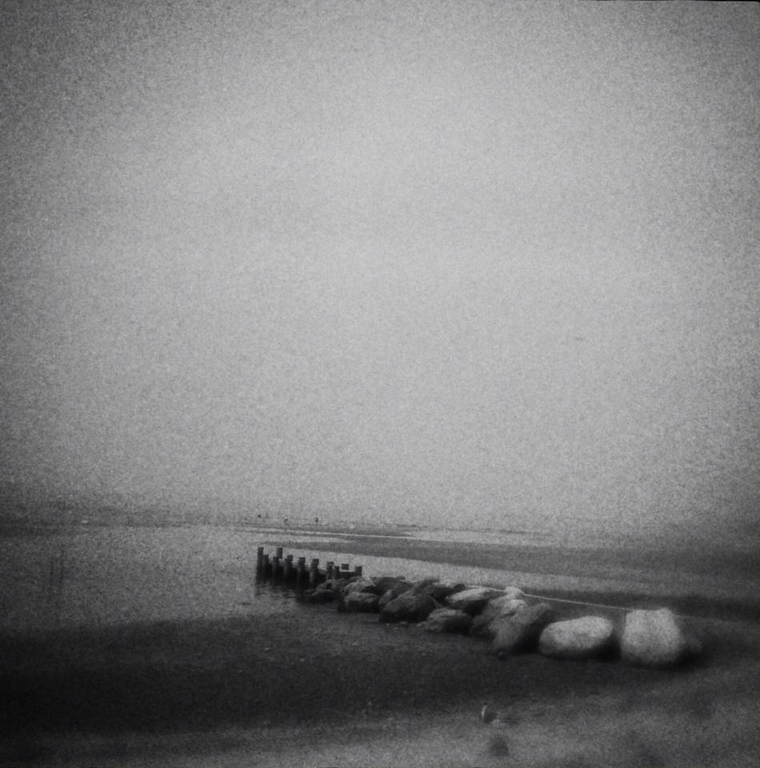
I considered that it showed aspects of Wabi Sabi in terms of both the image itself, which is imperfect and blurry and the subject matter which is a simple composition of a desolate beach.
It was this separation of whether the image or the subject shows Wabi Sabi which I found particularly interesting.
The meeting:
Robert gave a presentation expanding on the concept of “Wabi Sabi” beyond my brief reading.
He confirmed that origin of the concept from Buddhist principles of impermanence and mono no aware.
Of particular interest to me was his proposal that Wabi Sabi is an aesthetic category analogous to that of classical “beauty” which he had discussed in an earlier talk. He invited the students to suggest others. The list included
- Picturesque
- Sublime
- Realism
- Abstraction
- Surrealism
- Hyperrealism
This discussion was very helpful to me and I realised that there are many different frameworks against which a visual art work can be appreciated – this was something I had not really considered before and will be something I need to study more.
Robert suggested other artists to research in this area.
Objectives:
As a result of this meeting and the works discussed my objectives are
- Read more about aesthetics and categories
- Examine the works of artists discussed
- Edward Hopper
- Wolfgang Tillmans
- Daido Moriyama

 Andrew Procter
One thought on “Zoom Meeting 29 December 2019 – Wabi Sabi”