Exercise 5.3: Looking at photography
Brief
“Look again at Henri Cartier-Bresson’s photograph Behind the Gare Saint-Lazare in Part Three. Is there a single element in the image that you could say is the pivotal ‘point’ to which the eye returns again and again? What information does this ‘point’ contain?
Include a short response to Behind the Gare Saint-Lazare in your learning log…”
A Google search for images of “Henri Cartier-Bresson Behind the Gare Saint-Lazare” gives several results and they differ slightly in the shading and density of the reproduction of the shadows. While this may in part be a function of the reproduction of a print on a webpage, some of the variation may be due to the printing process as there are different dates given as to when the print was made.
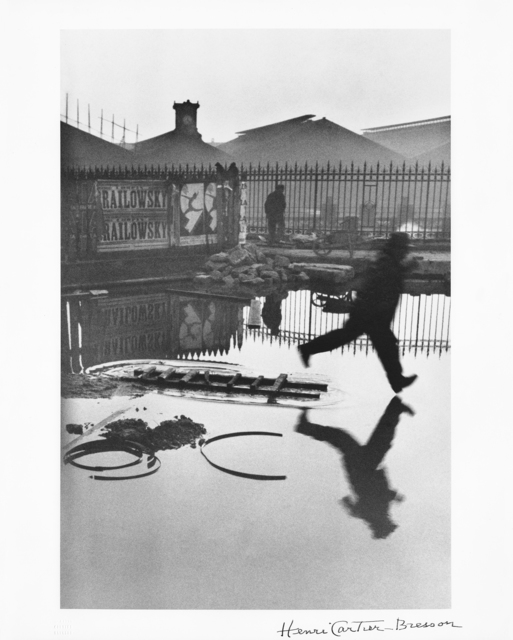
This image is titled on the website as “Henri Cartier-Bresson, Behind the Gare Saint-Lazare (1932), Gelatin silver print, 17 1/2 × 12 in” and is I believe one of the older versions, and I assume truer to the original intention of HCB in making this image.
Is there a single element in the image that you could say is the pivotal ‘point’ to which the eye returns again and again?
My eye is consistently drawn to the figure of the man striding into the puddle – his forward foot has not hit the water yet, but his posture indicates he is committed to his leap, as shown in this part of the image:
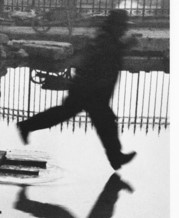
It is his unbalanced position that contains the key information of that “point” he is in motion, but the outcome of that is as yet unknown.
In my consideration of “The Decisive Moment”I referred to the concept of “peripeteia”, from the Greek meaning “dramatic moment”. Bate (Bate, 2016) described this as “the striding foot indicates a future event, caused by the past, whose outcome is anticipated by what we see in the picture.”
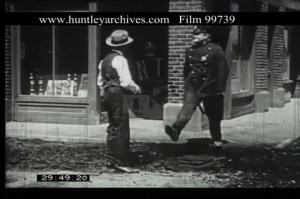
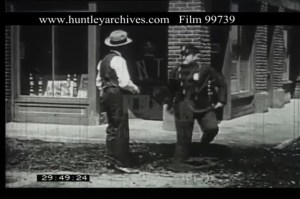
I think it is the uncertainty as to what might happen next which fascinates us (or at least me) and keeps drawing me back to that point. I would suggest that the story of a man stepping into a puddle is a classic image in the slapstick comedy of silent film and so widely known that we are aware of it almost subliminally. An example of this is in this clip of a Hal Roach comedy with Oliver Hardy cameo from the 1920s, a few years before HCB produced his image, (Hal Roach comedy clip with Oliver Hardy cameo in 1920s. | Huntley Film Archives, s.d.). I cannot upload video to this site but the relevant section of this is at
https://drive.google.com/file/d/1IW57Suj7Av9wdmS-Ui10TPsqruKU5UYD/view?usp=sharing
and stills from the clip show the drama as it unfolds.
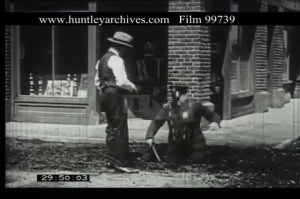
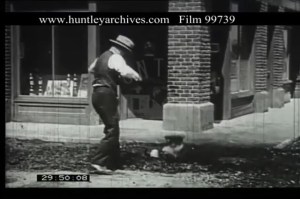
However, there are many images of people jumping over or into puddles contemporaneous with HCBs and since then, such as


But these do not draw our eye and fascinate us as much as this one though. There are other elements of the image which I believe cause this.
The example of the image which I show above, has been printed in such a way as to emphasise the line of the railings behind the jumping man. The background buildings show a gradation of density from the top (darker) to behind the railings (lighter) and the line of the railings is more obvious and frame the man. Similarly the water is not featureless, but there are objects showing above it. These curves are then echoed by the ripples at the left end of the ladder from which he jumps, as seen here:
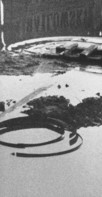
The water is, however, generally smooth and this enhances its mystery – how deep is it, there are no clues.
There is enough interest in the background that after a while our gaze is drawn to the posters, the other figure and the surface of the water. But these are not so intrusive as to detract from the foreground figure.
Overall I find the image itself fascinating, but more so is the way it was made. My experience of trying to complete “The Decisive Moment” using 35mm film cameras was to increase my admiration for both the technical aspects of this as well as the compositional aspects.
References
References to the works cited in this post are found in my separate post “References”

 Andrew Procter
One thought on “Exercise 5-3: Looking at Photography”