Assignment 4: Languages of light 1
Brief
“Revisit one of the exercises on daylight, artificial light or controlled light from Part Four (Ex 4.1, Ex 4.2 or Ex 4.3) and develop it into a formal assignment submission. The submission requirement for this assignment is a set of between six and ten high-quality photographic prints.”
The brief also requires I include an analysis of the work outlining:
- how you have developed the assignment from the original exercise in Part 4
- which practitioners you’ve looked at for inspiration and how their work has influenced you
- your technical approach and any particular techniques you incorporated
- the strengths and weaknesses of particular photographs and your project as a whole (self-assessment)
In this post I will address the first two points (how I have developed the assignment from the original exercise and which practitioners I have looked at for inspiration and how their work has influenced my submission).
I will address the other points in later posts describing the methods used and the images submitted.
Prior to starting this element of the course I posted some initial thoughts about this assignment.
“My initial thoughts on this are that I will probably choose to do the “Daylight” or “Artificial Light” exercises as my Assignment submission as I have already developed a studio-lit sequence for my submission for Assignment 2. This is a learning experience and I think I will learn more if I use a different technique for this assignment.”
Having now completed the exercises in this part of the course I have decided to revise the “Exercise 4.2: Artificial Light” as my assignment. This is largely because I have found that exercise the most challenging of the three.
I have previously completed an assignment using studio lighting, and developed the exercise 4.3 into a submission for Exercise 5.2: Homage. I am most familiar with working in daylight, but found the technical challenges of working by ambient artificial light more challenging. Also, I found it more difficult to predict what the image would look like after a long exposure, as it did not always resemble my perception of the scene. I have discussed this more later with reference to the methods and technical aspects of the project.
In myaccount of my work for Exercise 4.2, I refer to a number of themes which have influenced my and my approach to the exercise and assignment. I will summarise these and refer back to my earlier accounts.
My Interpretation of Beauty in Relation to Artificial Light
While it is the case that “beauty” is, as the course notes suggest, a subjective term, I have considered this in the light of the statement by Mary Richardson, following her attack on the Rokeby Venus (From the Rokeby Venus to Fascism Pt 1: Why did suffragettes attack artworks?, s.d.)
Richardson is quoted as saying “I have tried to destroy the picture of the most beautiful woman in mythological history as a protest against the Government destroying Mrs Pankhurst, who is the most beautiful character in modern history. Justice is an element of beauty as much as colour and outline on canvas”
I have extended this argument to concerns in contemporary society, where environmental issues should be prominent. Thus I have suggested “an artificial light source could only be considered to demonstrate “beauty” if it does not harm the environment”, either by using excessive and unnecessary energy, and/or contributing to light pollution. I have found this a difficult concept to incorporate into my images, but will attempt to do so.
Artists and Photographers as Influences
In my initial account of my approach to the Exercise 4.2, I described the work of the artists referred to in the course notes.
Of these the influences I have consciously tried to incorporate into my work include those of Sally Mann and Rut Blees Luxemburg.
Sally Mann refers to “the refulgence or the reflection when light and water interact” (Rong and Mann, 2013), albeit with respect of images made in daylight. However this is also the case also the case with artificial light.
I was unfamiliar with the term “refulgence”, however the Shorter Oxford English Dictionary (Little et al., 1973) defines this
Refulgence “The quality of being refulgent, splendour, brightness, radiance…”
Refulgent “Shining with or reflecting, a brilliant light; radiant, resplendent, gleaming…”
It is this quality of the light in Rut Blees Luxemburg’s series,”Liebeslied: My Suicides”(Luxemberg and Duttman, 2000) which I hoped to emulate.
In addition, Rut Blees Luxemburg’s images of night-time London, have a distinctive colour palette, with a very marked orange overtone to many of the images. This is illustrated by images such as these
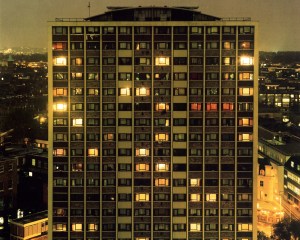

One of the consequences of this is that the final image has a colour range which is different from how I perceive night-time scenes illuminated by street lighting. I set out to try and establish the reason for this and to incorporate it into my images.
In addition, my tutor referred me to the work of Duncan Hill, in particular his series “Night Topographics”, such as this
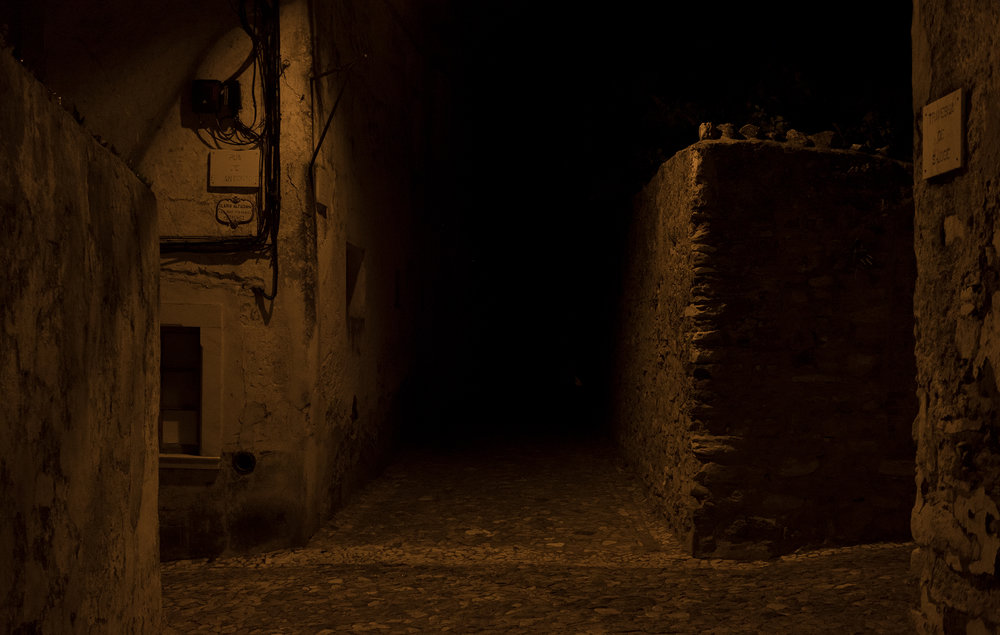
This image has a similar colour palette to those of Rut Blees Luxemburg. However, it also adds a distinctive feeling of unease, as large parts of the scene are hidden in darkness. It also appears very empty of the day to day life as might be expected of a road junction during the day. This encapsulates to me a feeling of what it is like to be out late at night/early morning before the town gets going.
Duncan Hill also has images of trees illuminated by street lighting; these show the foliage in a different aspect.
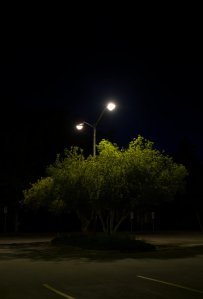

They remind me of the images I saw made by Matthew Murray from his series, “Saddleworth” made by lighting “the landscape with artificial lighting, external lights, torches, car headlights” (Murray, 2017).

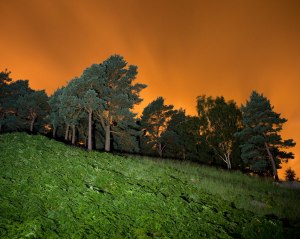
I hoped to capture the unusual appearance of foliage when lit from unexpected directions.
Development from the original exercise in Part 4
I have already suggested ways in which I would like to develop the exercise. These include:
“I do not think I have addressed “the beauty of artificial light” in these images”
I find it hard to work out how to address this – in the event I found that LED street lights with many light sources in the array, gave a very distinctive pattern of shadows. I will discuss how I think I address this in my analysis.
“I would like to try and capture more of the interaction between the light and water”
“the reflection of lights from different surfaces creates interesting patterns, unique to the night time”
These elements all relate to the idea of refulgence of the lights, which I would like to capture more.
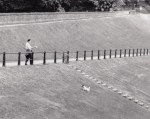
“The pools of different types of light on the ground here make patterns which could be the subject for further exploration”
This relates to this part of one of my images..
Overall, when I reviewed my exercise I realised many of the images were of artificial lights, not images made by artificial light. In many if not most of the images made by those photographers I cite, the actual light source is not seen… My overall aim is to make images using the artificial light to illuminate the scene.
References
References to the works cited in this post are found in my separate post “References”




 Andrew Procter