Light metering

Light metering
Part 4 of the course begins with a suggested exercise to complete “If you’re not completely sure how your light meter works…”

When I first started using a DSLR, I completed a course with the Jessops academy which included discussions about metering. This included the various metering modes available on the cameras – on mine these are
• Centre weighted average
• Evaluative
• Partial
• Spot

In addition we completed an exercise of photographing a white card using exposure determined by the camera – the result was a grey image.

Whereas when the metering was made for a grey card and then the image of the white made at the exposure, the card appears white.

Having completed these exercises I feel I am confident with the basic skills of the use of exposure metering, and exposure lock in order to be able to expose the image for which I aim. This is of particular importance with my film cameras as I am unable to confirm the correct exposure on site and only on developing the film. For this work I use three types of exposure metering: my 35mm SLRs have through the lens metering, I also use a hand held meter (for the medium format camera) and then I often check the exposure with the meter in my DSLR.

“The Corridor” by Jill Chaloner


IMG_0001c
The Corridor. Jill Chaloner

I receive the British Journal of Psychiatry each month. The editors “are always looking for interesting and visually appealing images for the cover of the Journal”.

B J Psychiatry 2020, 216(1) cover

I received the January 2020 copy while working on Part 4 of this course “Languages of Light”. The cover has a reproduction of a painting, The Corridor by Jill Chaloner.

Chaloner is described in the Journal as “an East Anglian artist trained at the Norfolk Painting School who previously worked as a Consultant Psychiatrist in the NHS for 20 years”. (B J Psychiatry (2020) 216(1): A2).

She describes the painting:
This painting arose out of memories of working and training in several old asylums, Claybury, Bexley and Warley hospitals among others. Also at the back of my mind was a paper I read in the yellow Journal more than 30 years ago entitled “The Corridor People”. It was a study of patients whose main activity was daily wandering in the main hospital corridor and who were not in receipt of any other “therapy”. It was argued that their seemingly purposeless activity could in fact be part of a healing process. In my picture though the human figures seem to inhabit deep darkness, bright light is never far away hinting at the possibility of transformation.

Like Chaloner, I trained and worked in an old asylum, Bexley Hospital. The subjects of the painting and their situation has a resonance for me. In terms of how Chaloner depicts this, I was struck by the use of bright light and deep shadow. This is not only visually appealing and adds to the interest of the image, but is also here used as a metaphor for chronic mental illness and recovery.

I include this post in my consideration of my assignment as an additional way artists use light – as a metaphor.

Part 4: The Languages of Light

Part 4 The Languages of Light

In preparation for a forthcoming Zoom Meeting (Improbable Images – 26/11/19) I noted that this topic from Part 5 is titled differently from that in my notes.

The course notes I have been working from are version:

EYV Manual cg_ph4eyv_240117_red,

whereas “Improbable images” features in the newer version of the course notes:

EYV Manual cg_ph2eyv_180618_red_0.

Robert Bloomfield who is leading the Zoom meeting has advised me to use the later version because the images and exemplars have been updated and there are some useful case studies at the back.

I plan to follow the sequencing and numbering of exercises from the later version of the notes for Parts 4 & 5.


The notes for Part 4 begin “The assignment will ask you to select one of the exercises from Part Four to work up to an assignment submission, so please read the assignment brief before going any further.

Assignment 4: Languages of Light
Brief:
Revisit one of the exercises on daylight, artificial light or controlled light from Part Four (Ex 4.1, Ex 4.2 or Ex 4.3) and develop it into a formal assignment submission.”

The exercises are:
Exercise 4.1: Daylight:
Taking the photography of Mann, Atget or Schmidt or a photographer of your own choosing as your starting point, shoot a number of photographs exploring the quality of natural light.”

Exercise 4.2: Artificial Light
“Capture ‘the beauty of artificial light’ in a short sequence of shots”

Exercise 4.3: Egg or stone
“Use a combination of quality, contrast, direction and colour to light an object in order to reveal its form.”

My initial thoughts on this are that I will probably choose to do the “Daylight” or “Artificial Light” exercises as my Assignment submission as I have already developed a studio-lit sequence for my submission for Assignment 2. This is a learning experience and I think I will learn more if I use a different technique for this assignment.


The Beauty (?) of Artificial Light – first thoughts

I have recently become very aware of how ubiquitous sources of artificial light are in our environment. I have recently re-started developing and printing film. As I was about to load a film into a developing tank, I saw that I was wearing fitness tracker on my wrist which lit up as I moved, and had a green light displaying all the time, my phone was on the worktop and would light up if I was called. All round my darkroom were battery chargers and other items with LED displays.

This prompted my to do two things. The first very practically, was to remove all the light emitting objects and put them in a metal box, and cover up others with black tape; before loading my film…

The second was to remember images of “Rayographs” which I had seen in the Peggy Guggenheim collection.  His technique for producing these is described on the Metropolitan Museum website. https://www.metmuseum.org/art/collection/search/265487 (Accessed 1/08/2019).

“Man Ray made his “rayographs” without a camera by placing objects-such as the thumbtacks, coil of wire, and other circular forms used here-directly on a sheet of photosensitized paper and exposing it to light.

Another Rayograph is shown from their collection, here with those from the Peggy Guggenheim collection:


I wondered how a similar technique might be applied to modern everyday objects which themselves emit light.

Method

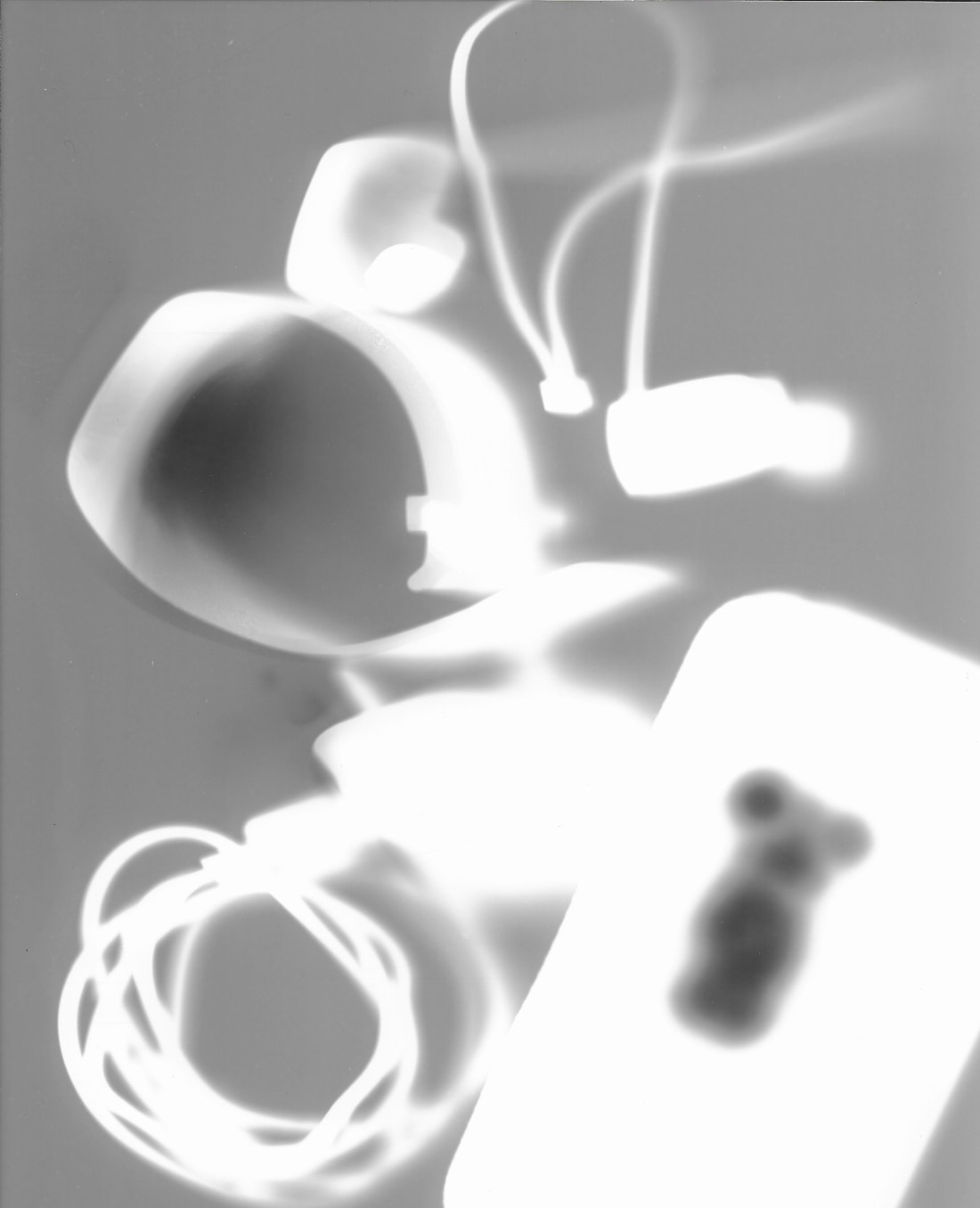
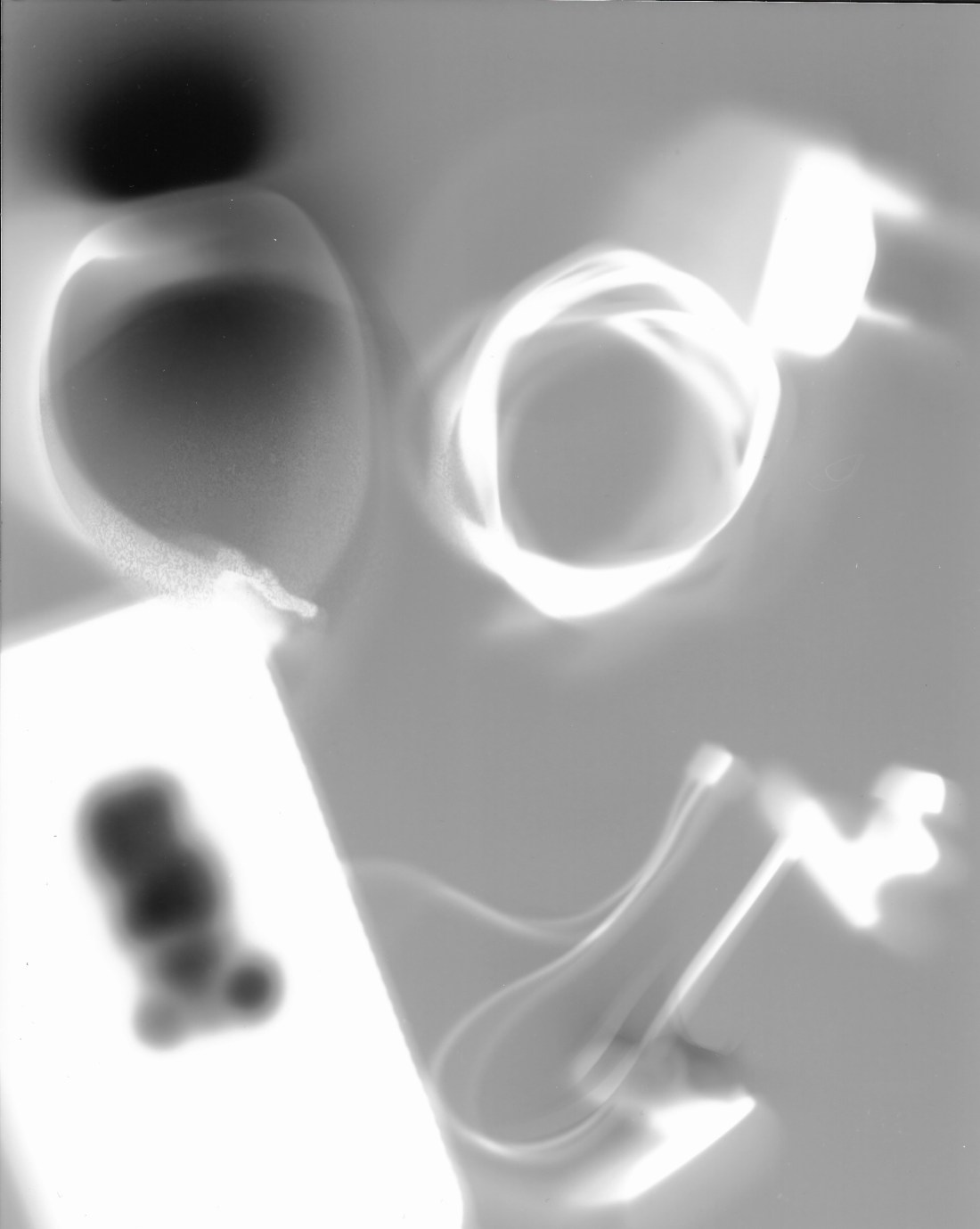
I selected some of the common objects which had so concerned me in the darkroom (including mobile phone, “Fitbit”, bluetooth earphones, phone charger) and arranged them on a sheet of photographic paper (Ilford Multigrade IV). I made sure the displays and LEDs were illuminated, and then exposed the paper with the objects to the light from a tablet. I then developed the paper normally.

I conducted a series of test exposures to ensure the exposure from the tablet light gave a mid-grey tone, and left the objects in place for long enough to produce a darker tone. (I was surprised as to how sensitive the paper was to the light of the tablet display (it only required a 4 second exposure from a distance of 120cm).

The final images are shown below:


2019-07-30 Image 1
2019-07-30 Image 1
2019-07-30 Image 2
2019-07-30 Image 2

Overall I think these show an interesting contrast to the approach by Man Ray, and show the effect of the intrinsic light of the objects. The images of Man Ray have much sharper edges to the shadows, and I think this is due to them being closely in contact with the paper. If I try this technique again, I might try to put the objects closely in contact to the surface of the paper, perhaps by pressing them down with a sheet of glass.

EYV Zoom Meeting – 30 July 2019

EYV Zoom Meeting – 30 July 2019

The Languages of Light: Robert Bloomfield

This meeting was led as usual by Robert Bloomfield and the topic was “ Languages of Light” and Robert planned to discuss Part 4 and the 4th Assignment.

There was a presentation of work by two students who were about to submit their work for the 4th assignment and had both chosen to do this on “The Beauty of Artificial Light”. There were two aspects of the discussion about these images which I found particularly interesting as they had themes which I have been considering.

The first of these was an image of someone looking at their mobile phone at night, illuminated by the light from the screen and the reflected light from outside lights. The quality of the two types of illumination was strikingly different, in particular with regard to the colour temperature of the light, the phone was a very blue/white light and had a stark quality to it, whereas the external light, although from an LED light had a warmer, softer quality as it was reflected off other surfaces. I had previously been considering how ubiquitous objects with light sources have become and how these influence our environment. I have started a consideration of this in another post and may develop it further for my assignment.

The other aspect of the student work which I found interesting was an image of a tower block with a sign across the windows. The wording was very prominent and gave a strong message in the image. However there were other aspects of the image which could be interpreted in many different ways. The incorporation of words into images is something I have considered before, and an area I need to research and consider more.

Robert gave a presentation about the concept of “Beauty” with the aim of making it a less subjective concept. He gave a historical view of the classical construct of “beauty” which equated to “perfection” and as such had a generally agreed definition and was not therefore subjective. However he then described the attack by the suffragette, Mary Richardson, on the “Rokeby Venus”, a painting by Valaquez in the National Gallery. My understanding of the rationale she gave for this was that the picture was an depiction of “beauty” but her own concept of beauty included the concept of “justice”, which she saw as missing from the contemporary treatment of women.

My own thoughts on this are that while the incorporation of other constructs besides perfection are important, there remains then an element of subjectivity as across societies, different people and groups are likely to have different understanding of concepts like “justice”, and value other constructs as defining beauty. For example in many elements of modern society, an artificial light source could only be considered to demonstrate “beauty” if it does not harm the environment.

Following the meeting I have briefly researched more about the attack on the Rokeby Venus by Mary Richardson. A description of this is at:

http://www.artinsociety.com/from-the-rokeby-venus-to-fascism-pt-1-why-did-suffragettes-attack-artworks.html (Accessed 1/08/2019)

Richardson is quoted as saying “I have tried to destroy the picture of the most beautiful woman in mythological history as a protest against the Government destroying Mrs Pankhurst, who is the most beautiful character in modern history. Justice is an element of beauty as much as colour and outline on canvas

There are other aspects of this painting and its subject which may have made it a target for such an attack as Richardson is quoted as saying several years later “I didn’t like the way men visitors to the gallery gaped at it all day”. Furthermore in the article, the authors cite descriptions of the painting as “’a body for Don Juanesque fantasies’ in a country (Spain) in which extreme machismo was the hallmark and women were regarded as ‘inferior, voiceless and … easy prey’”. This suggests to me that at the time of its painting the concept of beauty in that society included these aspects too. All of which shows how the subjectivity of the concept is influenced not only be an individual’s taste, but also societal values.

Other sources and writers to which Robert directed us in the meeting include Susan Sontag, “On Photography” in which she examines the development of the photograph beyond being a idealised image, and thereby a development of a set of aesthetic values by which a photograph can be judged. This is something I need to read more about.