I receive the British Journal of Psychiatry each month. The editors “are always looking for interesting and visually appealing images for the cover of the Journal”.
I received the January 2020 copy while working on Part 4 of this course “Languages of Light”. The cover has a reproduction of a painting, The Corridor by Jill Chaloner.
Chaloner is described in the Journal as “an East Anglian artist trained at the Norfolk Painting School who previously worked as a Consultant Psychiatrist in the NHS for 20 years”. (B J Psychiatry (2020) 216(1): A2).
She describes the painting: This painting arose out of memories of working and training in several old asylums, Claybury, Bexley and Warley hospitals among others. Also at the back of my mind was a paper I read in the yellow Journal more than 30 years ago entitled “The Corridor People”. It was a study of patients whose main activity was daily wandering in the main hospital corridor and who were not in receipt of any other “therapy”. It was argued that their seemingly purposeless activity could in fact be part of a healing process. In my picture though the human figures seem to inhabit deep darkness, bright light is never far away hinting at the possibility of transformation.
Like Chaloner, I trained and worked in an old asylum, Bexley Hospital. The subjects of the painting and their situation has a resonance for me. In terms of how Chaloner depicts this, I was struck by the use of bright light and deep shadow. This is not only visually appealing and adds to the interest of the image, but is also here used as a metaphor for chronic mental illness and recovery.
I include this post in my consideration of my assignment as an additional way artists use light – as a metaphor.
I had been directed towards examining the work of Fay Godwin by my tutor and then later in Part 2, Project 2 of EYV.
My research of her biographical details and published works is in my written notes and I will not reproduce here for conciseness.
Fay Godwin was a photographer who started her career photographing her children and then making portraits of literary figures in the 1970’s and 80’s. However her first published works were of landscapes, and it is in this genre she is most regarded.
In my research for this element, I have examined:
“Remains of Elmet” (1979), her collaboration with Ted Hughes
“Our Forbidden Land” (1990)
I also made a research visit to the Museum of Science and Media, Bradford (15 February 2019) and examined the archive material there. This material includes that displayed in the exhibition of her work “Land Revisited” which closed on 27 March 2011. It includes material included in her publication “Land” (1985) as well as other material. I have been able to photograph some of these images and they are reproduced here for study purposes.
I have several thoughts about the work, regarding what I have learned from this exercise.
Use of depth of field
All the images I viewed in Bradford had deep depth of field such that no part of any image was out of focus.
This was obvious in wide landscape images such as “Markerstone on the old London to Harlech road 1976”
Markerstone on the old London to Harlech Road. Fay Godwin (NSMM 1994/5015/52)
In this image the foreground grass is shown in precise focus and detail. I assume that a small aperture was used to take the image to give such a deep depth of field, and therefore a long exposure. In other images this results in blurring of those parts of the subject which move during the exposure. This is obvious in “Stream and Birch, Glen Bheinn Sutherland” (National Science and Media Museum, 1994/5015/87) where the branches of the tree have moved and are depicted as a blur.
Stream and Birch, Glen Bheinn. Fay Godwin (NSMM 1994/5015/87)
Detail- Stream and Birch, Glen Bheinn. Fay Godwin (NSMM 1994/5015/87)
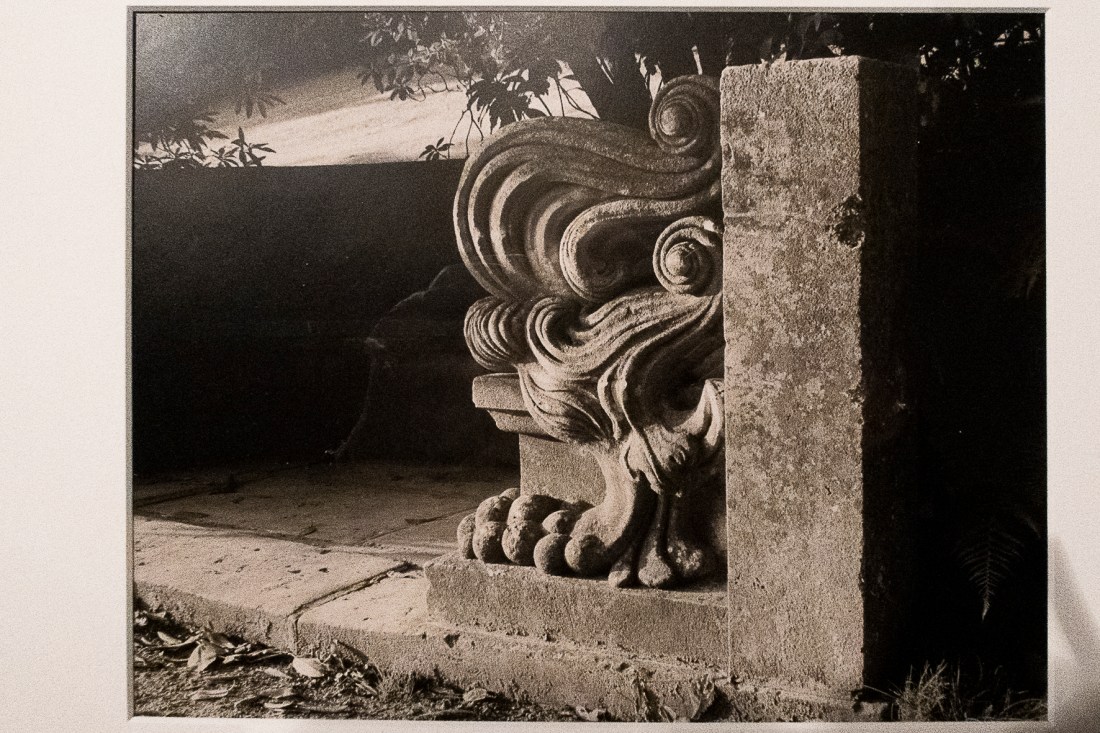
Godwin also used this technique in other images where other artists might has used a shallow depth of field to emphasise part of the subject. I saw this in “Carved Bench, Stourhead” (National Science and Media Museum, 1994/5015/70) where both the foreground grass and the leaves in the background are in sharp focus.
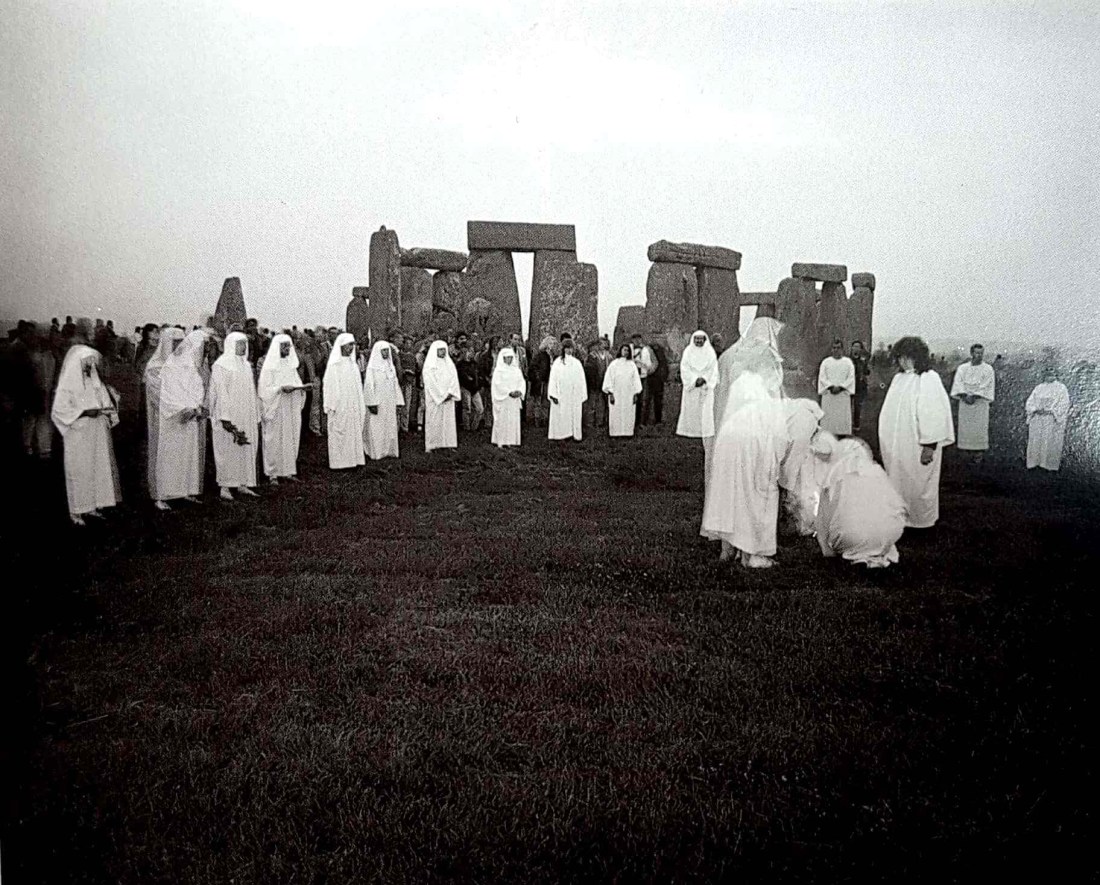
She also uses a long exposure in what might be a more documentary image “Free the Stones”. The foreground and background are in sharp focus, but the people photographed have clearly moved during the exposure. I am unclear what her aim was in producing this image, but it remains atmospheric and the blurring of the people captures their movement.
Free the Stones. Fay Godwin
In terms of this exercise, our course notes suggest that “depth of field was also a political decision for… Fay Godwin”. She appears to use a deep depth of field in virtually all her images. In this way she depicts the entire scene and does not emphasise any one part. I would suggest that this is consistent with her answer to a question put in an interview in 2002:
“Interviewer: Your photographs are often seen as being politically active. Is there a hidden agenda in your photography? Godwin: The viewer must bring their own view to a photograph.”
Godwin sets out the scene in her image and allows the observer to make of it what they will. Nonetheless her choice on subject and viewpoint determine what she wants to show to the observer.
Compositional technique
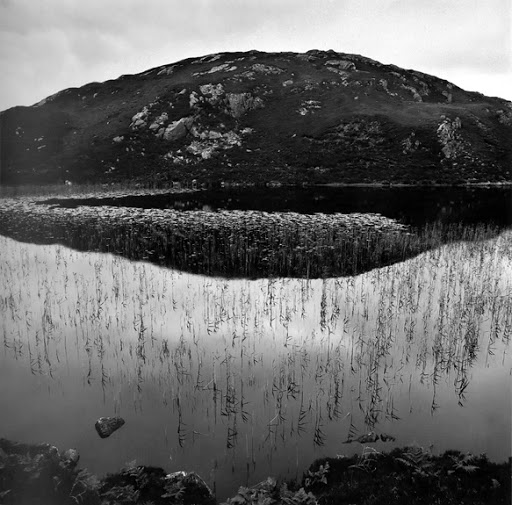
The wide depth of field she uses allows the use of foreground objects and features to contribute to the composition. This is the case in images such as “Reedy Loch” where the detail of the reeds attracts the eye to the foreground.
Reedy Loch. Fay Godwin (NSMM 1994/5015/95)
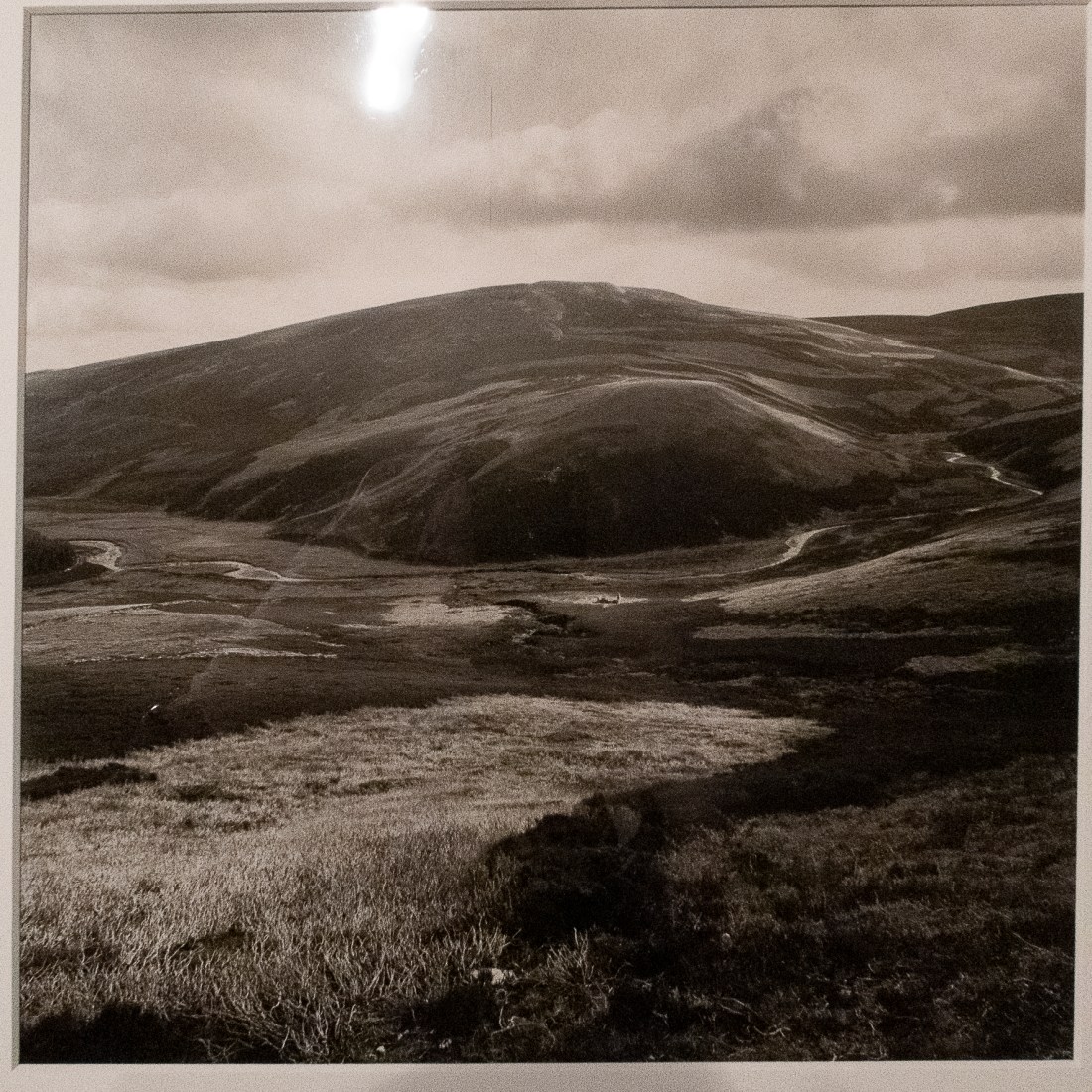
Other compositional techniques I was aware of was the use of patterns in the landscape revealed by the lighting which make an interesting image of a wide panorama of moorland. Examples of this include “View from Duffdefiance, Glen Buchat” (National Science and Media Museum, 1994/5015/74) where patterns in the vegetation provide light and dark on the otherwise featureless moor.
View from Duffdefiance, Glen Buchat. Fay Godwin (NSMM 1994/5015/74)
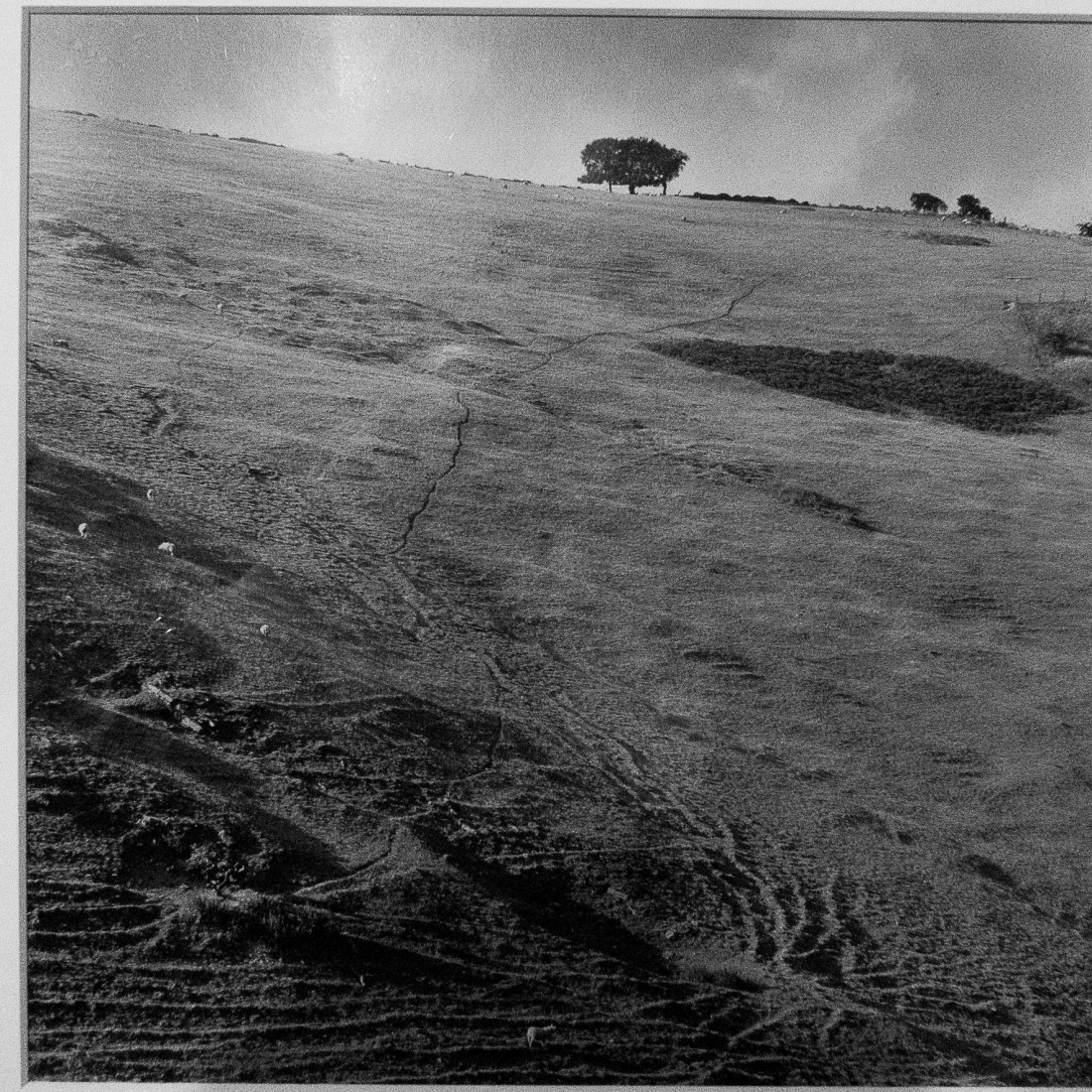
Similarly in “Haven Hill, Bradbourne” (National Science and Media Museum, 1994/5015/72) the angle of the light has emphasised the path erosion and provided lines across the hillside.
Haven Hill, Bradbourne. Fay Godwin (NSMM 1994/5015/72)
Sparse use of darkening of the sky
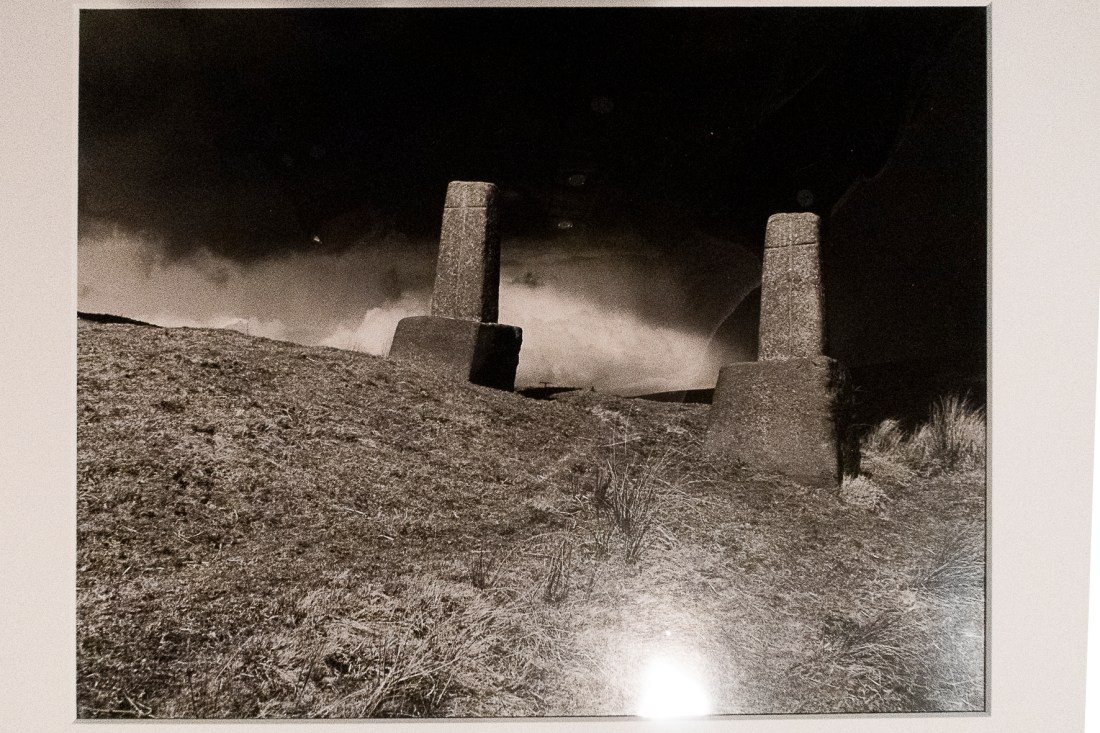
Godwin presents her images with a very naturalistic feel. The tonal quality of the skies is very natural and with a few exceptions is not darkened. These exceptions provide dramatic contrasts such as in the image of “Abel Cross” (National Science and Media Museum, 1994/5015/2)
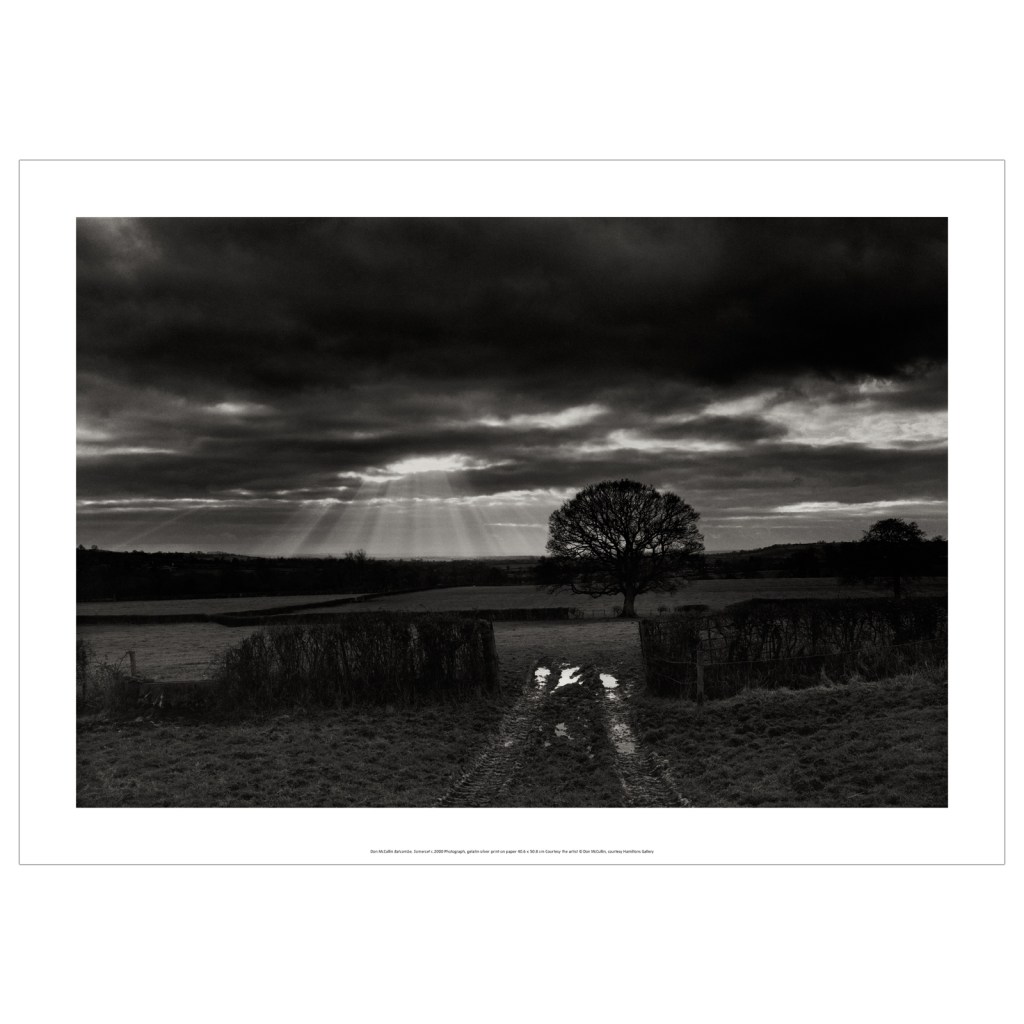
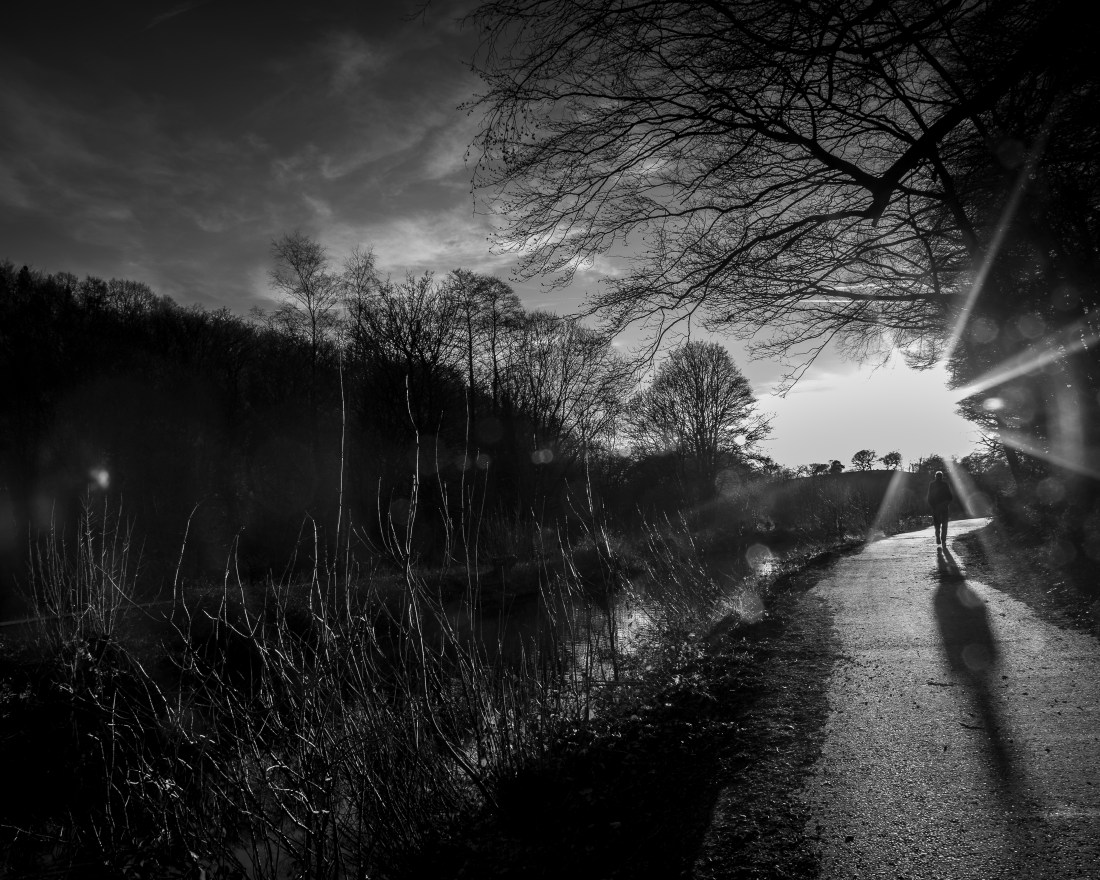
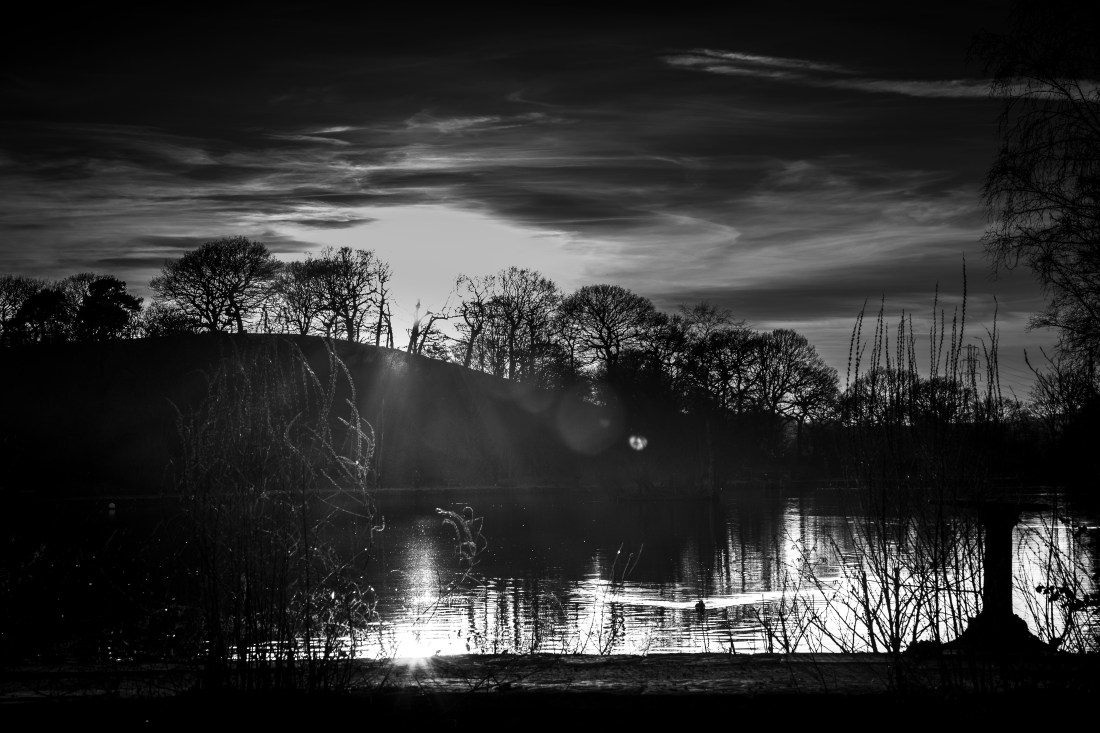
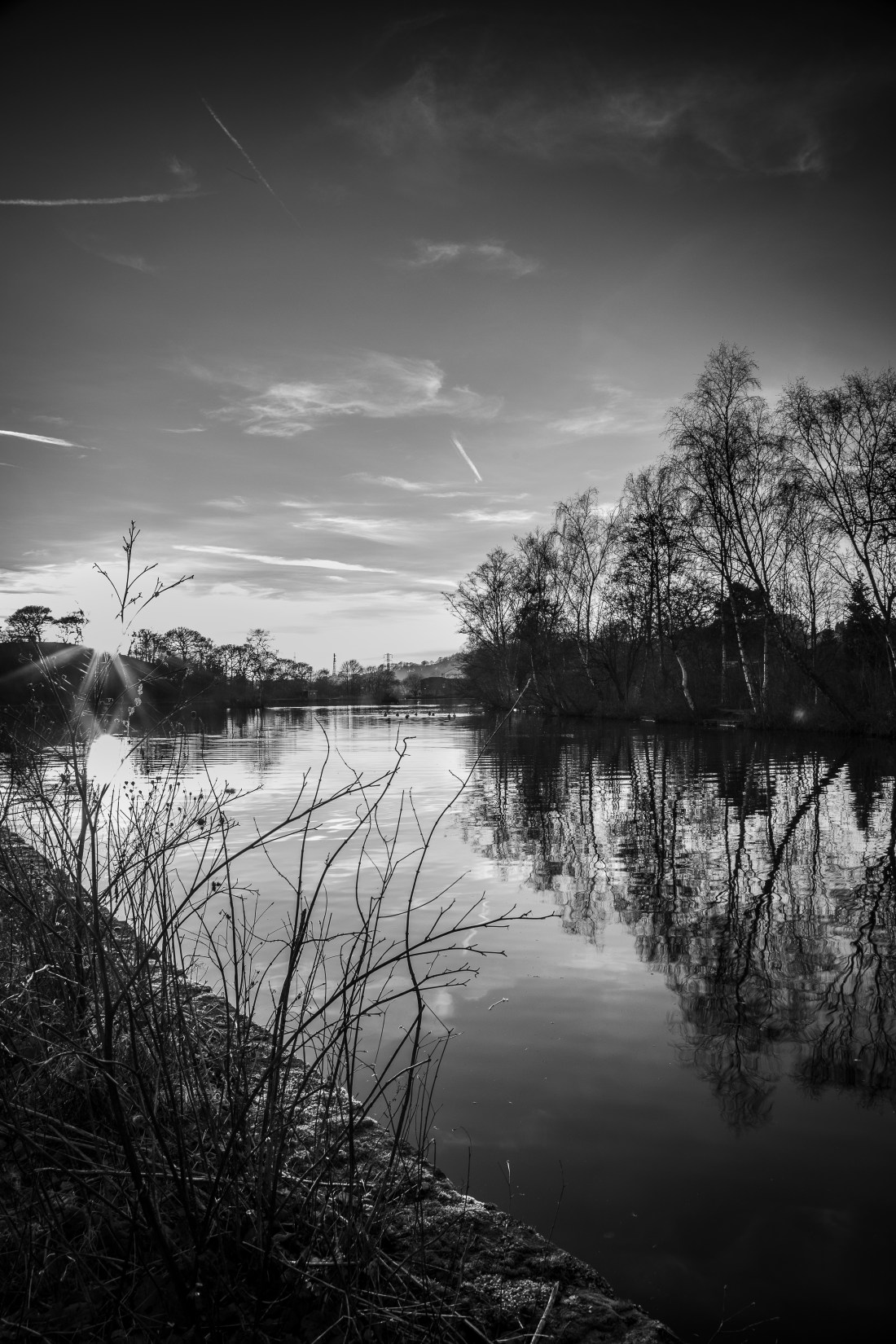
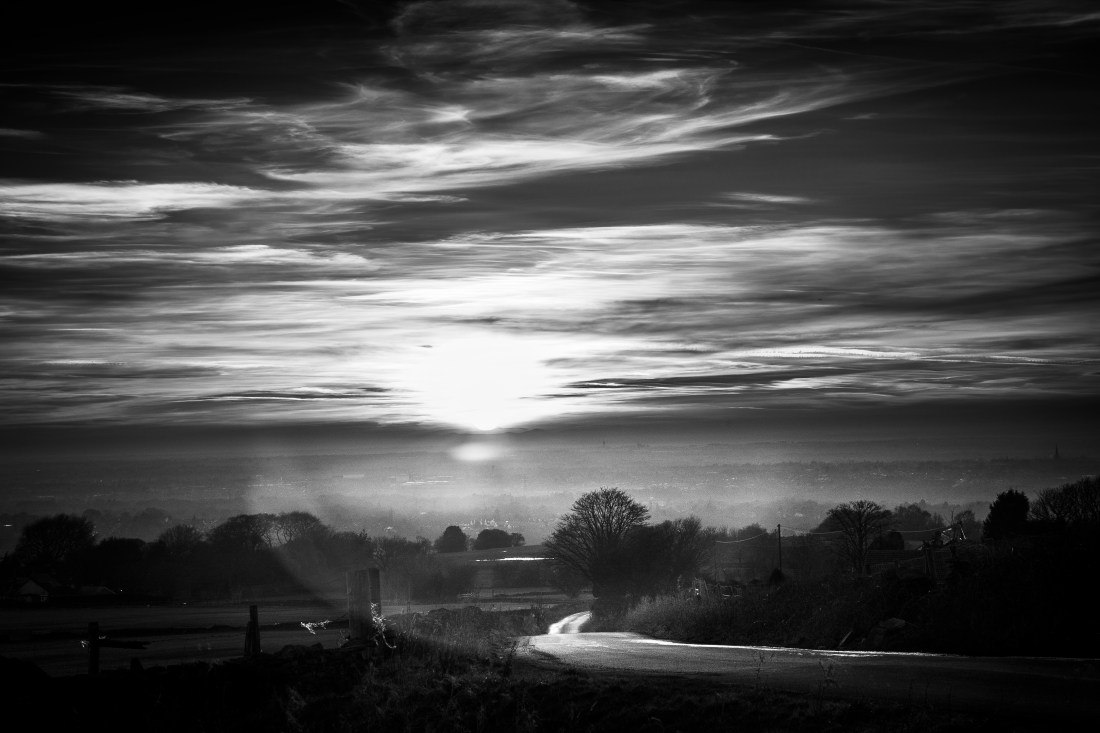
Having seen the exhibition of Don McCullin’s work at Tate Britain, Don McCullin – Tate Britain. Feb 2019, I tried to produce some images in his style. In the absence of a local war zone, I decided to use landscapes to do this. I completed Exercises 2.6 and 2.7 with that intention, and selected a site where I could photograph into the setting sun to try and get the effect McCullin has achieved in these images.
Somerset 2004. Don McCullin
Batcombe, Somerset. Don McCullin
My attempts shown here are Black and white versions of the images in my exercise 2.7.
Etherow Country Park 1Etherow Country Park 2Etherow Country Park 4Etherow Country Park 5Mill Brow 1Mill Brow 2
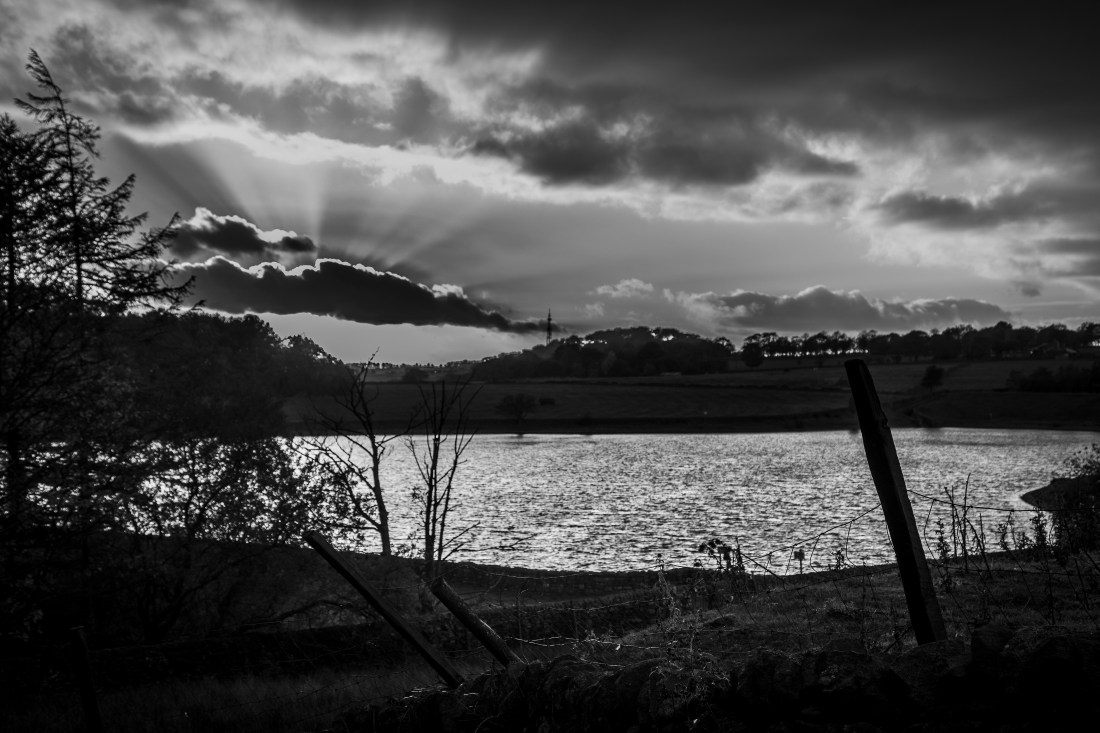
The cloud formations on the evening I chose were not really suitable to get this effect I was trying to achieve, however I remembered this image from exercise 1
Swineshaw Reservoir
and rendered it into black and white and adjusted the exposure locally to emulate McCullin’s landscapes.
Swineshaw Reservoir
Overall I think that this image achieves what I was trying to do.
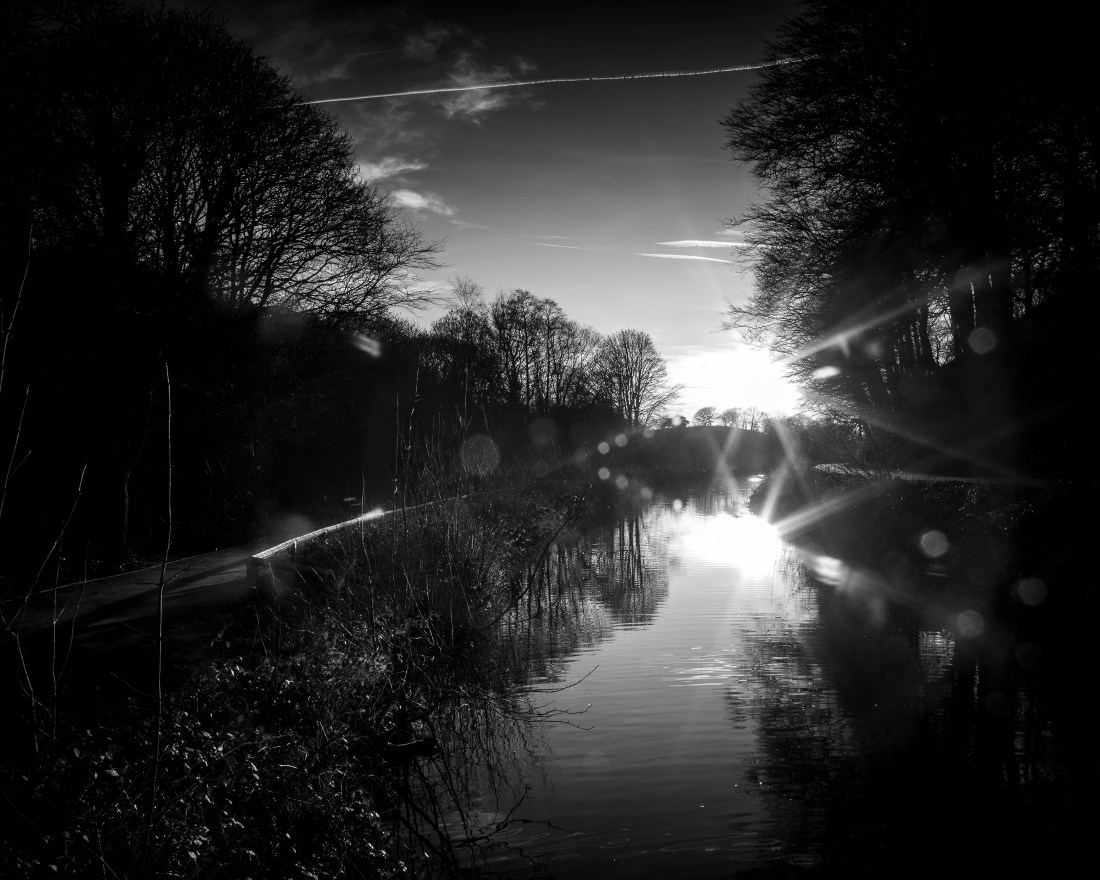
I initially rejected this one as the lens flare makes it quite confused, but I do think it has some qualities in common with the abstract landscapes of John Virtue.
I visited this exhibition of McCullin’s work soon after it opened. The Tate website describes the exhibition as:
“Spanning sixty years of photography and world events, this exhibition begins in and around the London neighbourhoods where McCullin was raised. It moves into his coverage of conflict abroad, interspersed, as his life has been, with sections covering his trips back to the UK. The exhibition ends with his current and longstanding engagement with traditions of still life and landscape photography.”
There is a huge amount of material presented in this exhibition. The subjects are varied from his early work in around his family home in London, his coverage of conflict abroad and in Northern Ireland, the urban conditions in the industrial UK, and his still life and landscape images in the UK and overseas.
As I have done with other exhibitions, I have summarised here my key impressions and learning points, rather than try and encompass the whole exhibition. Some of these expand on ideas I already raised in my account of the TV programme, Looking for England.
1. Motivation
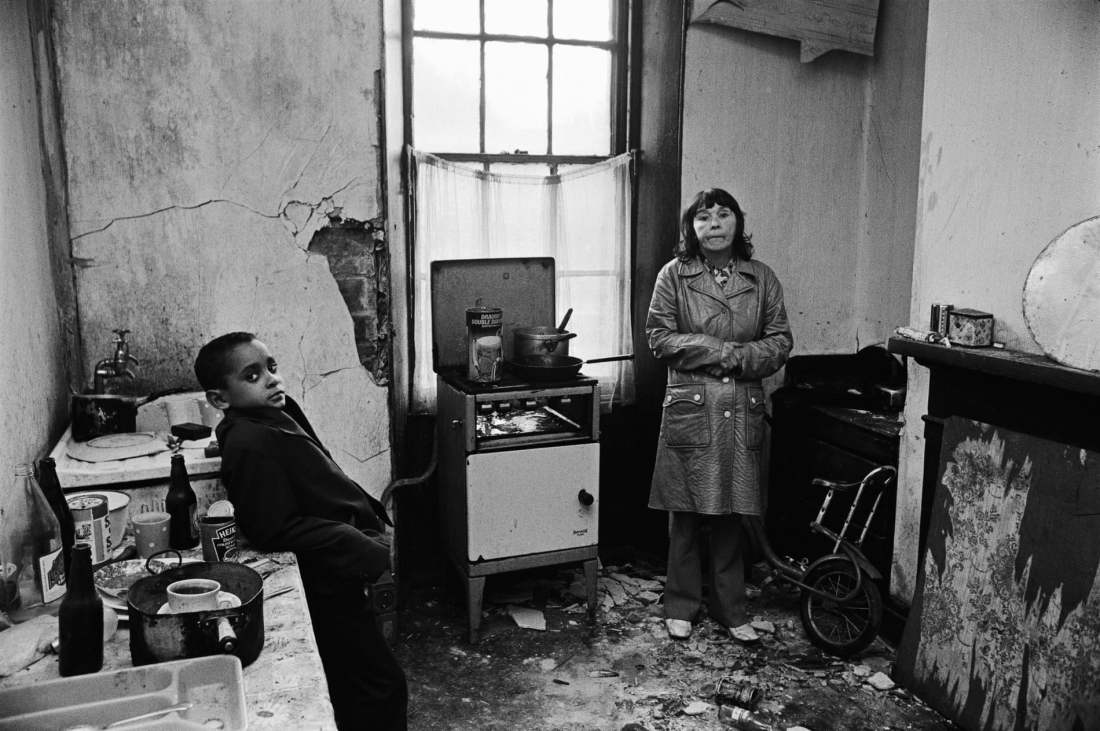
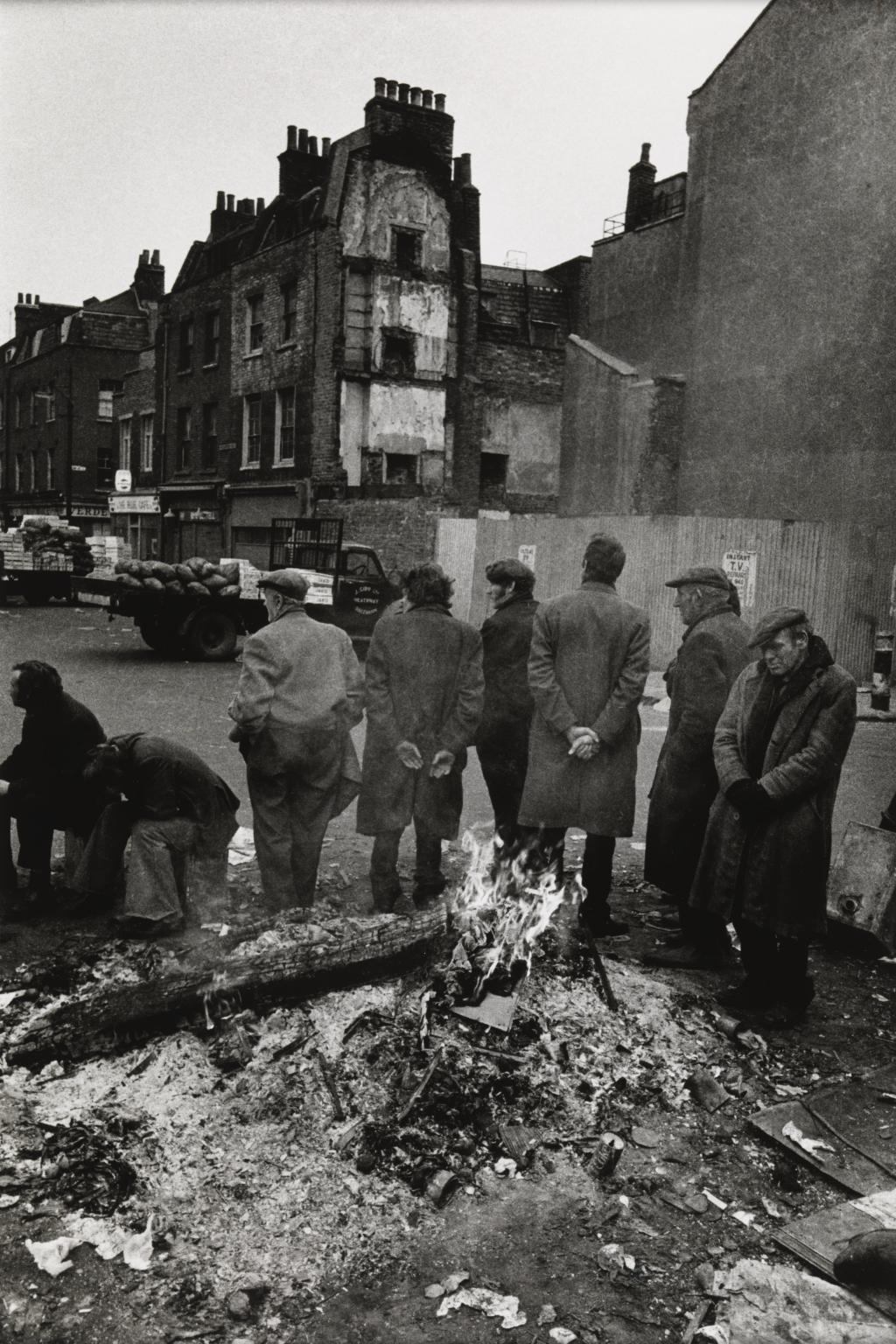
The exhibition of images from Bradford and the east end of London show McCullin’s concern with social inequalities and the conditions of the urban poor. I described this in my reaction to the “Looking for England” documentary.
In the exhibition notes is a quote from McCullin summarising his concern.
‘There are social wars that are worthwhile. I don’t want to encourage people to think photography is only necessary through the tragedy of war.’
While this is obvious in his documentary depictions of the living conditions of people in Bradford and the East End.
Bradford, 1978. Don McCullinHomeless Men, Early morning in Spitalfields Market, London 1970. Don McCullin
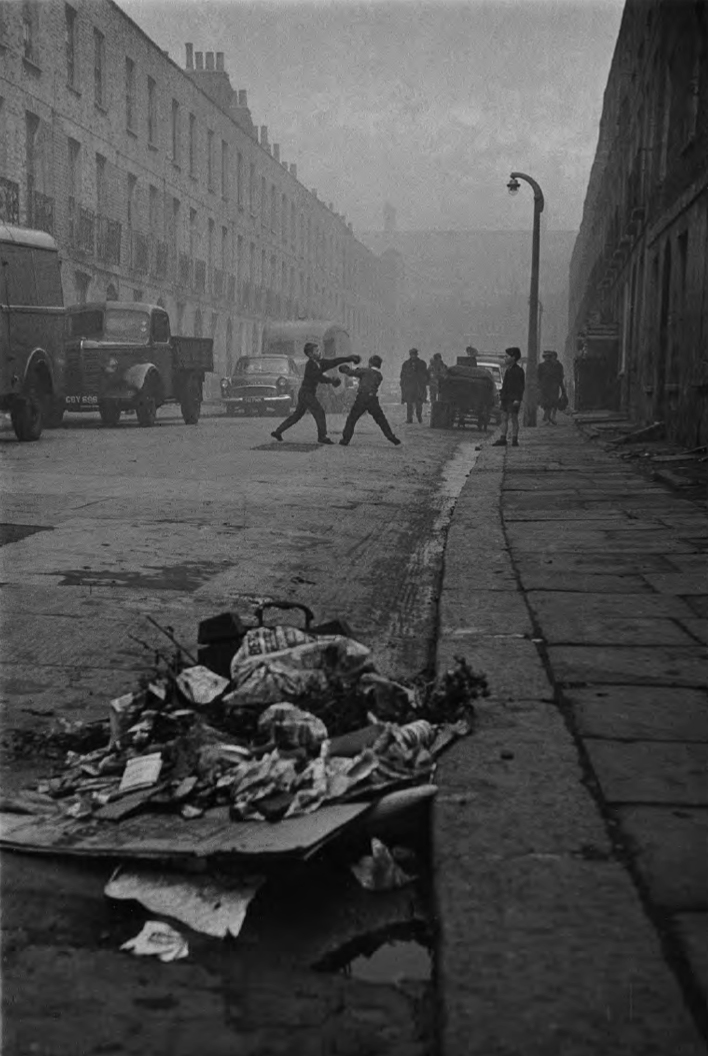
I thought his early work also showed this concern.
Boys Boxing near Caledonian Road. Don McCullin
This image of boys boxing puts the title subjects in the distance. Predominance in the image is the accumulation of rubbish in the road seen in the foreground. McCullin appears to be showing that boys play in the street here surrounded by this squalor.
Although he clearly has these views about inequality, he has throughout his career covering conflict McCullin has insisted on his own neutrality. In the exhibition was his statement of his position:
“No one was my enemy, by the way. There was no enemy in war for me. I was totally neutral passing-through person.”
2. Darkness in his images
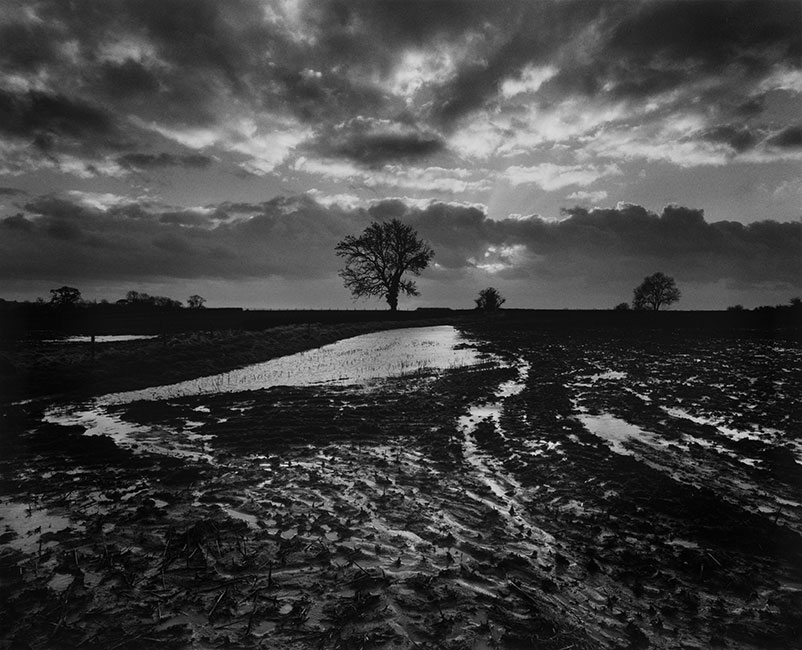
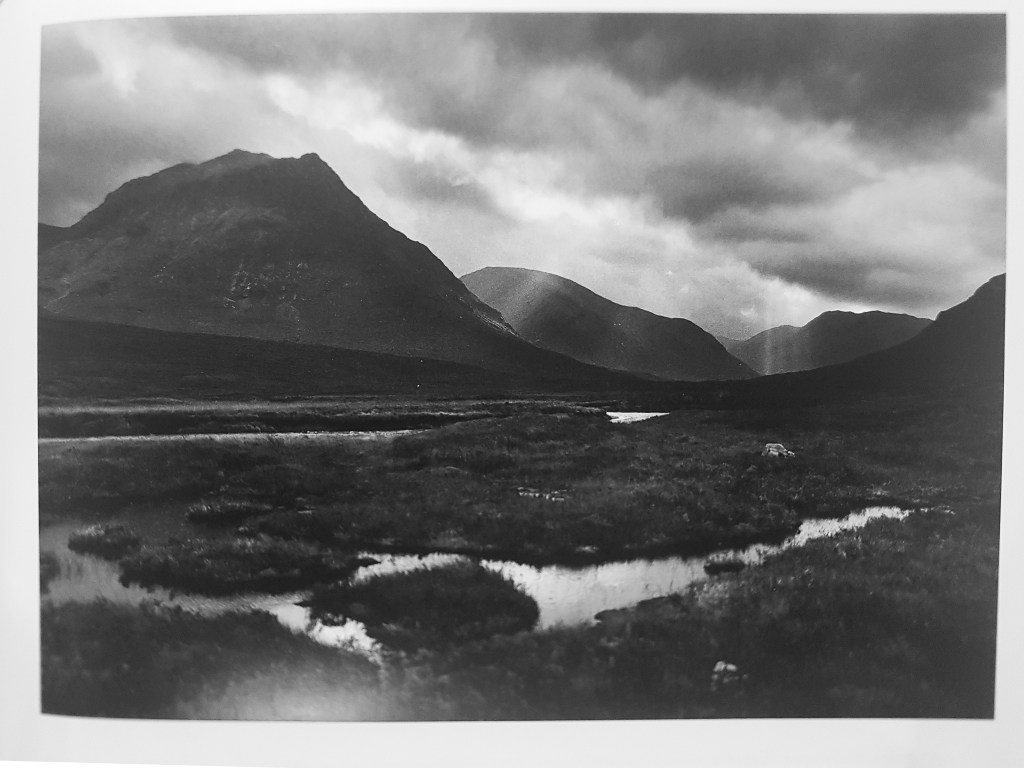
In “Looking for England” McCullin says “I cannot help taking my prints darker and darker and darker, I don’t know what makes me do it”. His images of English and Scottish Landscapes are dark – the skies are darker than would be the case in life. This gives a brooding threatening sky and land.
Somerset 2004. Don McCullin
Batcombe, Somerset. Don McCullin
North of Glen Coe 1992. Don McCullin
McCullin himself compares these to war zones.
“You can see in my landscapes the dark Wagnerian clouds, which I darken even more in my printing, the nakedness of the trees and the emptiness, which make the earth look as if it had been scorched or pulverised by shells.” (Don McCullin. Mehrez A Ed. Tate 2019. p155).
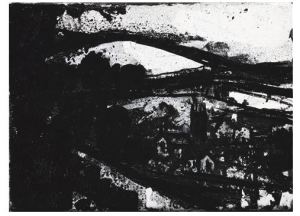
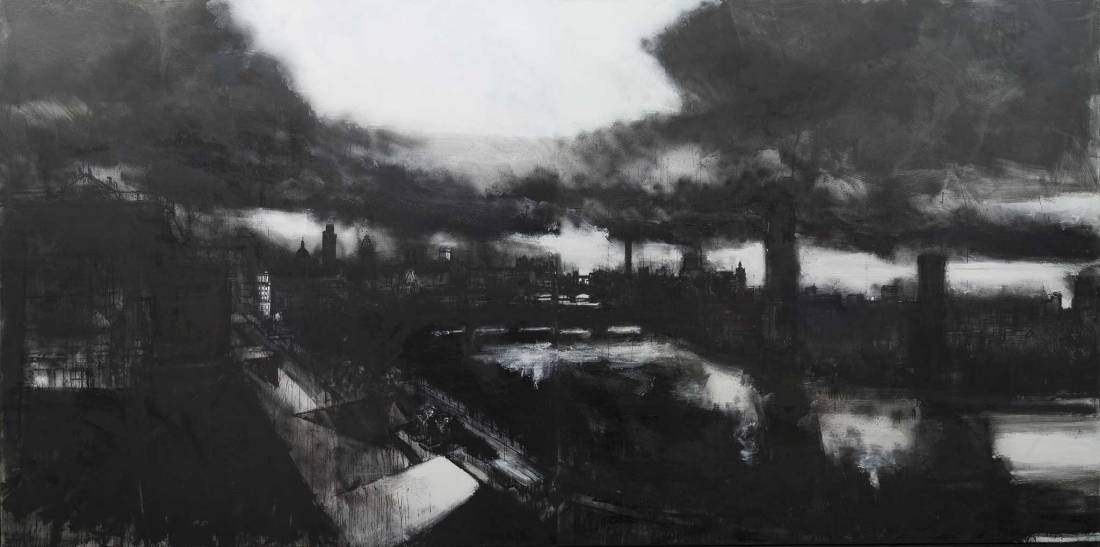
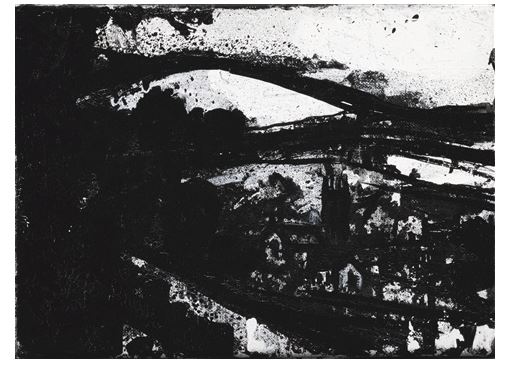
The large expanses of black in many of his images reminded me of the landscapes of John Virtue. I was directed to the work of John Virtue by my tutor. Virtue is a landscape artist who uses only black and white on his work; he uses shellac black ink and white paint.
Landscape 710. John VirtueLandscape 260. John Virtue
The landscapes become abstract in this medium but the quality of the image is very like that of the McCullin landscapes.
3. Emotional contact with subjects
In many of his images McCullin establishes contact with the subject by them making eye contact with the camera. This is in the same way as I commented about Willy Ronis’s work.
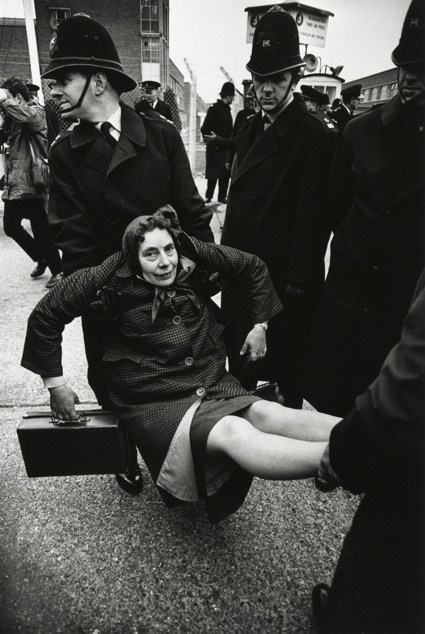
For example we can see this clearly in this image of the Aldermaston demonstrations in early 1960’s
Aldermaston, Don McCullin
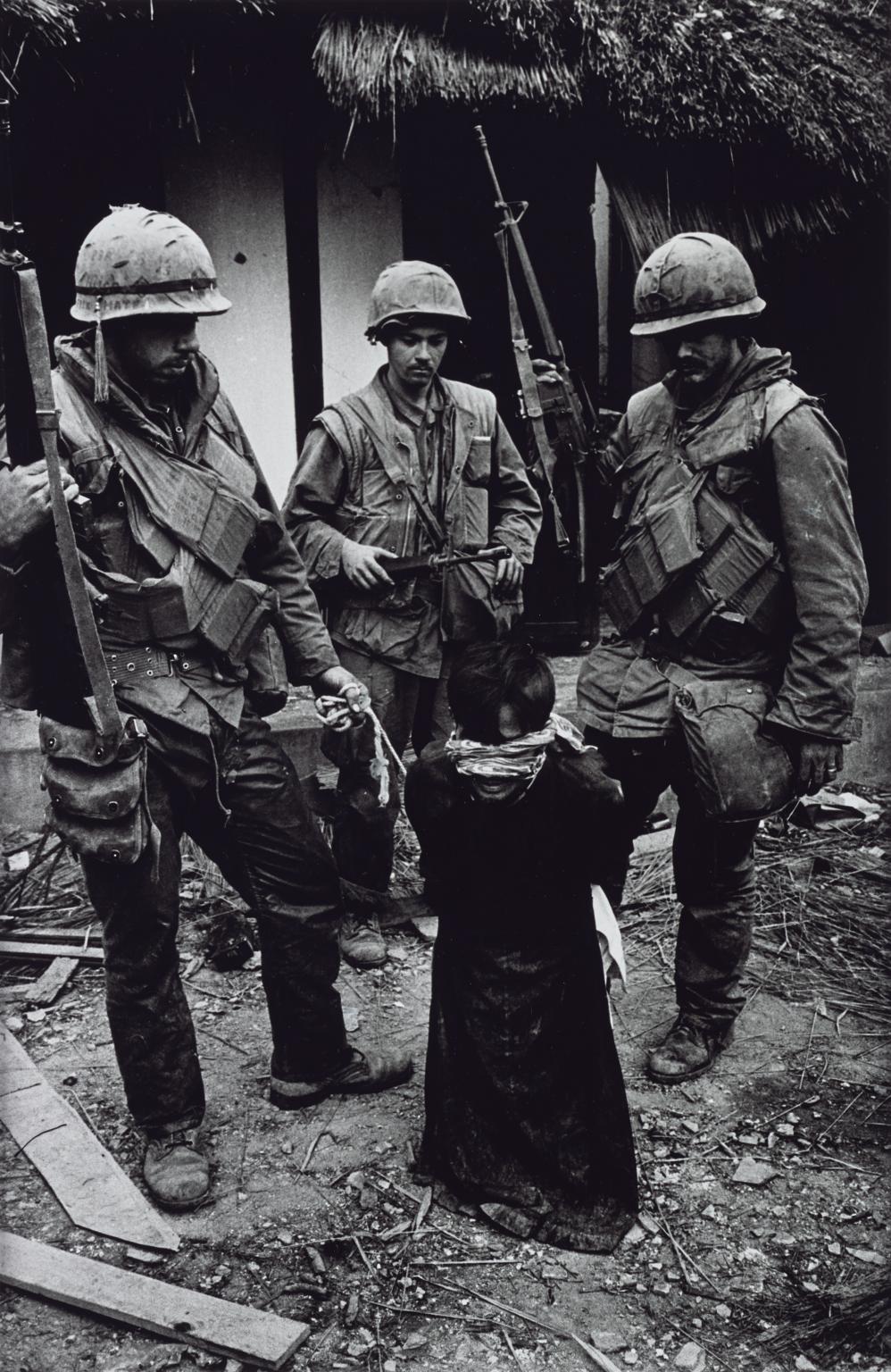
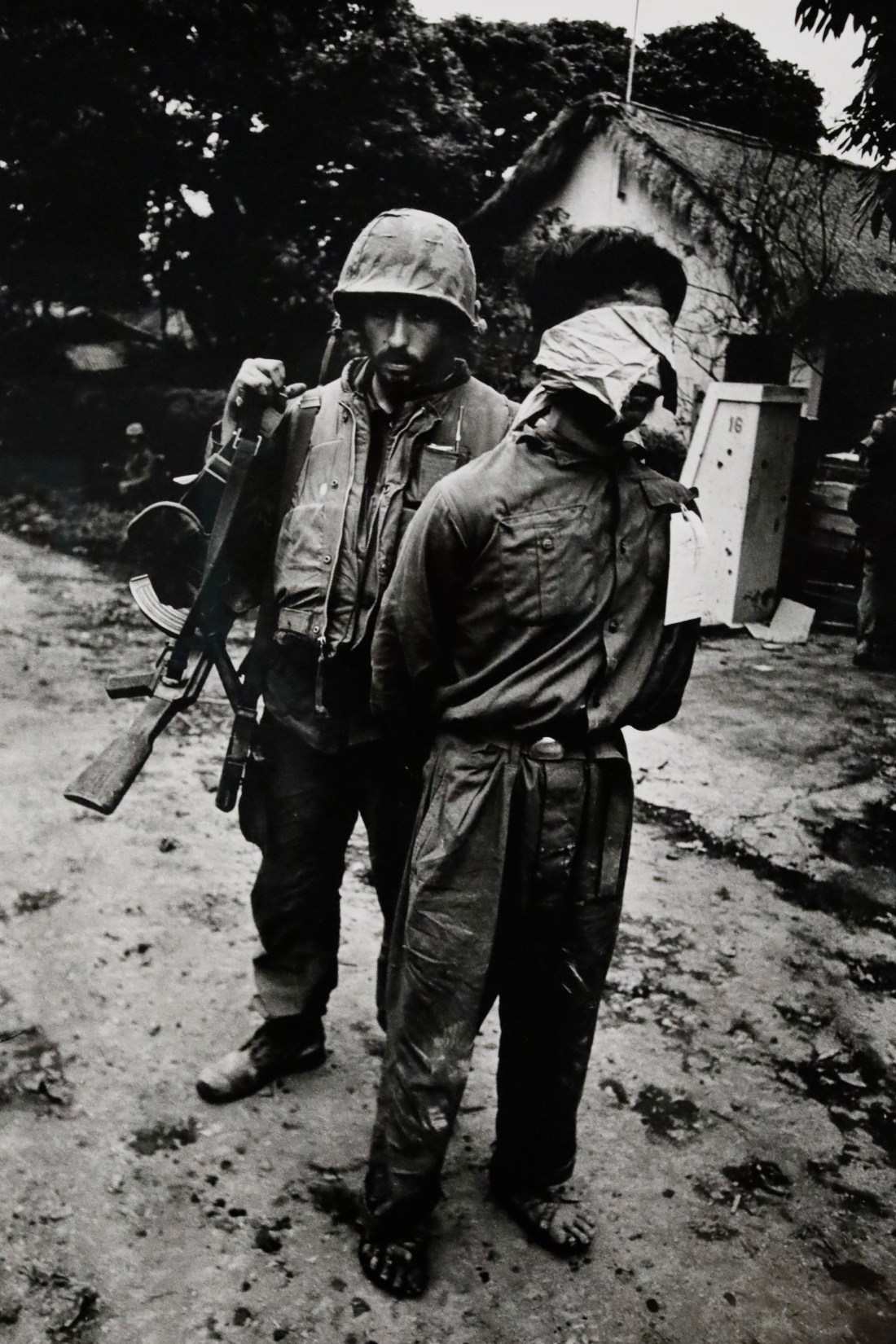
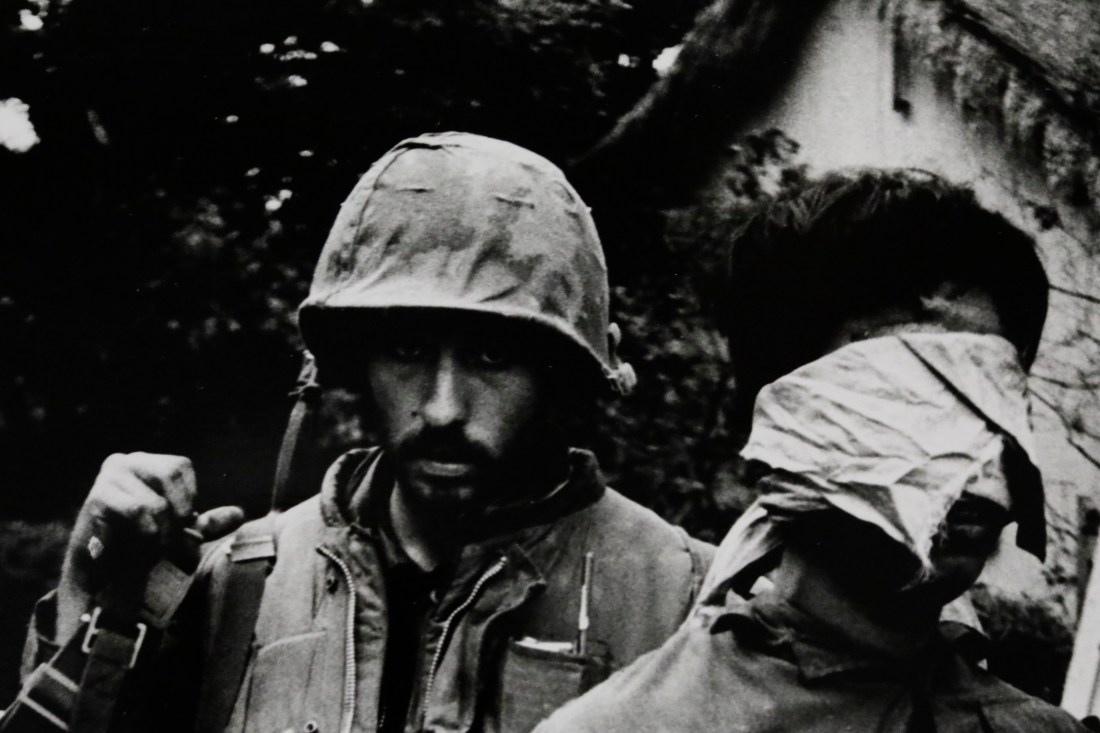
However I noted that in some of his war photography, it becomes more difficult to see the main subjects eyes and establish this same type of contact and I would suggest, empathy. These images from Vietnam taken in 1968 show the US marines’ eyes to be in the shadow of their helmets and difficult to see.
US Marines Tormenting an Old Vietnamese Civilian, Hue 1968,. Don McCullinUS Marine with captured North Vietnamese soldier, 1968. Don McCullinDetail – US Marine with captured North Vietnamese soldier, 1968. Don McCullin
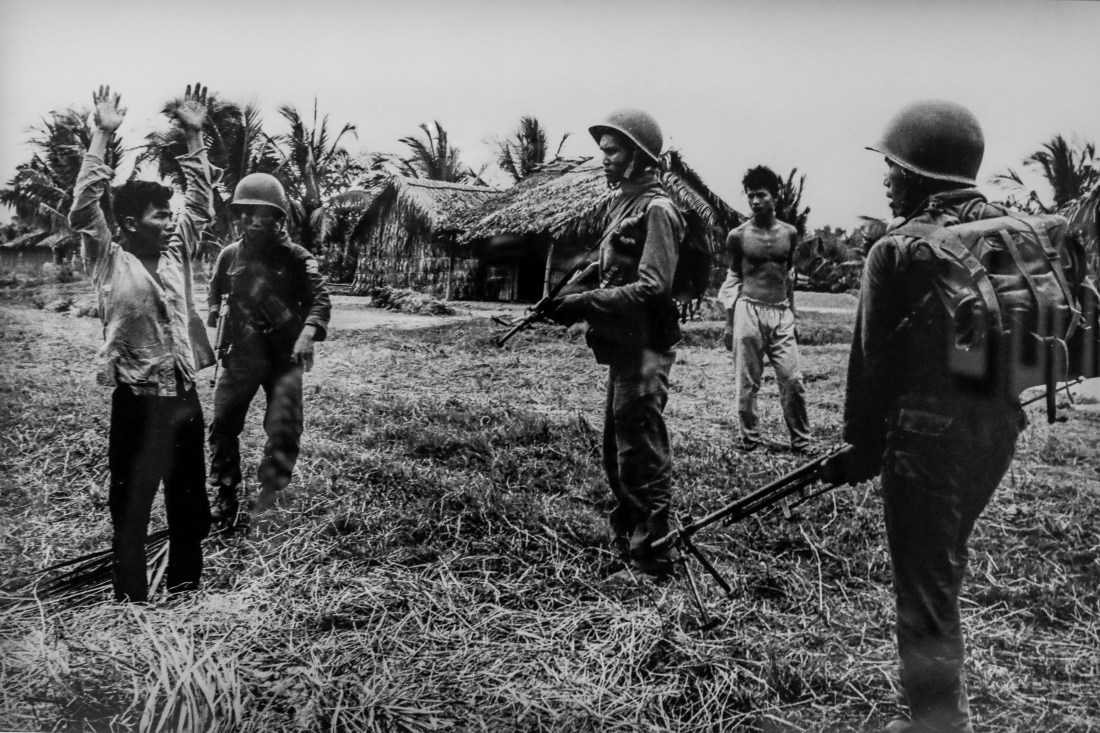
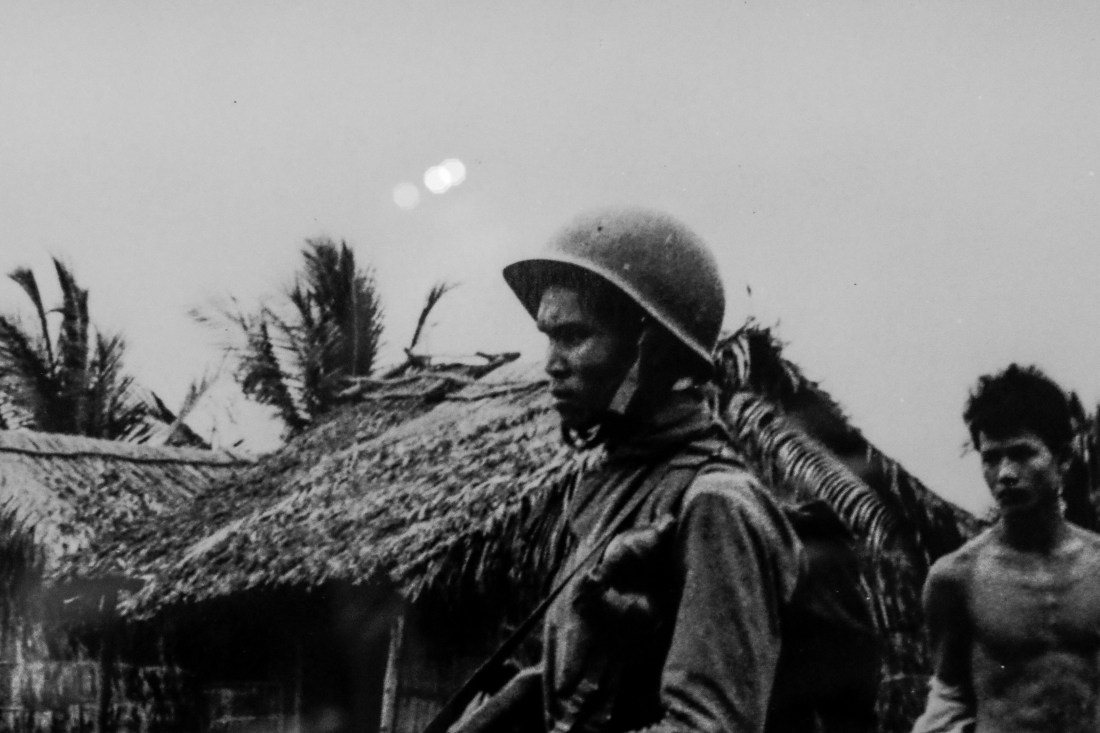
This is in contrast to earlier images such as this taken three years earlier in 1965, where we can clearly see the eyes of the soldier.
ARVN patrol, South Vietnam 1965. Don McCullinDetail ARVN patrol, South Vietnam 1965. Don McCullin
This made me wonder if after three years of the Vietnam war, McCullin is in some way distancing himself from the emotional contact with his subjects. Having experienced the events of the war and witnessed the effect on the soldiers and civilians, I would be surprised if this did not have an effect on him.
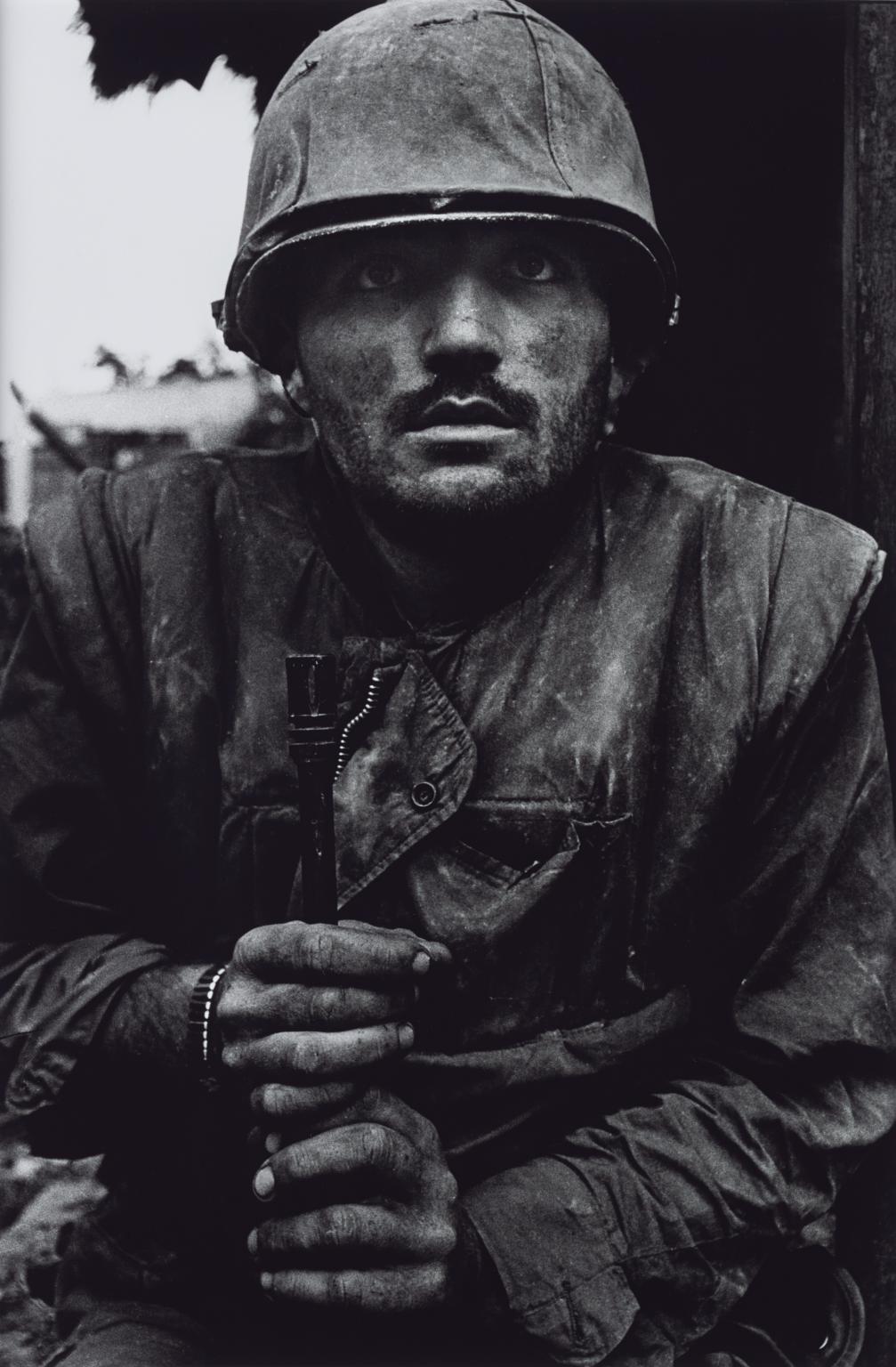
The effects of combat stress on military personnel is well known and McCullin records it in this image of a “shell-shocked” US marine (my italics).
Shell-shocked US Marine, Hue 1968. Don McCullin
Descriptions of this soldier’s condition made by people around him at the time are described in a newspaper article by Antony Loyd ( Shell-shocked: Anthony Loyd goes in search of the Vietnam War veterans photographed by Don McCullin. The Times, February 23 2018). Loyd summarises these:
“The Marine was swallowed by the night. When he was found he was mute, though in his eyes lay a stare best unmet while dreaming: a gaze that was part trance, part fear, but mostly horror. The men who had located him recall that he neither blinked nor uttered a single word.”
He quotes McCullin as saying
“I noticed he was moving not one iota. Not one eyelash was moving. He looked as though he had been carved out of bronze. I took five frames and I defy you to find any change or movement in those frames.”
and his colleagues
“He was in a state of shock. He had the classic thousand-yard stare, and was kind of frozen.”
“I thought someone had cut his throat, the way he looked. Because I’ve seen people with their throats cut and their eyes just wide open.”
The navy corpsman, a medic, who examined him is reported as saying to the sergeant in charge:
“Sarge, his mind is not there. We need to get him out of here.”
These are classic descriptions of recognised mental disorder, specifically Acute Stress Reaction (ICD-10 F43.0) followed by a Dissociative Stupor (ICD-10 F44.2) and I have included fuller descriptions of these in another post, International Classification of Diseases (ICD-10) – Reactions to Stress.
The effects of psychological stress on combatants is well recognised and steps are now taken by armed forces to mitigate these. However others who witness these events are also susceptible to stress reactions, and I wonder if McCullin himself has been affected by this.
The risks of physical harm to journalists covering conflict has been recognised in the film A Private War, 2018, describing the career and death of war correspondent, Marie Colvin. Indeed McCullin himself has been injured on several occasions and the Tate exhibition includes a camera body he was carrying, in which is embedded a bullet.
The psychological consequences of working in a war zone and/or witnessing massive humanitarian crises are less well recognised in journalists. What is even less recognised is the effect this then has on the types of image produced by photographers subject to this stress.
The Tate exhibition includes a quote from McCullin regarding him being asked to cover the Iran-Iraq war in 1991.
“I hadn’t covered a theatre of war for seven years since leaving the Sunday Times and felt mentally ill-equipped for the assignment I had suggested to the Independent newspaper. It felt like tempting providence once too often. I began to wish I wasn’t there when I saw the burnt and injured children and in some respects, I wish I hadn’t gone. The immorality of the situation seemed intolerable. Did I need to face all this yet again?.”
He is clearly describing mental distress at his situation and having to witness the events. Furthermore he describes longer-term sequelae.
“Sometimes when I’m walking over the Yorkshire moors or in Hertfordshire, the wind rushes through the grass and I feel as if I’m on the An Loc road in Vietnam hearing the moans of soldiers beside it. I imagine I can hear the 106-mm howitzers in the distance. I’ll never get that out of my mind” (Don McCullin. Mehrez A Ed. Tate 2019. p154).
These sound like episodes of “repeated reliving of the trauma in intrusive memories (‘flashbacks’)” a characteristic feature of Post Traumatic Stress Disorder (ICD-10 F43.1).
Is it this psychological reaction to what he has witnessed and his memories which initially made him want to distance himself emotionally from the protagonists as shown by lack of clarity of the soldiers faces in later images of Vietnam, and now make him produce such dark images of the British landscape?
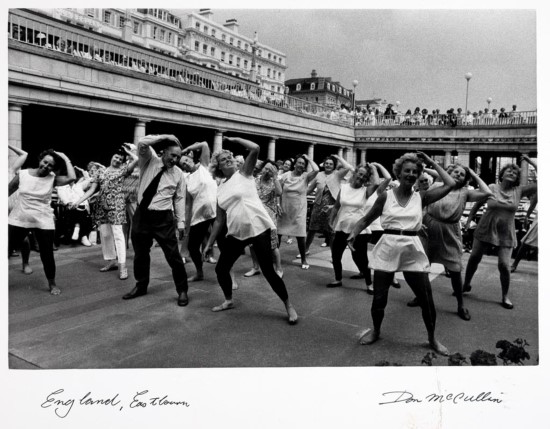
However it is easy to categorise McCullin’s work as dark and harrowing. There is a lighter side to his work perhaps exemplified by this image of a dance class in Eastobourne.
Dancing, Eastbourne. Don McCullin
In the documentary, Looking for England, he revisits this site of this image and clearly enjoys the incongruity of the sight of people enjoying a brass band in the pouring rain.
He makes jokes about people going to the beach in the wind and rain. Overall, he does not seem a overly preoccupied with the horrors he has seen over the years, but is enjoys his interest in people and their activities. I wonder if it is from this that his sense of justice stems, when he sees inequalities or brutality to which he needs to draw wider attention.
During my brief stay in Venice I visited the Peggy Guggenheim Collection. This is a museum of modern art principally based on the personal collection of Peggy Guggenheim who collected the artworks mostly between 1938 and 1946. Works on display include those of American and European artists largely working in the first half of the 20th century, and include works of Cubism, Surrealism and abstract expressionism.
I am not familiar with this style of art and I hoped my visit would extend my knowledge and expose me to different forms and styles of visual expression.
There was a lot of material in the collection and I made notes as I visited. To try and put this experience into a manageable form I have decided to write here three things I believe I learned from this visit. I am sure that there were more, and I may recognise these as I progress through my OCA course, however I will add to that account from my notes as I need.
1. Rayographs by Man Ray
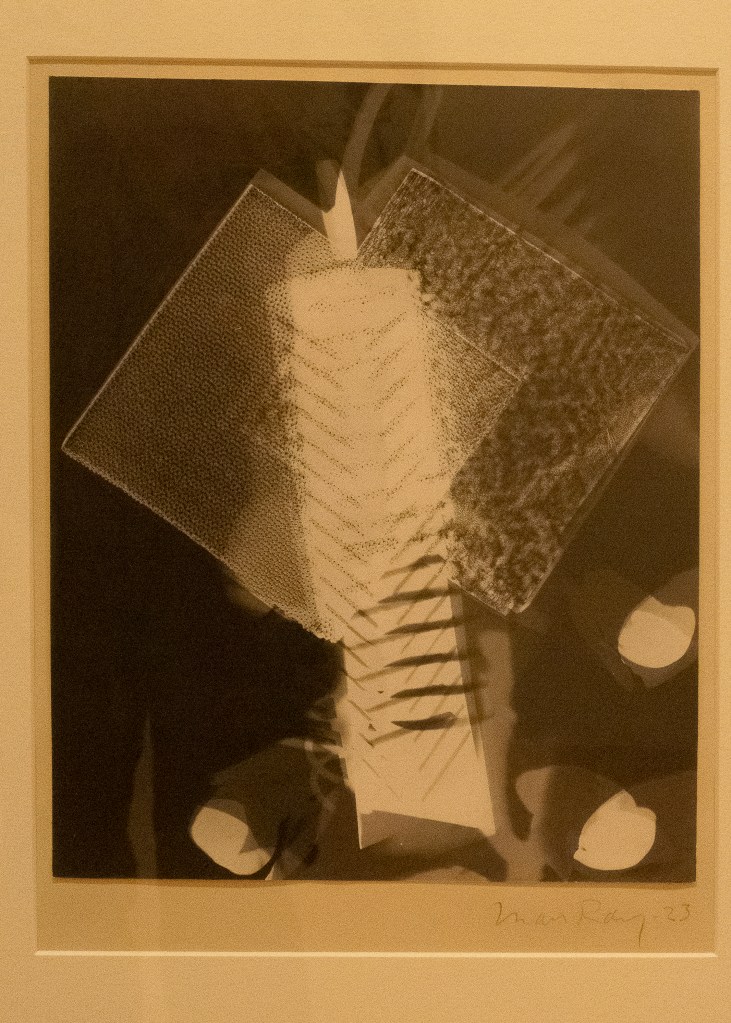
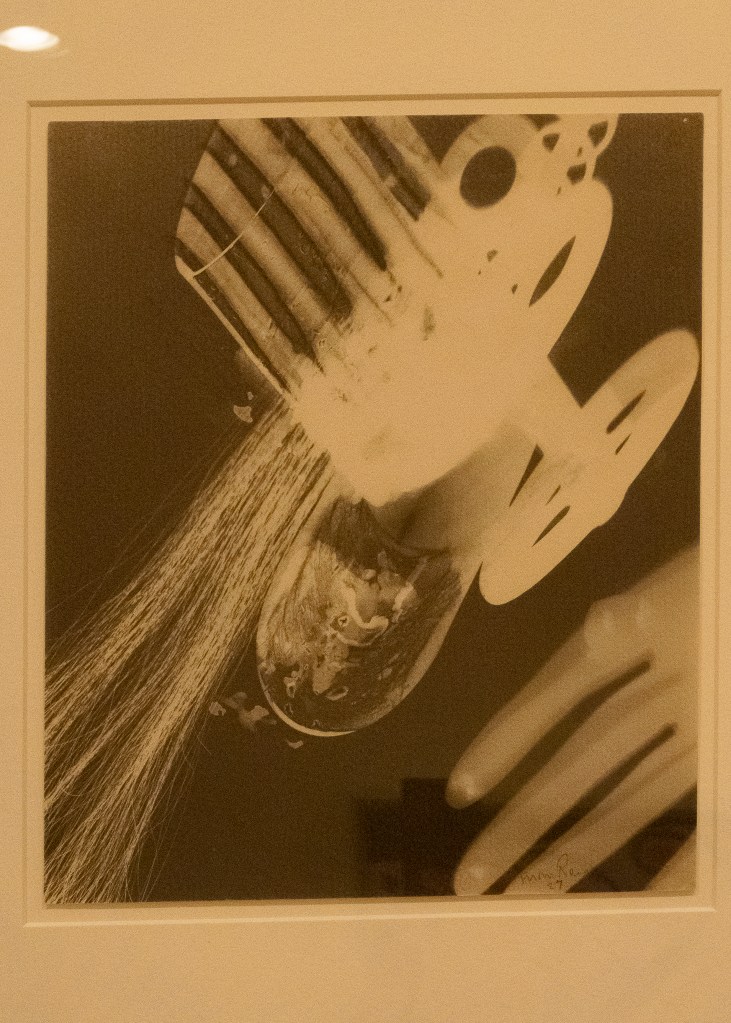
The collection includes two examples of Rayographs made by Man Ray.
Man Ray is described as a painter, filmmaker, photographer and sculptor, active in Paris from 1921. His work is considered influential in the development of Surrealism. As a photographer he is also noted for technical experimentation with techniques such as solarisation, grain enlargement and the production of camera-less prints, “Rayographs” (Photography the Whole Story (2012) Hacking J (Ed.) Thames and Hudson.)
These rayographs were made by placing objects directly on a sheet of photosensitized paper and exposing it to light. The resulting image becomes more abstract and representational.
Rayograph, untitled. Man Ray. Peggy Guggenheim Collection
Rayograph, untitled. Man Ray. Peggy Guggenheim Collection
2. Abstract art and Surrealism
I had never really considered the massive differences in styles of “modern art”. Going round the gallery I could see how the styles evolved through Cubism to abstract. The work of the surrealist artists I found particularly interesting as these employed imagery based on the principles of psycho-analysis. Symbolism is widely used based on classical Freudian theory and later artists such as Max Ernst, employing Jungian principles.
3. The work of Jackson Pollack
I have never understood the work of this artist. However the notes from the collection helped me to begin to do so.
The concepts of line, form and colour in creating an image began to be explored in our coursework, exercises 1. However seeing the abstract images in this collection made me understand to what extent these can be separated and function independently. Pollack takes this to an extreme and does not appear to depict any realistic description.
The exhibition notes also referred to the principle that some of the key feature of some of these works is the process of creating the image, rather than the image itself.
These are relatively new concepts for me, but I think this visit has started me on a different path of understanding art works.
This section of my learning log really documents my development of different visual appreciation and understanding.
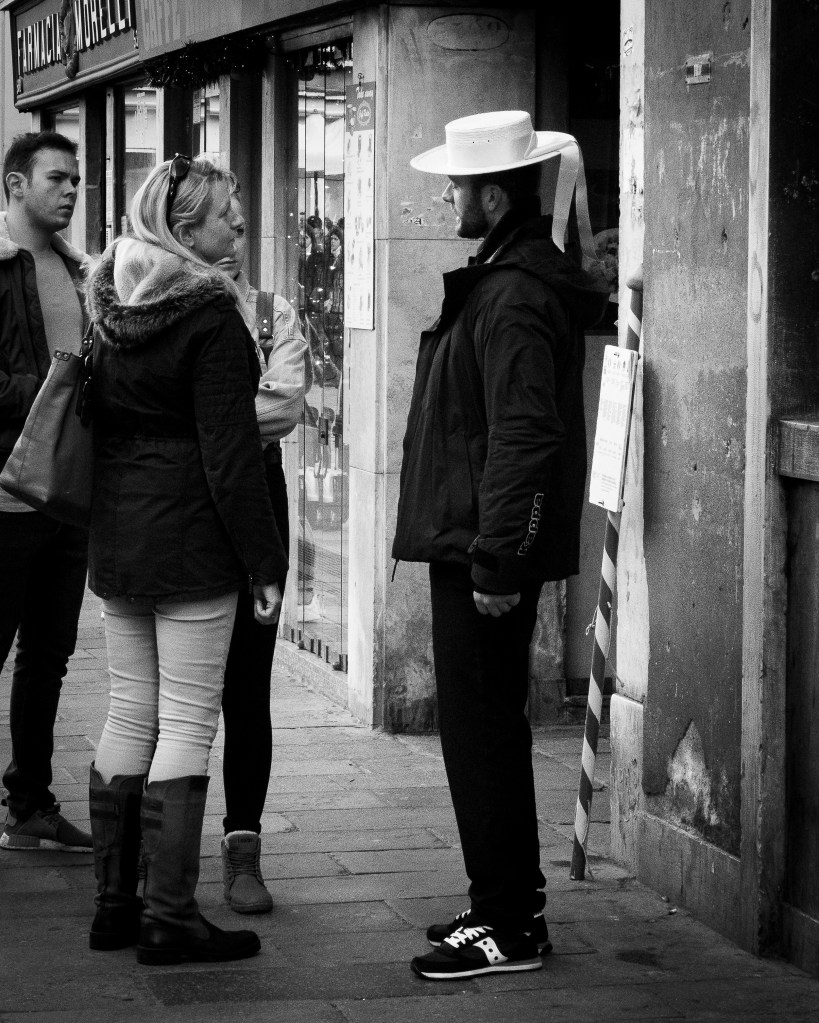
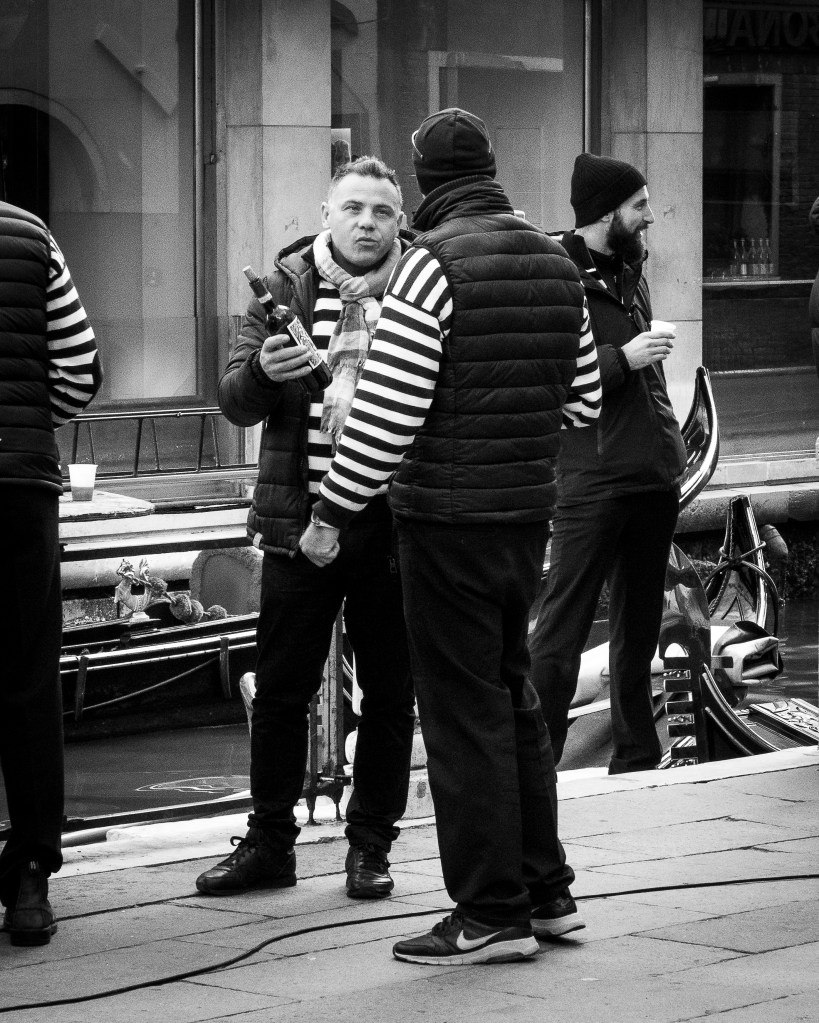
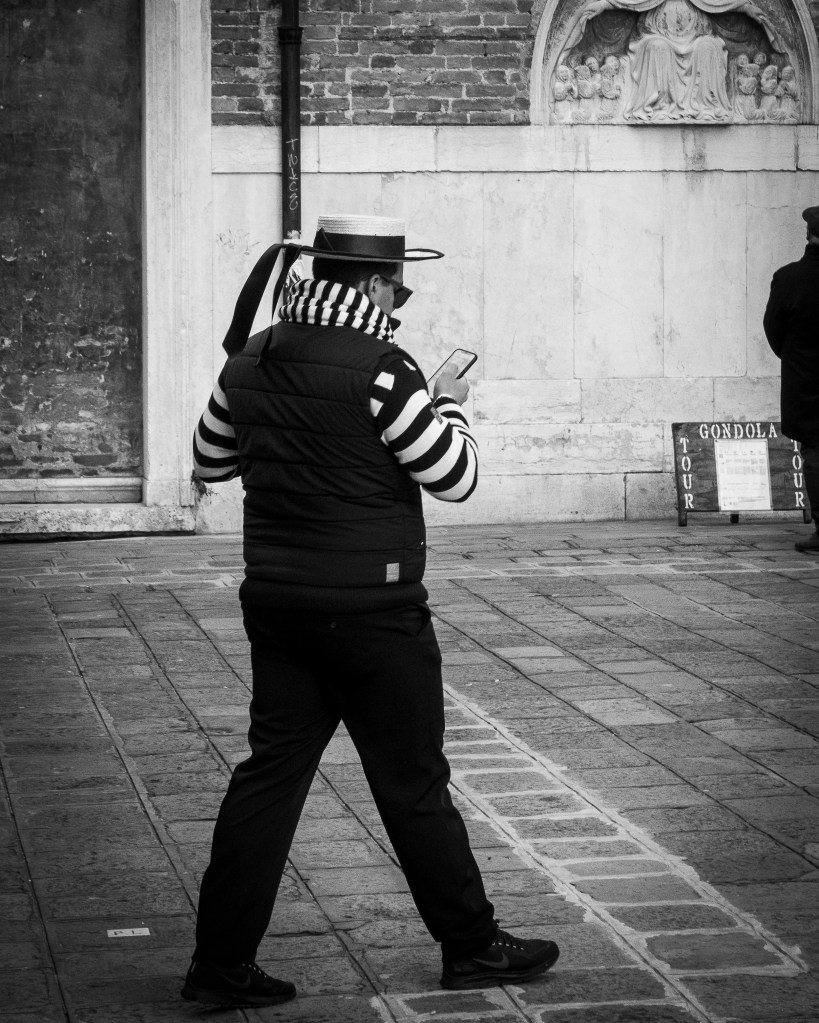
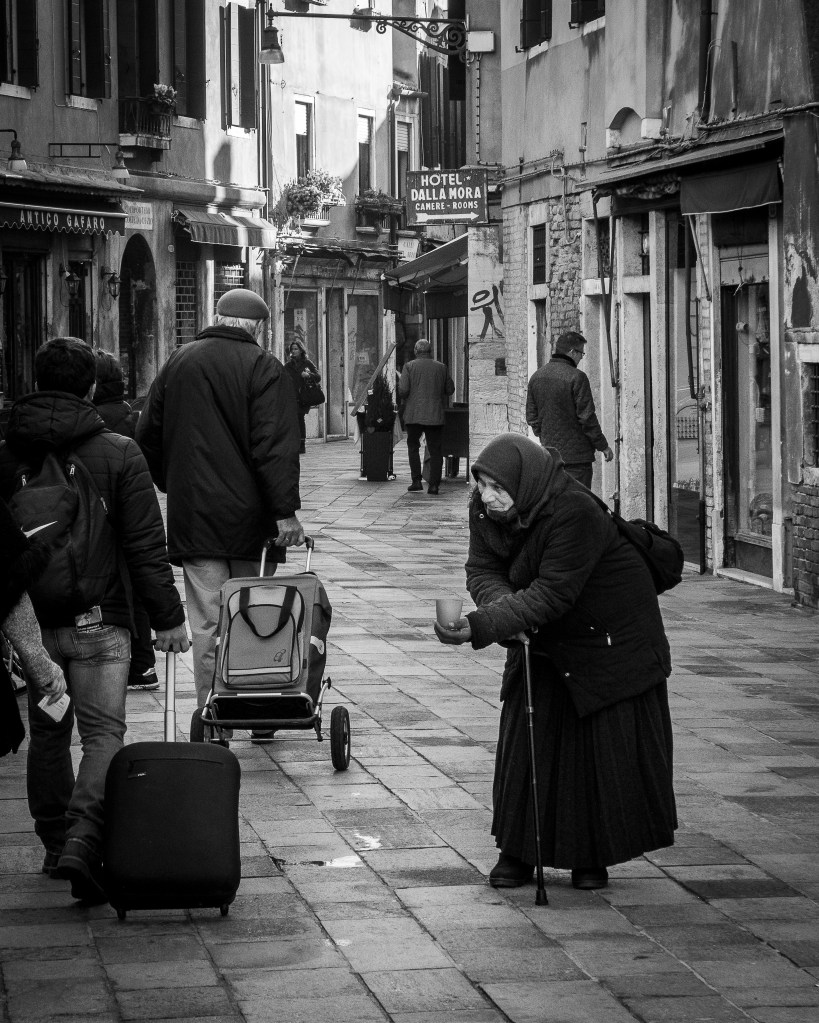
Following viewing the Ronis exhibition I took some photographs around Venice and tried to emulate the style and spirit of some of those I had seen in the exhibition.
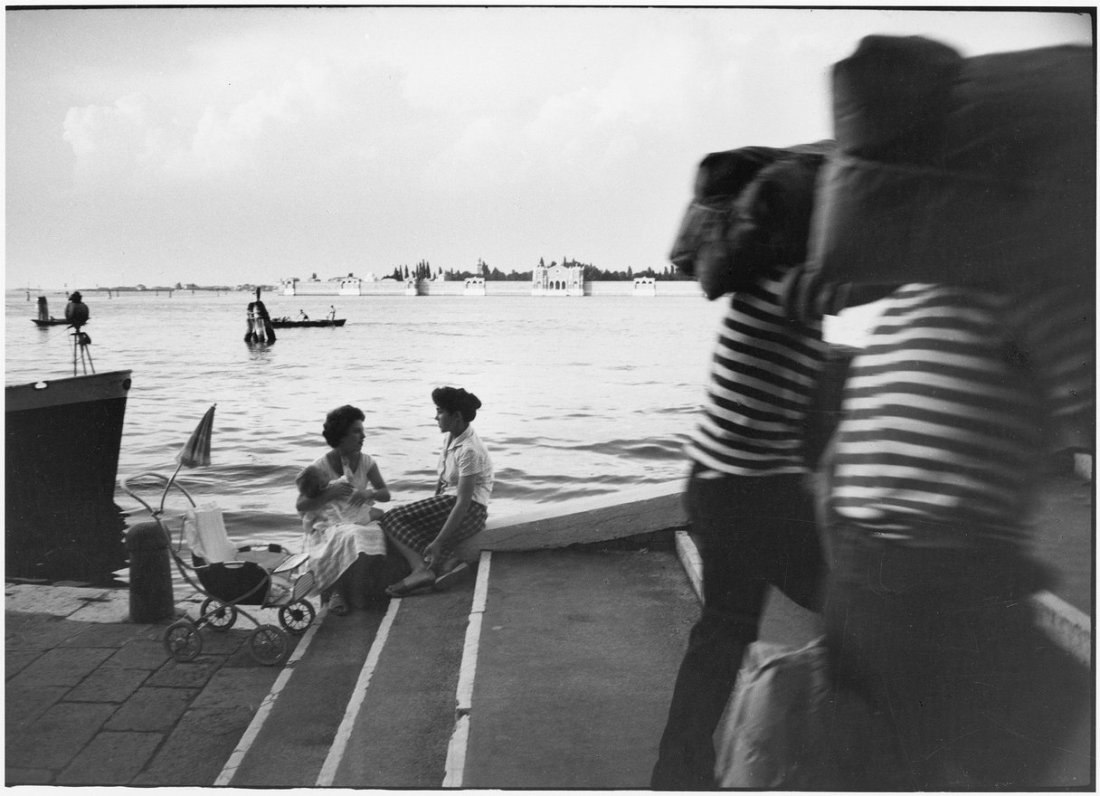
In addition to the images I have shown in my account of my visit to the exhibition there were some images of Venice taken by Ronis. These and his images of the people of Paris influenced my selection of subjects.
Venice Willy Ronis 1959
I tried a number of images of people in the street – particularly the gondoliers who were in their winter clothes of thick jackets!
Gondolier and tourists
Gondoliers
Gondolier and wine
Gondolier and mobile phone
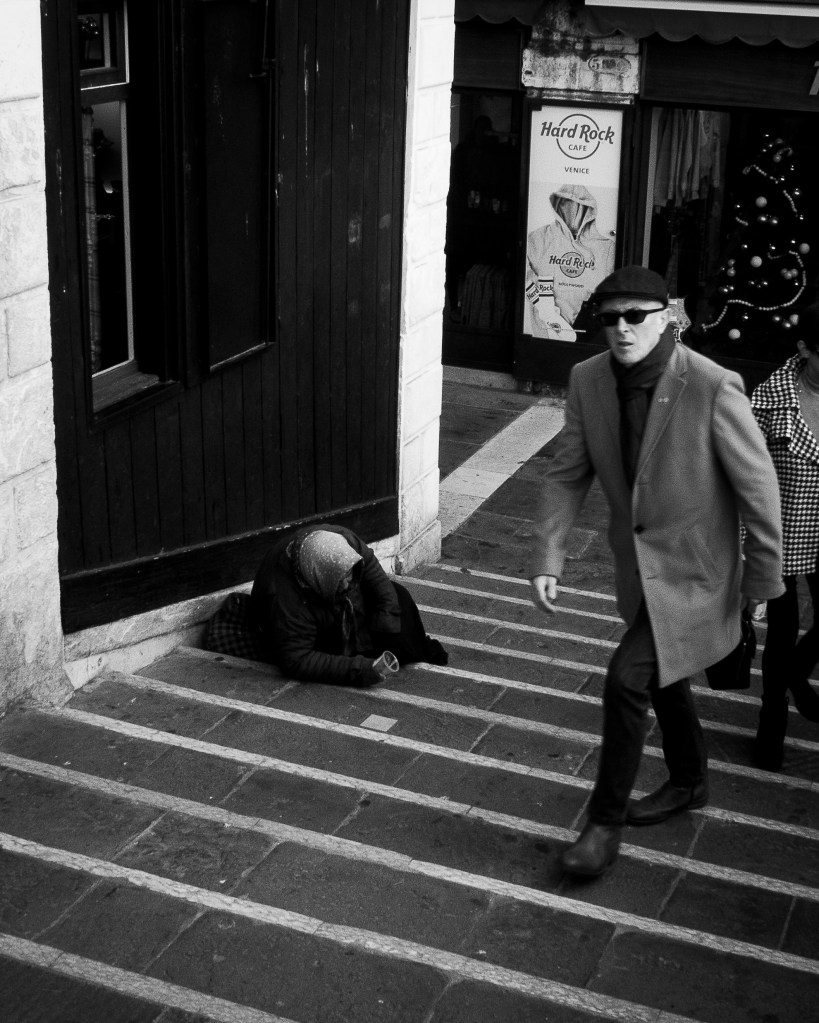
As well as these, Ronis’s sense of social justice inspired these images highlighting social inequality in this city.
Venice resident and tourists
Rialto Bridge 1
Rialto Bridge 2
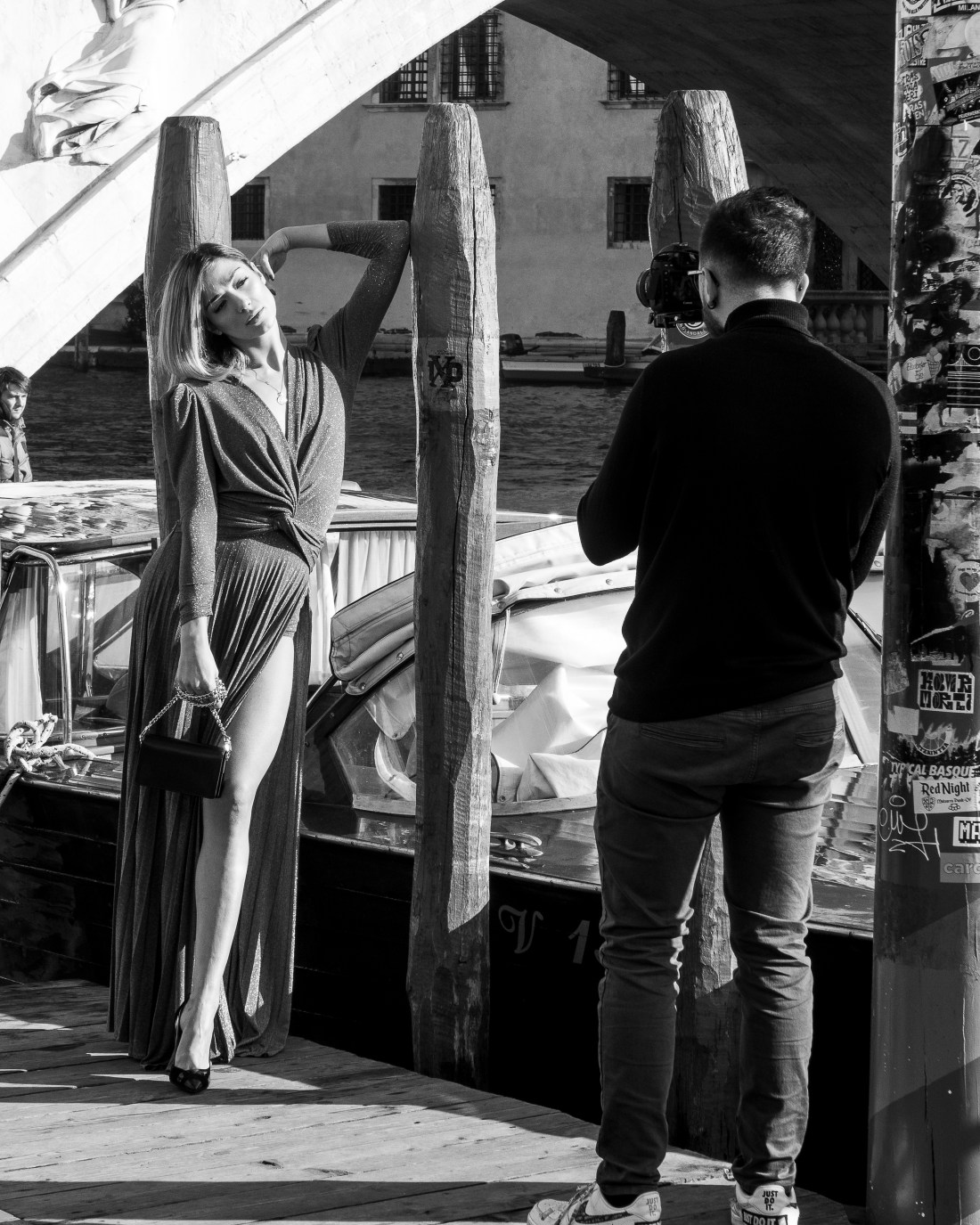
The glamour was highlighted by a video shoot
Video shoot near the Rialto
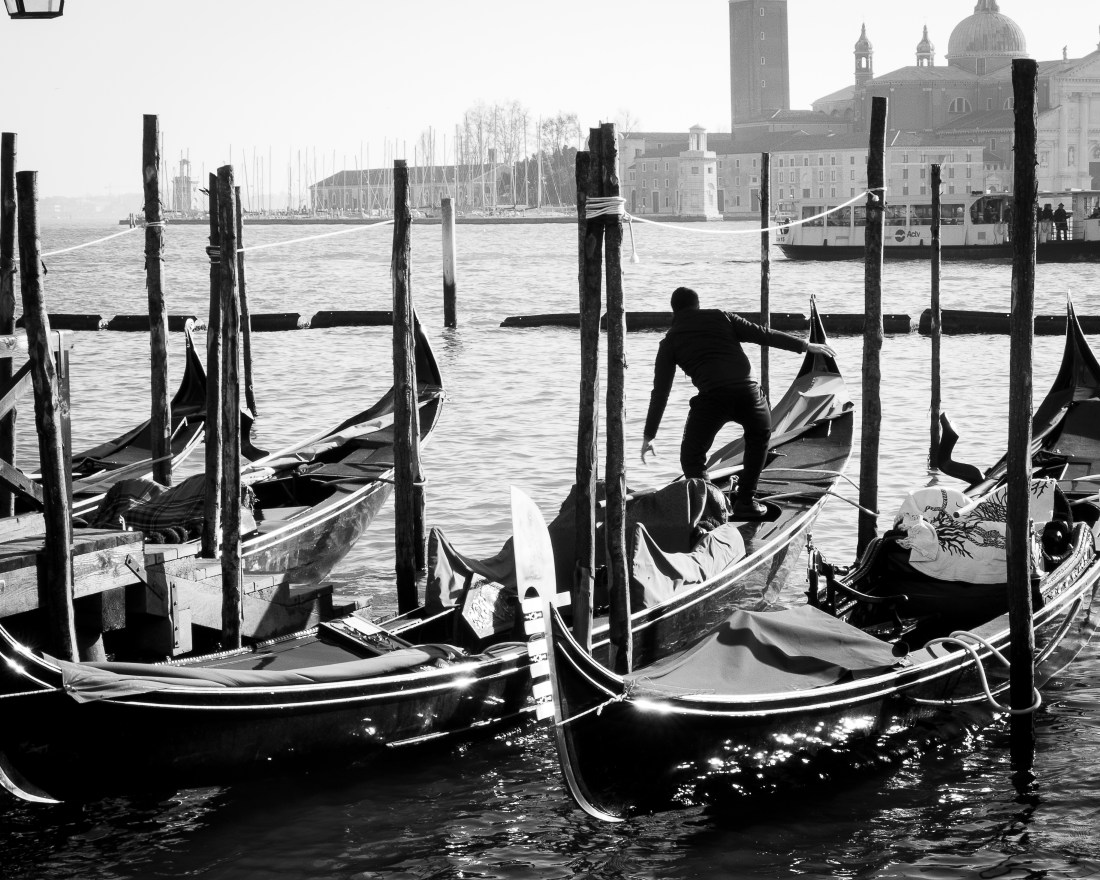
The last of my images I include has a similar silhouette effect to this one by Ronis
Venice. Willy Ronis 1959
Again taken with the light on the water providing a marked silhouette.
Gondolas and gondolier near San Marco
I may use this image as a link to the Decisive Moment assignment – as every time he places his foot on the deck of a wet and moving gondola is a decisive moment!
Willy Ronis: Photographies 1934-1998 Casa dei Tre Oci, Venice
I visited this exhibition while on a short visit to Venice in December 2018.
The exhibition was described as “the most complete retrospective of the great French photographer to be held in Italy, featuring 120 vintage images, among which about ten previously un-exhibited ones devoted to Venice, together with documents, books, and letters never previously shown… The exhibition ranges over the whole career of one of the major interpreters of twentieth century photography and a protagonist of the French humanist tradition.”
The notes accompanying the exhibition indicate that Willy Ronis was born in 1910 and died in 2009. His mother was a piano instructor and his father had a photography studio in Montmartre, Paris. Ronis was interested in music and initially planned a career in music. However in 1932 on completing his compulsory military service, he was needed to run his father’s photography studio as his father was suffering from cancer. After the death of his father the business closed and Ronis began working as a freelance photojournalist until 1940 when he left Paris to escape the German invasion. He returned to Paris in 1946 and he joined the Rapho photo agency (an agency specializing in humanist photography). In the early 1950s, he became known internationally for his commissions for Life and other magazines.
The exhibition included 120 images made by Ronis over a 64 year period. As such there was a great deal of content for me to assimilate.
I have made extensive notes about the exhibits, but to focus my learning will describe here three aspects which I regard as my key learning points from visiting this exhibition.
1. Editorial Control of Output and use of images
Ronis had strong views about the use of his images and the depiction of his subject matter in publication. He resigned from Rapho for a period when he objected to the captioning by The New York Times to his photograph of a strike (“Willy Ronis” by Peter Hamilton, in The Oxford Companion to the Photograph, ed. Robin Lenman Oxford: Oxford University Press, 2005; ISBN 0-19-866271-8).
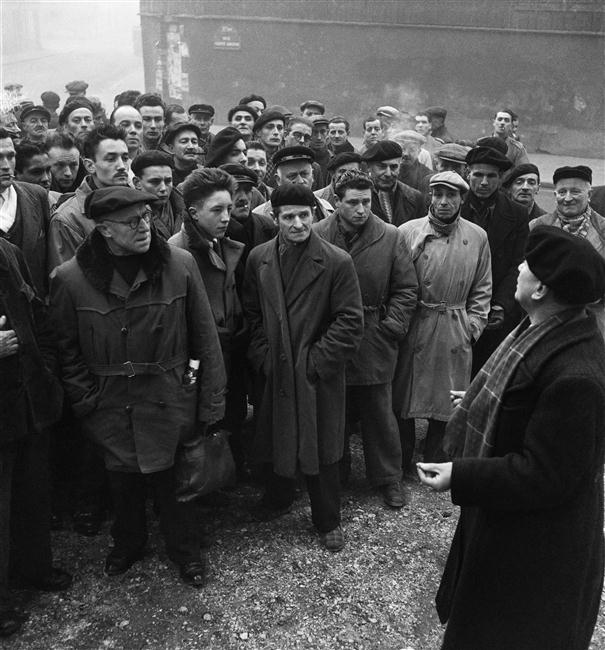
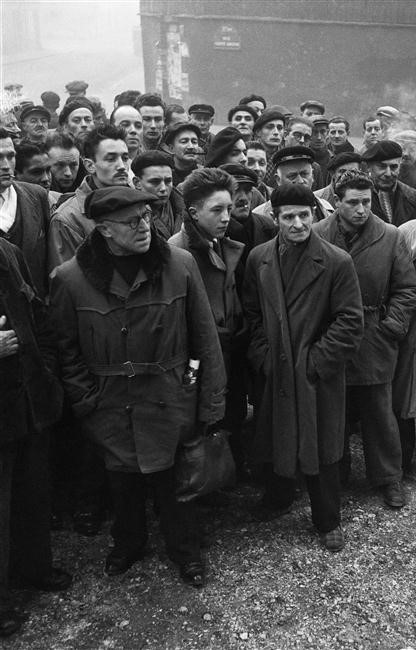
Of note also is that he objected to the cropping of one of his images for publication in a British journal. The image “The delegate, strike at the Charpentiers de Paris, Paris” (below) shows a trades union representative addressing strikers in 1950. However when published the right hand side of the image was cropped, removing the delegate. This changes the image and what it appears to show. Before cropping it showed strikers listening attentively to their representative; cropping it appears to show a mob without that direction and leadership.
The delegate, strike at the Charpentiers de Paris, Paris. Willy Ronis 1950
The delegate, Willy Ronis – as cropped by publisher
I found this very clear and stark example of how simple changes to an image alter its interpretation and therefore, meaning. As photographers we need to be explicit about any such manipulation of the image to create the effect and meaning we want. When this is outside our control we have to be wary our work still shows what we intend. 2. Emotional contact with his subjects
Many of the photographs made by Ronis in Paris show his subjects facial expressions very clearly. This in turn appears to show some emotional contact with them which is communicated through the image.
Examples of this which stand out to me are:
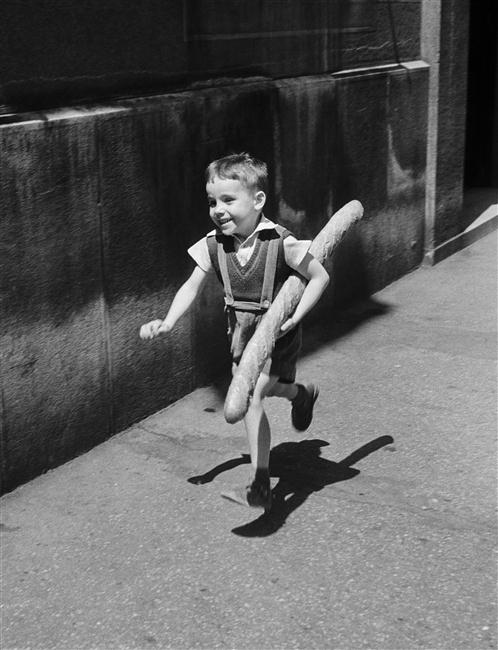
Le petit Parisien, 1952. The boy is smiling broadly, we can sense his happiness from his expression.
Le Petit Parisien Willy Ronis 1952
Conversely the man pictured in the Christmas shopping, Semaine de Noel, place du Palais Royale 1954, is clearly not enjoying himself unlike the others around him.
Christmas week, Place du Palais-Royal. Willy Ronis 1954
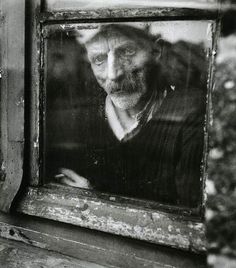
A third image, of a Miner Suffering with Silicosis, Lens 1951, shows a clearly sad man. However Ronis has chosen to photograph him through a window. It seems as if this barrier represents a separation of the miner from his work and colleagues because of his illness.
Miner with silicosis, Lens Willy Ronis 1951
What I think I learned from these and other images is the importance of capturing the facial expression in these informal portraits and thereby communicating some emotional contact with the subject to the observer.
3. Ronis’s self-perception as shown by self-portraits
There were five images in the exhibition which were self-portraits by Willy Ronis taken at different stages in his career. I thought these images depicted aspects of himself which he wanted to emphasise at these different stages. They appear to show his interests and activities at various stages in his career.
I was unfamiliar with all the work of Willy Ronis when I went to the exhibition, but writing up these notes I became aware of many other self portraits. This made me realise that the exhibition was curated and the views opinions and attitudes of the curator influence the choice of exhibits. Thus my perception of Ronis as I learn it from this exhibition is coloured by what the curator chooses to show me. It is with this caution that I describe what I think I learned about Ronis’s self-perception and how he chooses to show himself to the world.
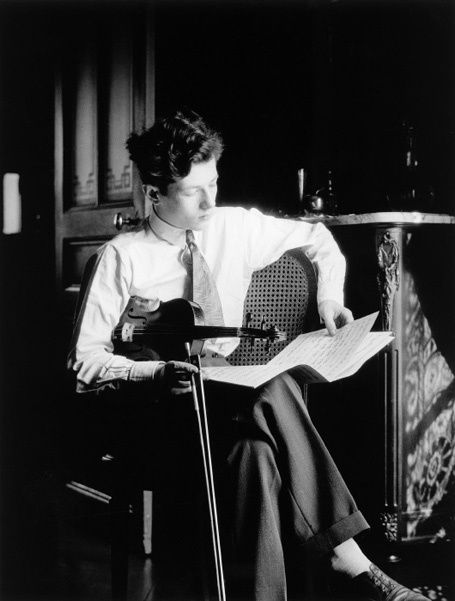
The earliest image was from 1929 and shows a young Willy Ronis in the dining room of the family apartment. He is studying a music score and has his violin under his arm and his bow in his hand. It is a very formally composed image: he is smartly dressed, looking studious, and on a side table behind him is a water jug and glass.
Self portrait Willy Ronis 1929
The reports of his life story indicate that at this stage in his life he was serious about music and intended to pursue this as a career. I interpreted this image as him showing this interest and wonder if he took this for posterity so that when as a successful musician it would show his early interest and activity in this area. It is ironic that this is however the early image of a great photographer – rather than a musician.
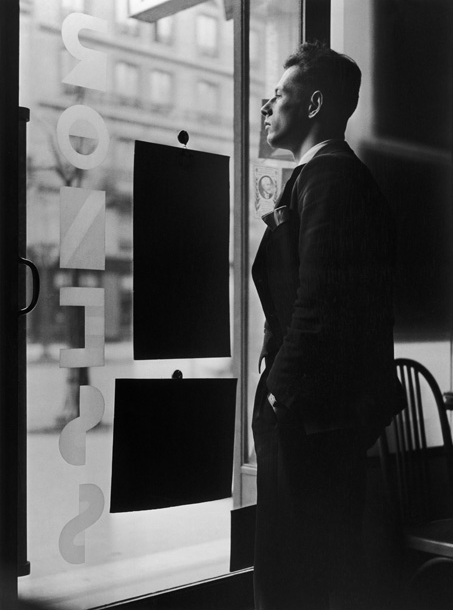
The second image in the exhibition is from 1935 and shows Ronis in the window of what had been his father’s studio which he now ran.
Self Portait Willy Ronis 1935
He is smartly dressed in a suit and looking out of the window. He has a confident stance, erect and looking straight ahead. He is now businessman running an established business premises. The appears to present himself as well-to-do successful and respectable businessman.
I was struck by the composition in this image. Because the image is taken from inside looking out of the window, notices in the window become black shapes, the left side of the image is also black with little detail and the body of Ronis in his dark suit provides a dark shape to the right side of the image. I am probably over interpreting this, but during the same weekend I visited the Peggy Guggenheim collection and saw Miro’s Femme Assise II, 1939 (below). The Miro is composed of shapes of black with small areas of detail.
Femme Assise II. Miro 1939
Although painted after Ronis made this image, I wonder if the influence of some of Miro’s earlier works had led Ronis to compose this image with blocks of black.
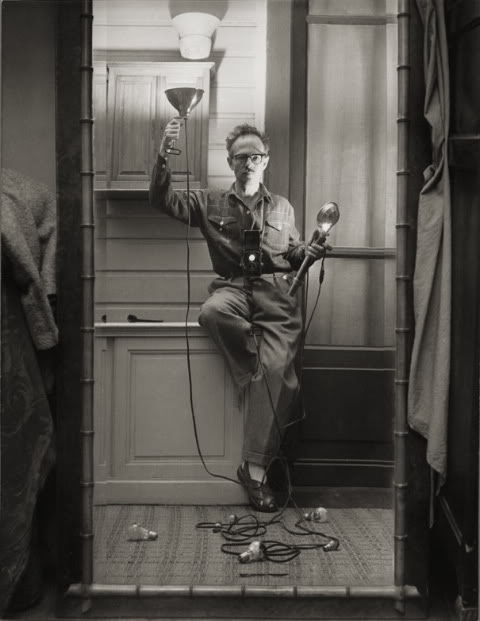
The third image, Self Portrait with Flash (1951) shows Ronis in a different light. At this stage in his career he had worked as a freelance photojournalist. He had covered workers disputes and had developed a strong self of social justice. He is quoted in the exhibition “We must work to change this world and make it better”.
Self portrait with flash. Willy Ronis 1951
This image shows Ronis in his studio holding a flash. He is now dressed in clothes suggestive of a working man, rather than the suit of the previous image. He also adopts a quirky pose on one leg and it is this that adds a sense of light heartedness to the image compared to the seriousness of the two previous ones. Does this reflect the greater self confidence of an established freelancer with international publication – he chooses how he wants to show himself, rather than how he thinks others want to see him.
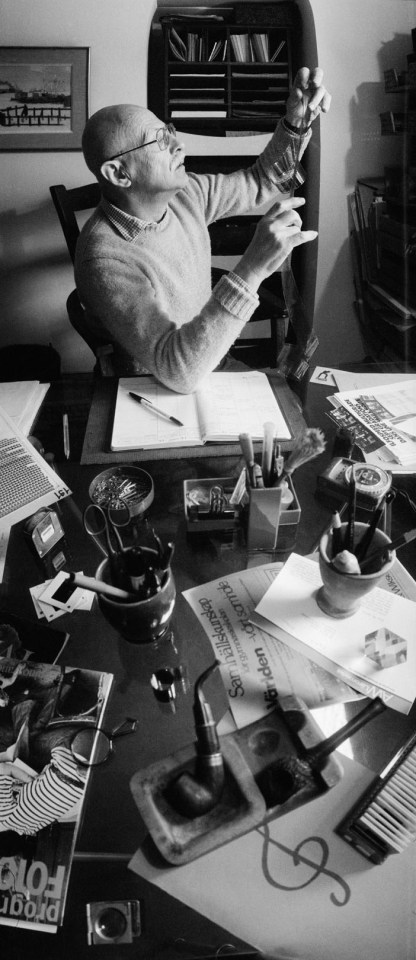
The fourth image, Self-portrait L’Isle sur la Sorgue 1978, continues this theme of him portraying himself as the established successful photographer.
Self Portrait, L’Isle sur La Sorgue Willy Ronis 1979
He is sat at his desk, studying a negative. The desk appears to be covered in the clutter associated with this position. I suspect it is carefully arranged and selected to show different aspects he wants to show. His diary is open in front of him – a diary of appointments will determine his activities and has a great importance in his life. There are collections of negatives and mounted slides, documents and journals in foreign languages reflecting his international status. A large treble clef is drawn on a page, part covered by other clutter – is this a memory of his original career plan, it appears incongruous otherwise.
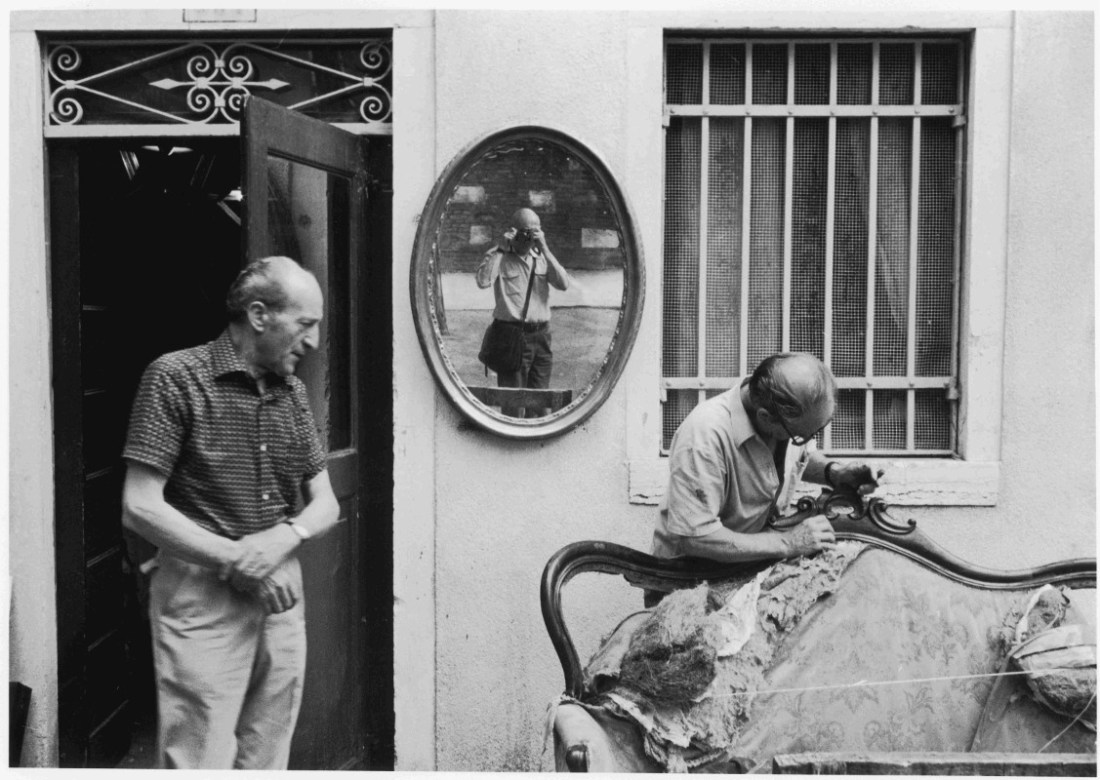
The final image is from Giudecca, Venice in 1981. He describes it as a “discrete self-portrait” as the image appears to be of upholsterers outside their workshop, but Ronis can be seen clearly in the centre of the image, reflected in a mirror on the wall.
Self Portrait, Giudecca Venice. Willy Ronis 1981
Ronis is seen, casually dressed, with his camera bag and small camera. He appears as what he started out as, a street photographer. He is not taking a large part in this image, which remains that of the upholsterers and otherwise looks like one of his early images from Paris. His presence is discrete – as it needs to be for a street photographer. I consider that this reflects Ronis portraying himself as how he started and how he wanted to be seen towards the end of his career.
4. Other learning points
There were many other aspects to this exhibition which influenced how I looked at these images. Many of them made me consider the “Decisive Moment” and I will refer to these in my account of Assignment 3 “The Decisive Moment”.
A further aspect to many of Ronis’s works is the sense of humour. I have mentioned this in relation to his Self-Portrait with Flash, however there are many more images which one cannot look at without smiling.
Exhibition Visit: I went alone to this as I was unable to attend an OCA Study Visit and the curator-led visit I had planned to attend was cancelled. This was unfortunate and meant that I might not have gained as much from the visit as I had hoped.
The Exhibition “celebrates northern photography across five decades”. Included are images of studio and informal portraits, rural landscapes and urban/industrial scenes.
My objectives from the visit:
• To gain an insight into more contemporary photography
• To see the work of photographers who create images in similar geographical areas to myself
• To gain some ideas for use in my “Square Mile” project
• To visit an exhibition and try to understand the range of work shown and the rationale for inclusion
• To try and study the work more systematically to develop my own assessment/appraisal skills
The Works Daniel Meadows
The images included were made around 1972 and are of residents of Moss Side where Daniel Meadows was living at the time. He took free portraits of local residents and it is some of these which are shown.
They are black and white images in portrait formal. The subjects are against a simple dark background, the folds of the material can be seen. All are looking directly at the camera and seem to have a very “stiff” pose. This suggests to me that they are not used to having their photograph taken.
I was struck by an image of Teenager with Pram. At first sight this might appear to be a stereotypical image depicting teenage pregnancy/single mothers etc, however on closer examination it is clear that the pram contains a television and seems to be a way of transporting it!
I found these interesting images of people capturing a time and style. For me it was evocative of a period when I started taking photographs and used the same techniques.
Chris Harrison
The images shown were from his series “Under the Hood” and are studio portraits of Salford young men and boys made in 1994. They are colour images in a square format. The subjects pose against deep red drapes in what appear to me to be classical poses. These are offset by contemporary objects, such as their beer cans.
I noted that in many of the images one side of the subject’s face is in deep shadow, whereas in one the subject looks directly at the camera and is more evenly lit. In the subject’s pupil, I can see in the latter two light sources (flash and reflector ?) and only one in all the others. I am unclear as to what the photographer was trying to achieve here – I wonder if it is to show that although they have lost their hoodies, the subjects still do not show all their faces…
Tessa Bunney
The exhibition notes describe Tessa Bunney as a photographer of rural life, capturing the way landscape is shaped by humans. The images displayed are of domestic flowers of the British countryside. They are in colour in a square format. The colours are muted pastels and to me, seem reminiscent of paintings. One work is a montage of many such images, reminding me of some of the works of Andy Worhol.
What I learned from this, is that although the artist has shown images of the flowers, the story behind the images is of the domestic flower growers and changes in flower farming from small domestic production to more industrial scale, and now back to smaller farms again.
Lisa Dracup
The exhibition notes quote critic Michael Prodger as describing Lisa Dracup’s work as “not about capturing a particular moment in time but about timelessness. Her focus is less on something fleeting… and more on the long afterlife of places, plants and animals.”
The images shown are of taxidermied animals and birds. They are in a portrait format with a black background. I note that there are large areas in each image of this black background, and each subject in shown with great detail visible.
I was keen to see Lisa Dracup’s work as my thoughts about my work are that I want to depict more than the here and now, perhaps the “pre-life” rather than the “afterlife”. It is interesting to me to see how this timelessness is shown by the use of taxidermy.
Paul Floyd Blake
The images shown are from his series, “Give us a Sign” and are images of churches with signs outside, all with a humorous aspect. They are colour images in a square format. The colour enhances the visual impact of the sign, making it stand out from an otherwise, quite grey urban/suburban background.
I saw in these images how a single point of interest and the use of humour, can elevate an otherwise bland scene.
Matthew Murray
The images shown are from the series Saddleworth: Responding to a Landscape. They are large images, described as “metallic”. Many have traditional landscape compositions of woodland and moorland but they are striking because of the lighting.
I found it difficult to see how he achieved the lighting effects but have since found his description of this. “I photographed throughout day and many times throughout the night. When shooting at night I would light the landscape with artificial lighting, external lights, torches, car headlights, I wanted to interact and manipulate the landscape”. (Murray, M (2017) Matthew Murray’s atmospheric landscape images inspired by walks on Saddleworth Moor. British Journal of Photography 8765: 20-21)
Overall I found this a striking way to show the landscape of the moorland and woodland around me.
Phoebe Kielty
These are black and white images from her series “These were my Landscape”. They are of details from an urban landscape which produce almost abstract black and white patterns. While the object in the image can be seen and identifies, I found I looked at the pattern not the image.
I liked the way the detail in a landscape has been identified and the pattern created used to create an abstract appearing image.
Ian Macdonald
These are images of Cleveland taken over a several year period from the 1970s to the 1990s. They are black and white images of the industrial landscape and people of Cleveland.
I noted that the images of industry in the 1970s were highly lit and contrasty. The sites looked clean. I formed the impression that these images aimed to capture the spirit of the “white heat of the technological revolution” speech by Harold Wilson in 1963, rather than our current disillusion with industrialisation as adverse effects on society and the environment become recognised.
I noticed what might be a recognition of this in the images of traditional fishing boats and a rural landscape of the estuary, while in the distance industrial plants can be seen with chimneys and emissions which probably would not be acceptable today.
The image, Picnic at Fourth Buoy Sands, shows local people picnicking in such a setting. It reminded me of Cartier-Bresson’s image of Juvisy, France 1932 of working people having a working lunch in an apparently rural setting, but close to their urban work.
My overall thoughts and implications for my work
I set out my objectives for the visit above
• To gain an insight into more contemporary photography
My notes above summarise the insights I have gained. I think this is a start, but find it raises more questions for me than answers. I now have other sources to look at and other work from these artists
• To see the work of photographers who create images in similar geographical areas to myself
I have seen this and commented above, however have observed that time is as important as geography even over a period of 50 years. “The past is a foreign country: they do things differently there” (L P Hartley) has particular resonance for me in the light of these images.
• To gain some ideas for use in my “Square Mile” project
I have outlined above how I see these are relevant. I found most resonance with Ian Macdonald’s work and my own aspirations. However, I felt the images shown very much reflect a period in time, and my current work on “Square Mile” must deal with post-industrialisation and its consequence on the landscape.
• To visit an exhibition and try to understand the range of work shown and the rationale for inclusion
I have looked at some aspects of this, but clearly have a long way to go in this
• To try and study the work more systematically to develop my own assessment/appraisal skills
I have tried to look at each image systematically, but do tend to concentrate on my comfort zone and look at the technical aspect of the image, although I am beginning to understand elements of the intentions of the photographer.











 Andrew Procter