Zoom Meeting 25 August 2020 – Assessment

Zoom Meeting 25 August 2020 – “Assessment”

Led by Robert Bloomfield

This was the first meeting with Robert since a break over the summer period. As the deadline for the November assessment event is approaching, the topic was “Assessment”.

Only two of us were planning to enter for assessment, although following discussion a number of others were encouraged to do so, rather than leave it to the next event.

Robert went through the assessment criteria and described the process for digital assessment as it was used in the last event, and will be done in November.

He listed the material which we are required to submit. The main learning point and his very strong message was that for this course the key work to concentrate on is the images which are to be submitted.

He re-iterated what I had gathered from the discussion with my tutor, that a selection of images is needed, and these can be from assignments or exercises.

I asked a question about the linking of images. For the exercises and particularly the assignments, there is a theme linking the images making them a series. While we have had discussions in the past about what constitutes a series, I remain somewhat unclear about this. However he suggested that images could be combined into composites images, in a similar way which my tutor had suggested pairing them.

We had a more general discussion about Exercise 1.4, which was very helpful. In particular a question Robert asked about images in general..

“How do you notice that thing you have never seen before?”

To me this seems to capture an issue I am having generally about the work and creation of images. I think I tend to over plan the image I am hoping to create, and a more spontaneous style will lead to more unexpected results.
OCA North Zoom Meeting: 5 July 2020

OCA North Zoom Meeting: 5 July 2020

This meeting was the first of a regular monthly zoom meeting to replace our previous meetings in person in Halifax.

There were only 4 of us able to be there, and we each gave a presentation of our work at the moment.

I was able to discuss my plan for Exercise 5.1, and had encouragement with that from the others who thought the area I was trying to depict sounded interesting.

The biggest learning point for me, was the presentation of his work by Michael Millmore who discussed the work he has been doing and posting on Instagram. He is writing an essay at the moment and exploring the use of social media sites and how these affect the presentation of visual images.

These ideas resonate with thoughts I have been having and I have incorporated into my objectives for the medium and longer term of my studies.

Susan Bright: Collaboration & Creative Practice

Virtual study event: Susan Bright | Collaboration & Creative Practice

2 June 2020

Open College of the Arts, Photography & Moving Image, International Guest Lecture:

Susan Bright | Collaboration and Creative Practice, Followed by in conversation with Arpita Shah and Dan Robinson.

I watched the on-line lecture by Susan Bright and attended the conversation session

From the OCA description of the session:

Susan Bright is a curator and writer based in Paris. She has curated exhibitions internationally at institutions including: Tate Britain, The National Portrait Gallery in London and The Museum of Contemporary Photography, The Photographers’ Gallery and the Foundling Museum Chicago amongst others.

This lecture asserts that photographic practice is inherently collaborative…Drawing on recent projects where she has developed relationships and friendships with artists, writers and editors, Bright considers what curating can be and its possibilities when working with others. Examples including Elina Brotherus’ solo exhibition Playground and her Guest Curation of PHotoESPAÑA 2019. Both projects highlight the in-flux nature of her work and the various roles a curator and her collaborators play.


From this lecture I think I gained a better understanding of the role of the curator – both in an institution and, like Bright, as a freelance curator.

A second aspect of this was the interplay between curator and artist – which in the course of the conversation after her lecture, she described as analogous to that between and writer and editor. ie a collaboration to produce the finished works.

Zoom Meeting 26 May 2020 – EYV Padlet

Zoom Meeting 26 May 2020 – EYV Padlet
Led by Robert Bloomfield

In recent weeks there has been a number of emails and notifications from the OCA regarding arrangements for improved distance working in part it would seem as a general development of the courses and also as adaptation to the COVID-19 pandemic. In his emails prior to this meeting Robert had described part of this work involving the establishment of a Padlet to support EYV.

I have previously come across padlets to support the OCA North Group and enable sharing of work when we are unable to meet in person.

( https://oca.padlet.org/emma516150/go12xthllg7r20p7)

However I am generally unfamiliar with the concept and how best to make use of them.

I had examined the EYV site (  https://oca.padlet.org/robertbloomfield/eyv)   prior to the meeting. During the meeting Robert shared his screen and showed how he had set up the layout of the padlet but was seeking opinions as to the best way to use it.

There was some discussion about this and I familiarised myself with the new layout.
Robert suggested incorporating links to sites with useful podcasts and other general material can be found. Other students suggested
https://mackbooks.co.uk/pages/live
https://grainphotographyhub.co.uk/portfolio-type/online-talks-programme/

My objectives from this meeting are to:

  • Visit the EYV Padlet regularly
  • Use the materials there
  • Contribute to discussions
  • Share my work as appropriate
  • Access the sites suggested for podcasts etc for useful background reading/learning


Library Webinar 27 May 2020 – Referencing Software

Library Webinar 27 May 2020 – Referencing Software

Led by:
Matthew Parfitt – UCA Epsom Campus
Ian Badger – UCA Canterbury Campus

Objectives and Content
Overview of types of referencing software
Creating Paperpile account
Using Paperpile
Adding references
Creating bibliography
Other features

My reaction to this session
I have previously recognised that I need to have a more structured and systematic approach to recording work which I reference in my research for this course. Because of my previous research experience (PhD thesis and post-doctoral research in bio-medical science) I am aware of the need for a system for this and that need will continue throughout this undergraduate course. I have therefore identified this as a learning and developmental need.

Matthew and Ian gave an introduction to Paperpile, the reference managing software supported by the UCA/OCA. They also mentioned Zotero, which is a locally held database, rather than a web-based system.

During the course of the webinar, I was able to set up a Paperpile account and explore the basic functions they described.

As this software has support from the UCA/OCA library, it is my intention to use this and incorporate it into my learning log.

OCA North Meeting: 12 January 2020


OCA North Meeting, Halifax 12 January 2020

Venue: Fletcher’s Mill, Dean Clough, Halifax

The plan for the day was:

  • a presentation on her work by Miranda Richmond
  • general discussion
  • presentation by participants of their OCA work

I have previously read a little about Miranda Richmond’s background and work, and have described this in my log.

Presentation by Miranda Richmond
Miranda described several aspects of her work. These included her work produced during a recent residency on Iona. She also described her influence by her late husband the artist, Miles Richmond; and in turn his influences including Bomberg. She described this as “English Constructivism”.

She referred to a principle advocated by Miles to “find a subject that is too big for you”. My understanding was that by doing this it forced you to look at the entirely of the subject. Thereby it may be possible to get a sense of the “essence” (my term) of the subject rather than focus on small details.

Miranda also brought along her sketch books and it was helpful to see how work produced in the field was translated into a sketch. I have tried using sketch books in the past and found difficulty in that I try to produce a “finished” image. I saw that this is not the purpose but rather to capture key points to develop further later.

General Discussion
There was a general discussion about future meetings, the direction of the group and the possibility of an exhibition.

Presentation of OCA Students’ work
Several students presented their work from the textiles courses.
My Aims and What I Learned
I had similar aims from attending to those for previous meetings.
Practice my assessment and appraisal skills
Gain a better understanding of other art disciplines and influence on photographic work

Seeing the work of Miranda Richmond and hearing her describe her approach and the background to it, enabled me to understand a little better what an artist is trying to show by more abstract images.

New Objectives

To find out more about the work of Miles Richmond and Bomberg, as well as the school of “English Consructivism”.

To try and use sketch books again to help my visual skills

Zoom Meeting 08 January 2020: New Year – New Work Resolutions

Zoom Meeting 08 January 2020 – New Year – New Work Resolutions
Led by Andrea Norrington

My notes for this meeting are in my Rocketbook notebook – and Andrea’s presentation is available on the OCA forum.

Andrea gave a presentation on study techniques with particular relevance to photographic studies. I thought that the suggestions were very useful and these included techniques for dealing with
Creative block
• repeating exercises or doing other exercises
• taking photographs generally, not necessarily of relevance to the course
• reading – of any subject matter, again not necessarily relevant to the course
Procrastination
• set a time of 25 minutes to work on a topic
• making this the first task of the day
Setting aside a regular time slot for revew and reflection – weekly or bi-weekly
As a result of this meeting my objectives are
1. Setting aside my time for regular reflection and review
2. Preparing an overall time plan for the rest of my course with projected deadlines

Zoom Meeting 29 December 2019 – Wabi Sabi


Zoom Meeting 29 December 2019 – Wabi Sabi

Led by Robert Bloomfield

My notes for this meeting and my reading before it, are from my Rocketbook notebook

19-12-29 Zoom Wabi Sabi  Wabi Sabi Reading


Before the meeting:

Prior to the meeting I briefly researched the concept of “Wabi Sabi”, with which I was previously unfamiliar. My research was fairly brief and based largely on Wikipedia (https://en.wikipedia.org/wiki/Wabi-sabi  accessed 08/08/2020).

This suggested that the concept of Wabi Sabi has its origin in the Buddhist concepts of the “three marks of existence”

  • Impermanence
  • Suffering
  • Emptiness/absence of self nature

The characteristics of the Wabi Sabi aesthetic include

  • Roughness
  • Asymmetry
  • Simplicity
  • Economy
  • Modesty
  • Austerity
  • Appreciation of the integrity of natural objects and processes

Western artists who have incorporated the principles include John Connell and Jesse Richards.

I looked at some of the work by Jesse Richards, who the Wikipedia article indicates also used the concept of Mono no aware – an empathy towards things and acceptance of their impermanence.

Jesse Richards (https://www.jesserichardsfilm.com/  accessed 08/08/2020) is “a New England based filmmaker, photographer and artist. Former member of the Stuckists, founded the Remodernist Film Movement,  co-founder of Cine Foundation International, founder and artistic director of Art Secession Cabal”.

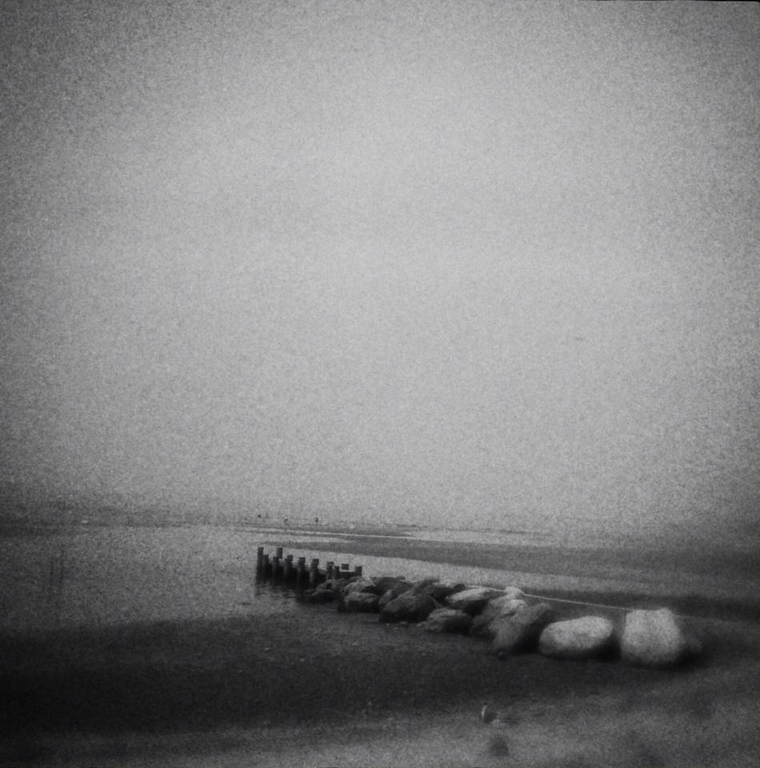
His work includes images created with “toy” cameras including pin hole cameras. I found this image particularly striking.

Harvey's Beach, Old Saybrook, 2015
Harvey’s Beach, Old Saybrook, 2015. Jesse Richards

I considered that it showed aspects of Wabi Sabi in terms of both the image itself, which is imperfect and blurry  and the subject matter which is a simple composition of a desolate beach.

It was this separation of whether the image or the subject shows Wabi Sabi which I found particularly interesting.


The meeting:

Robert gave a presentation expanding on the concept of “Wabi Sabi” beyond my brief reading.

He confirmed that origin of the concept from Buddhist principles of impermanence and mono no aware.

Of particular interest to me was his proposal that Wabi Sabi is an aesthetic category analogous to that of classical “beauty” which he had discussed in an earlier talk. He invited the students to suggest others. The list included

  • Picturesque
  • Sublime
  • Realism
  • Abstraction
  • Surrealism
  • Hyperrealism

This discussion was very helpful to me and I realised that there are many different frameworks against which a visual art work can be appreciated – this was something I had not really considered before and will be something I need to study more.

Robert suggested other artists to research in this area.


Objectives:

As a result of this meeting and the works discussed my objectives are

  1. Read more about aesthetics and categories
  2. Examine the works of artists discussed
    1. Edward Hopper
    2. Wolfgang Tillmans
    3. Daido Moriyama


Zoom Meeting 26 November 2019 – Improbable Images

Zoom Meeting 26 November 2019 – Improbable Images
Led by Robert Bloomfield

My notes for this meeting are from my Rocketbook notebook

26-11-19 Zoom Mtg Improbable IMAGES

Robert gave a presentation expanding on the concept of “improbable images” as described in the course notes. This is based on the principles outlined by Vilem Flusser in “The Philosophy of Photography”.

That is, the concept of the photograph alters from that of the memento (“people who look at a photograph naively photographs represent the world”) to a more generalised unique type of image (“representation of the world no longer depends on direct experience but on interpretation of previous images or representations that already exist”).

As a result of this meeting and the works discussed my objectives are

  1. Read Flusser’s book “The Philosophy of Photography”
  2. Examine the works of the artists discussed
    1. Steele-Perkins
    2. Tomasz Windland
    3. Re-examine Hokusai’s work

Later thoughts on the meeting

Overnight I thought more about the meeting and some of the issues Robert had raised.

  1. Some of the images Robert showed included areas of white, lacking detail, and he emphasised the importance of these in the composition, adding a sense of ambiguity to the overall  image. This reminded me of the concept of “kindly vacancies”  introduced by John Ruskin in his work “On Modern Painters” and referred to by Rachael Talibard in the talk I heard her give.
  2. Robert had made many of his images with film and he emphasised the ability of film to enable the photographer to make images other than those which are our original intention. With digital cameras we are able to review the image immediately and may discard those that do not meet our plan, whereas some of these discarded images may have features making them of significance. This to me was reminiscent of the principle employed in the “Nine Eyes of Google Street View” by Jon Rafman, whereby captured images become art works because of the selection process by the artist.

Zoom Meeting 20 November 2019 – Learning logs

Zoom Meeting 20 November 2019 – Learning logs
Led by Andrea Norrington

My notes for this meeting are in my Rocketbook notebook

ZOOM MTG 20-11-19 LEARNING LOGS

Andrea summarised the concept of the learning log in terms of what happens between doing the coursework and assignments. The write-up of the learning log is all the posts on the blog that do not directly relate to these other elements.

As a result of this meeting my objectives are

  1. Look for and read the David Hurn book “On being a Photographer”
  2. Apply the process described in there and summarised by Andrea of identifying topics to be covered in a project ie planning and then take images to support these topics
  3. Use the 30 second rule to summarise learning experiences
  4. Andrea suggested an open post to compile a bibliography for all references and sources referred to in the blog. Another student suggested the use of “Paperpile”, “Zotero” or “Evernote” to compile bibliographies as did Andrea . I recognise that I need to have a more systematic way to record these and show on my website.