Miranda Richmond: Proposed speaker for OCA North Group
The three students who organise meetings for this group invited others to help and I have volunteered to improve my knowledge of and involvement in the activities of the OCA more peripheral to my course.
I have found that this gives me a forum for discussing and considering other art disciplines, for example when planning speakers for forthcoming meetings.
One suggestion has been the artist, Miranda Richmond who is currently exhibiting at Dean Clough. This meant that I needed to research her work in order to be better informed as to what to get out of the next study day.
Also her entry on the gallery site http://colonyart.co.uk/artist/miranda-richmond/ (Accessed 17-11-2019)
says
“Her works are usually produced on location, which enables a direct and immediate response to the subject. “
I would be interested to hear how this immediacy relates to her works and how that might be relevant to us photographers who also produce the main part of our work on site.
I will add an update to this following the study day.
The plan for the day was:
• a presentation on his work by tutor, Andrew Conroy (photography tutor)
• general discussion
• presentation by participants of their OCA work
Presentation by Andrew Conroy
Andrew described several aspects of his work. These included a project he has been undertaking for some time about Orgreave, documenting the present state of sites of significance during the period of an active mining industry in these areas. To this end he also showed images of a series of walks he did around Barnsley including former coal mining sites. A theme here was the “re-greening” of these areas – often with little reference to their former uses.
He also described his collaborations with other artists and how his work has then been modified and adapted to create something new.
General Discussion
There was a helpful discussion about “research”, and writing, with particular relevance to the more advanced courses.
Presentation of OCA Students’ work
Several students presented their work). I presented the images I had prepared to date for Assignment 3, Decisive Moment.
Other photography students (Level 2 and 3) presented their work, and there were a set of 4 paintings by another student.
My Aims and What I Learned
I had similar aims from attending to those for previous meetings;
To gain a greater understanding of studying with the OCA
A major point I learned is that there is a librarian for the OCA who is available for advice regarding literature searches and databases of journal etc. This is something I have struggled with greatly since studying with the OCA. I am familiar from bio-medical research with various search techniques but have failed to find these for the arts discipline and resorted to general search engines such as Google, which I think does not have the academic validity of other methods.
Practice my assessment and appraisal skills
I was able to give feedback on four abstract paintings. Of note was that the student presenting the work has four very specific questions to structure the feedback around. I found that I was able to make, to me, apparently sensible and it seemed helpful comments for her. I relied to some extent also on criteria described by Grayson Perry in his book “Playing to the Gallery”, albeit I think a little tongue in cheek.
Gain a better understanding of other art disciplines and influence on photographic work
The collaborative work of Andrew Conroy demonstrated to me how other arts disciplines can use elements of photographic images to create new novel artworks, probably classifiable as “visual art” rather than any more specific discipline. However, his collaboration was not limited to visual art, but also included images as part of a work with a poem, analogous to the collaboration between Fay Godwin and Ted Hughes, Remains of Elmet.
To present my own work and get feedback on it
I took contact prints and prints of the six images I have shown on here.
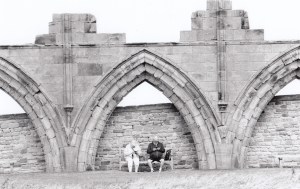
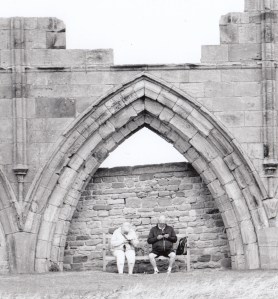
Suggestions were to crop image 2019-09-17 #02-13
2019-09-17 #02-13
2019-09-17 #02-13: Cropped
– my own thought is that cropping closer to the couple on the seat implies they are more important than the setting and pattern of the arches, and I will leave as it is for now.
There was a comment about the “tactile” quality of the prints, perhaps particularly because of size and the texture of the paper (pearl finish). This highlighted to me the significance of the uniqueness of a hand printed image.
The image 2019-07-30 #22 was described as “having a lot going on” to the lower left side and I agree this does make it difficult to work out where to look at the image. Its composition does not lend itself to easy examination.
The topic for this meeting was “Portraiture”. Robert explained that although previous meetings had been around the topics of assignments he thought this more general topic was relevant to many parts of the EYV course.
Robert gave a presentation based on some theoretic aspects of portraiture drawing on examples of the styles of various artists/photographers.
These included Irving Penn, notable for his studio portraits using ambient light with reflectors.
Jean Baptiste – referred to in the notes for the course.
He also described the concept of “Rembrandt Lighting” , a style of lighting the face with one side lit, and one side in shadow. This in turn gives prominence to the nose shadow. This lighting arose because of the design of Rembrandt’s studio with a single high window, which was north facing so gave a diffused light, diffused even more on occasions by translucent paper across it.
The other concept he referred to was styles of pose for the models, including the classical style “contraposto” where the model’s weight is more on one leg than the other, leading to a curve in the body with the hip thrust out. This is exemplified in the Venus de Milo from classical times and Michaelangelo’s David.
Overall these were the key things I learned from this, but the main lesson was that formal portraits are very much a constructed image, the dress and pose of the model, together with the lighting and background establish an image the photographer wishes to create. This is in distinction to me from the candid images of people taken by street photographers. Although there is clearly an overlap, as the documentary showing Don McCullin working (which I have described elsewhere) demonstrated his rapport with the subject by which he was able to create the image he sought.
This meeting was led as usual by Robert Bloomfield and the topic was “ Languages of Light” and Robert planned to discuss Part 4 and the 4th Assignment.
There was a presentation of work by two students who were about to submit their work for the 4th assignment and had both chosen to do this on “The Beauty of Artificial Light”. There were two aspects of the discussion about these images which I found particularly interesting as they had themes which I have been considering.
The first of these was an image of someone looking at their mobile phone at night, illuminated by the light from the screen and the reflected light from outside lights. The quality of the two types of illumination was strikingly different, in particular with regard to the colour temperature of the light, the phone was a very blue/white light and had a stark quality to it, whereas the external light, although from an LED light had a warmer, softer quality as it was reflected off other surfaces. I had previously been considering how ubiquitous objects with light sources have become and how these influence our environment. I have started a consideration of this in another post and may develop it further for my assignment.
The other aspect of the student work which I found interesting was an image of a tower block with a sign across the windows. The wording was very prominent and gave a strong message in the image. However there were other aspects of the image which could be interpreted in many different ways. The incorporation of words into images is something I have considered before, and an area I need to research and consider more.
Robert gave a presentation about the concept of “Beauty” with the aim of making it a less subjective concept. He gave a historical view of the classical construct of “beauty” which equated to “perfection” and as such had a generally agreed definition and was not therefore subjective. However he then described the attack by the suffragette, Mary Richardson, on the “Rokeby Venus”, a painting by Valaquez in the National Gallery. My understanding of the rationale she gave for this was that the picture was an depiction of “beauty” but her own concept of beauty included the concept of “justice”, which she saw as missing from the contemporary treatment of women.
My own thoughts on this are that while the incorporation of other constructs besides perfection are important, there remains then an element of subjectivity as across societies, different people and groups are likely to have different understanding of concepts like “justice”, and value other constructs as defining beauty. For example in many elements of modern society, an artificial light source could only be considered to demonstrate “beauty” if it does not harm the environment.
Following the meeting I have briefly researched more about the attack on the Rokeby Venus by Mary Richardson. A description of this is at:
Richardson is quoted as saying “I have tried to destroy the picture of the most beautiful woman in mythological history as a protest against the Government destroying Mrs Pankhurst, who is the most beautiful character in modern history. Justice is an element of beauty as much as colour and outline on canvas”
There are other aspects of this painting and its subject which may have made it a target for such an attack as Richardson is quoted as saying several years later “I didn’t like the way men visitors to the gallery gaped at it all day”. Furthermore in the article, the authors cite descriptions of the painting as “’a body for Don Juanesque fantasies’ in a country (Spain) in which extreme machismo was the hallmark and women were regarded as ‘inferior, voiceless and … easy prey’”. This suggests to me that at the time of its painting the concept of beauty in that society included these aspects too. All of which shows how the subjectivity of the concept is influenced not only be an individual’s taste, but also societal values.
Other sources and writers to which Robert directed us in the meeting include Susan Sontag, “On Photography” in which she examines the development of the photograph beyond being a idealised image, and thereby a development of a set of aesthetic values by which a photograph can be judged. This is something I need to read more about.
EYV Online Meetup 28 June 2019: The Decisive Moment
Led by Robert Bloomfield
The topic for this meeting was “The Decisive Moment”, the title of the third assignment on EYV, and my next assignment.
In a previous post I have described my initial thoughts about this topic. For the meeting we were encouraged to bring images to discuss in terms of the “Decisive Moment”. I described my thoughts about compositional decisiveness and narrative decisiveness. Robert suggested that the latter is an extension of Cartier-Bresson’s original concept, but one that has been considered by others. He referred me to the writings of David Bates on this.
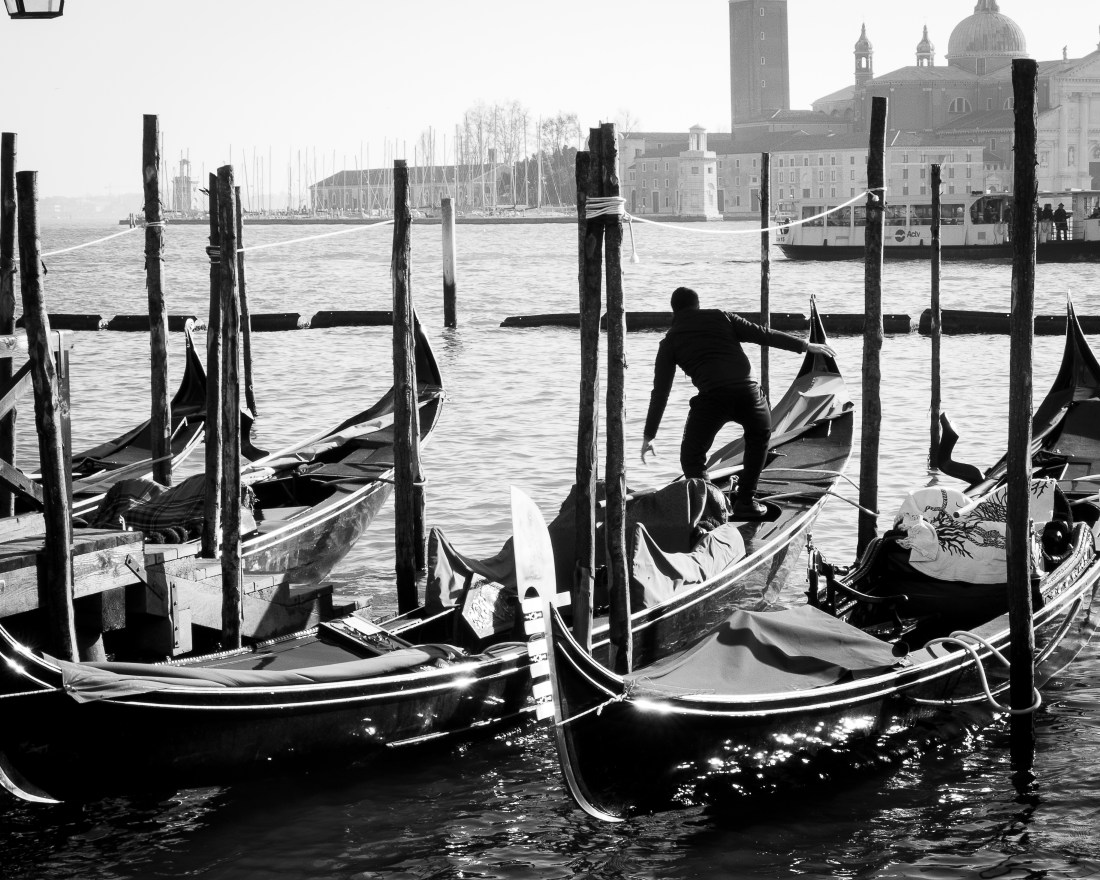
Robert discussed and introduced the concepts of “architectural framing” and “gesture” as characterising the Cartier-Bresson “classical” (my quotes) decisiveness. He pointed out the framing of the figure by the posts and suggested this is a type of architectural framing. He also commented on the posture of the figure, as representing “gesture”. This was a helpful discussion and helped me to understand the way forward with the assignment.
We discussed the use of film for the assignment. I am considering using this medium in order to avoid the temptation to use high speed continuous shooting to obtain the precise moment of decisiveness!
The other learning points I took away are suggestions for further reading including “Camera Lucida” by Roland Barthes.
EYV Zoom Meeting 21 May 2019: Photography is Simple
Led by Robert Bloomfield
This was the second of these meetings I have been able to attend and found the previous one very helpful but omitted to keep notes and record it here on my learning log!!
The meetings are described as:
“This is a new, supportive space for students to meet and share course experiences with each other and the Unit Leader, and to ask any burning questions.”
The topic for this meeting was “Photography is Simple”, the title of the fifth and last assignment on EYV.
I had not had the opportunity to give much thought to this as it is some time in the future and in recent months I have had an enforced gap in my studies for the course. My preliminary thoughts and approach on the subject was to look at the dictionary definition of “simple”. This definition includes two uses of the word “simple” which encompass
easily understood or done and presenting no difficulty and
plain, basic or uncomplicated in form nature or design
So, for example, the work of and artist like Rachael Talibard is not easily created – she goes to great lengths to make her images of storms, both in the planning and her positioning to make the image. However the images appear easy to understand – they are just what they appear, photographs of waves making patterns. On the other hand, the work of someone like Guy Bourdin may be easier to create but with its basis in surrealism is more difficult to understand.
In the meeting I presented this idea, and appeared to have some support for that view.
Other concepts were introduced by Robert Bloomfield with which I was not familiar and fnding out more about these are my objectives to do more work on.
The most significant of these ideas for me was the concept of photography as a mirror or window. In the former the photographer projects himself to the world (Robert associated the work of Francesca Woodman with this approach) and in the latter the world is “explored in all its presence and reality” – a concept attributed to Paul Graham.
The other major learning experience for me was the discovery of the course reading list! As it was at the end of the notes and not referred to earlier, I had not seen it up to now. My next work is to look at some of the suggested works from this.
This was the second of these meetings I have been able to attend.
The plan for the day was:
a presentation on her work by tutor, Dr Rachel Forster (drawing and creative arts tutor)
general discussion
presentation by participants of their OCA work– three students (myself and two others presented their work). I presented the images I had put on my website for the “Frozen Moment” exercise, as the latest work I have done for my course. There was a presentation of an exercise in progress by a textile student and another of images depicting “forgetting” by a level 3 photography student.
I had several aims from attending.
These included general aims similar to those I had for the last one I attended in Leeds, which was to gain a greater understanding of studying with the OCA. In addition I had aims based on my objectives I have described in my plan
Assessment and appraisal skills – how to critically assess a piece of work, including that of others as well as my own.
There were opportunities to see photographs of the work Rachael and the prisoners had produced. I found that as these were mural paintings and so it was interesting to evaluate these. One point I was interested by was the incorporation of emotionally loaded words in wall coverings for spaces for psychological therapy/work. I have seen this in many other settings and I am unclear why it seems to be considered important in a primarily visual medium. When I asked about the rationale Rachael said it was the one element specified by the group commissioning the work (the psychology department!).
Similarly the presentation by the other students enabled me to see and discuss other styles and media of work.
Gain a better understanding of other art disciplines and influence on photographic work
I think the day has helped me primarily in this objective. In particular, the presentation and discussion led by Rachael Forster was around the development of murals and other artworks by groups of prisoners. The discussion was around the effects of art on both the observer and artists and the effect of art work on spaces.
The presentation of work by a textile student was of a medium very different from photography. However there are elements of shared understanding around colour and texture particularly, and the differences seem to be mainly in technique rather than purpose and output.
My personal development in the Assessment area of “Demonstration of creativity – Imagination, experimentation, invention”
I do think that my own development of imagination has extended by looking at examples of what can be achieved and also the use of techniques other than photography.
Another aim of the day for me was to present my own work. I wanted to be able to explain what I was trying to achieve and then get feedback on this. Up to now I have made images and while they are on my website, I have rarely actively sought reactions from others about them. There is an element of desensitisation involved in this for me. I think I do make the images to share; if I believe in them then I need to share them!!
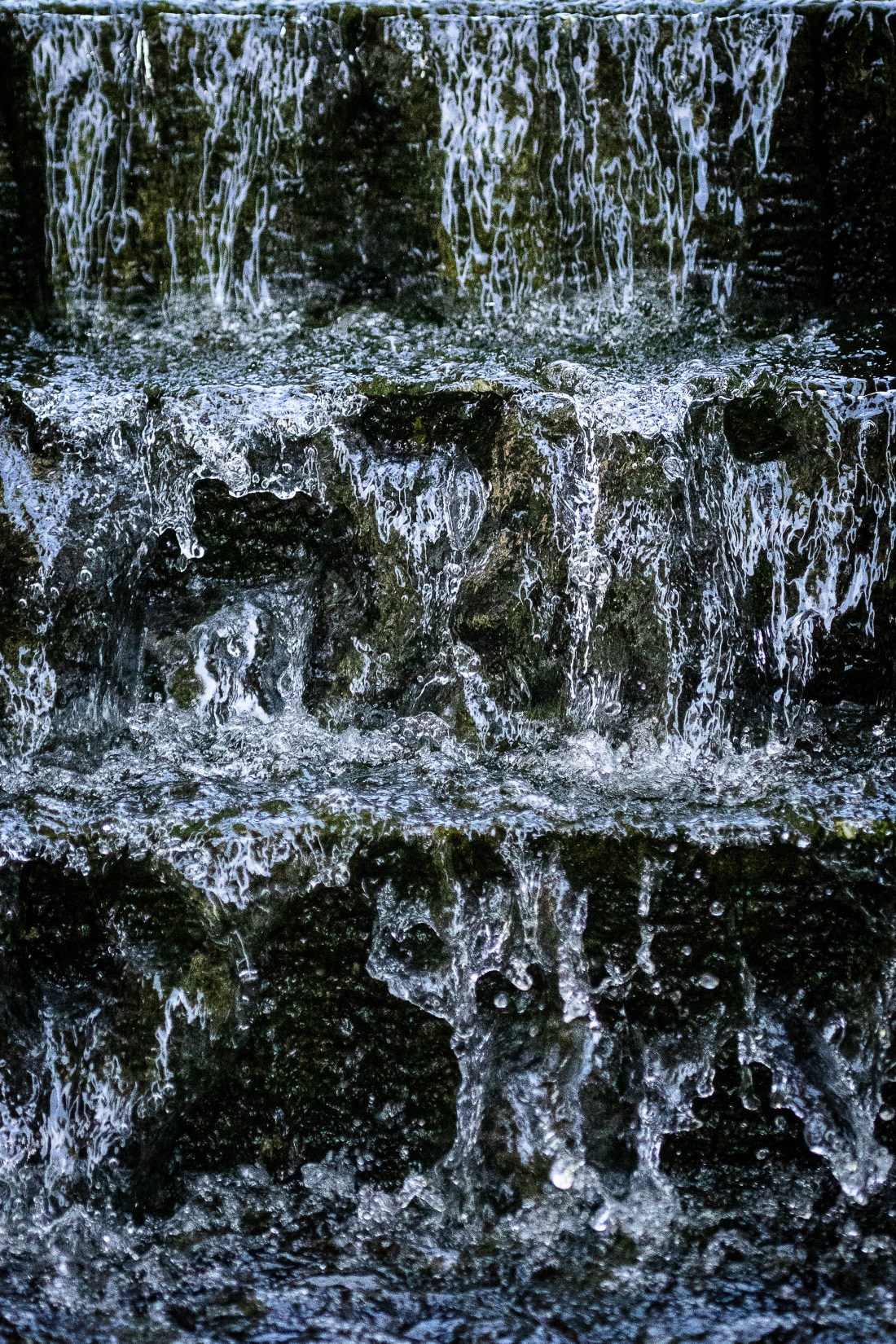
This was the first time I have done this. I think I was able to explain the rationale as to how I approached the exercise. The feedback was positive, and I was pleased that others appreciated the same aspects of the images of the fountain which I did. In particular the quality and nature of the light as it illuminated the droplets of water. The moss on the fountain has a distinct textured effect which was appreciated particularly by the textile students.
For improvement the suggestion was made to crop one of the images to make it more removed from context and more abstract. I had been thinking this myself, but kept it in to show the setting for the later pictures. However the cropped image is very effective and making it more abstract enhances the appearance of the shapes revealed by the fast shutter speed:
This was the first meeting of this group and my first physical contact with others from the OCA. I have only just started my studies with the OCA so was unsure what to expect.
There were three elements to the day.
Introductions to other students and tutor, Andrew Corby
Presentation of the results of a survey of OCA students about what they wanted from a study group and discussion as to how to progress with future meetings
Presentation and critique of work brought by some of the students
What I learned and gained from the day:
The majority of students were studying photography. Many of the students are taking more advanced courses than me, but it was helpful to hear about their experiences when they were at the same stage as me.
I saw other students’ work in the development stage and began to see how that process is working for them.
Hazel Bingham showed some of her work for her Level 3 project “Neoliberalism in the City” . I was able to discuss this with her and Andrew Corby.
Relevance to my work and study:
I am at an early stage of my study with the OCA and more pre-occupied with the process and techniques of studying rather than the subject matter itself.
I learned that my confusion over communication systems is common among students as there are several systems in place. The “hangouts” groups are used by students for informal discussions and I have since located how to access these and checked that hangouts works on my computer!
I have also a better understanding of the process through which students develop their work. Having seen the work brought to the day, I have a better understanding of the physical presentation of the work as well as the intellectual process for the development of it.
Hazel Bingham gave me a link to her blog and I have been able to look at that and other examples to see what is needed in a learning log.
Andrew Corby interpreted Hazel’s work in the context of neolibralism and the appropriation of old buildings. My plans for my “Square Mile” project are to examine the the re-use of old buildings and sites and this may be of relevance. I will re-examine this as my thoughts are more developed about my project.
 Andrew Procter