Miranda Richmond: Proposed speaker for OCA North Group
The three students who organise meetings for this group invited others to help and I have volunteered to improve my knowledge of and involvement in the activities of the OCA more peripheral to my course.
I have found that this gives me a forum for discussing and considering other art disciplines, for example when planning speakers for forthcoming meetings.
One suggestion has been the artist, Miranda Richmond who is currently exhibiting at Dean Clough. This meant that I needed to research her work in order to be better informed as to what to get out of the next study day.
Also her entry on the gallery site http://colonyart.co.uk/artist/miranda-richmond/ (Accessed 17-11-2019)
says
“Her works are usually produced on location, which enables a direct and immediate response to the subject. “
I would be interested to hear how this immediacy relates to her works and how that might be relevant to us photographers who also produce the main part of our work on site.
I will add an update to this following the study day.
“Dave Butcher is a black and white specialist with a worldwide reputation for his landscapes and city shots. He is an Ilford Master Darkroom Printer and still exclusively uses medium format Mamiya 7 film cameras and makes traditional silver gelatine darkroom prints.”
Dave “worked for Ilford Photo Ltd. for 21 years… This included as a photographic research scientist, technical service manager, regulatory affairs manager and project management… (he) managed the Ilford photographic printing department, and setup and edited some Ilford technical newsletters.”
Dave began the workshop with an overview of the techniques he uses for printing. These included various types of toning which are techniques I have not used before. He also described the main technique he was planning to demonstrate in the workshop – that of split grade printing. This is a technique new to me, and involves making a print on multi-grade paper with two exposures using different contrast settings. In this way the high contrast exposure can ensure the black parts of the image have a dense black, while the low contrast exposure ensures an adequate range of mid-tones in the image.
In the darkroom, Dave demonstrated printing one of his images in this way and then we printed some of my negatives.
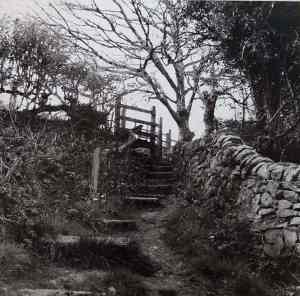
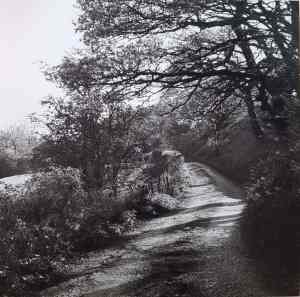
I had identified a need to improve the quality of the printing and am very happy with the greater contrast and range of tones in the final 14×11 inch prints. I have scanned these and reproduce them here, although the quality of the reproduction in this way does not show the detail as well as the actual print.
Hague Lane 2. Silver Print 28cm x 33cm
Towards Pingot Lane 2. Silver Print 28cm x 33cm
I think that my objective of improving my film processing and printing skills has been met and now I need to practice and review any further learning in this area. I have also been able to print some images which I may include in my next assignment “The Decisive Moment” and aim to submit this in this medium.
The information about this meeting described Peter Aitchison’s career:
Peter began his photographic career some 30 years ago, training as a studio assistant and having decided that studio work was not for him, his career progressed into PR and national press photography, including time spent as a Royal Rota photographer.
Travel, which Peter enjoyed enormously, was a fundamental part of his newspaper work and it was a natural progression for him to subsequently follow his passion to work on his collection of travel images. He currently hosts international photo tours, together with photo walks in Manchester.
His talk started with an introduction to his career and then he presented some of his images of India, and Cuba, reflecting their culture and people. In the afternoon session gave a presentation on Manchester street photography.
His travel images appear to me to form three broad types: showing scenery and architecture, groups of people and more formal portraits of a person in their normal setting. I have tried to describe important aspects of the presentation which I learned.
The first of these is to do with the style of his images. He said in his presentation that the incorporation of colour and texture was important, and it is clear from the images on his website that the colours in his foreign images are particularly vibrant. He did not describe how he achieves this, but did imply that he uses post-processing techniques to emphasise this aspect.
Many of his portraits are in black and white and he said he chooses to show an image in monochrome when there are particularly strong textures, particularly in a face.
One aspect of his slide show which was quite striking was his choice of framing of the image. All the images he showed had a black border with a white surround. He explained that this was a customised format he used in Lightroom, but he did not elaborate on his choice of this style. However to me it made the images have a style reminiscent of those of Cartier-Bresson, all edged with a black border.
A second aspect to his work was his description of his technique when taking portraits in the street. He emphasised the importance of engaging with his subjects by involving them in conversation and showing them the image on his camera. This seems very similar to the approach also described by Don McCullin which I described in my account of a television programme about this.
Another interesting theme from his presentation was that of the ethics of taking images in the street in candid and informal setting. He stressed his practice of being very open and obvious as to what he was doing and considered using telephoto lenses from a distance to take images of people “stealing the picture”.
A further ethical issue he considered was the approach to taking images in situations like the slums of Mumbai. He supports an educational charity for the children of the slums for his trips. He said he takes images of “happy” people, and avoids images of rough sleeping which he considers “poverty porn”. There seems to me to be a major ethical debate here about ethical tourism, rather than documentary photography. This is a subject I will consider in future posts (maybe in future modules…).
“Where Land meets Sea” 11/05/2019 Royal Photographic Society meeting “Where Land meets Sea – A Talk about Coastal Photography by Rachael Talibart
Prior to the meeting I searched for Rachael Talibard’s work on the internet and found her website: https://rtalibart.photium.com/about.html (accessed 1/05/2019)
Her website describes her biography:
About: One of ‘the best outdoor photographers working in the UK today’ Outdoor Photography Magazine June 2016
Rachael grew up on the south coast of England. Her first career was as a solicitor in the City of London. During the City years, Rachael’s friends and colleagues were used to seeing her return from trips with bags full of exposed film; the developing sometimes cost more than the trip! In 2008, she converted to digital and she says that is when the obsession really set in. In 2000, Rachael left her City career and, after obtaining two more degrees, she now works full-time on her photography.
Much of Rachael’s early childhood was spent at sea. This has left her with a life-long fascination for the ocean in all its forms, but especially in stormy weather. For Rachael, nothing beats a day on an empty shore, the wilder the weather the better. This is reflected in her work.
Rachael’s photographs have been published in books and both print and online magazines, have been exhibited widely in the UK as well as Barcelona, New York, and Massachusetts, and they feature in private collections in the UK and USA. She is owner of f11 Workshops, providing photography day workshops in the South of England and runs residential photography workshops for international, fine art photography business, Ocean Capture. Rachael is an experienced public speaker and writes for photography magazines. A member of Parhelion Group.
I also looked at the published portfolios on her website: Sirens, Ocean, Coast, Ice, Chalk/Sand, Freshwater, Black and White, Traces, Perigee
On reviewing the work on her website I formed the impression that there are two predominant styles to her work.
The first is of images of the sea, either in a calm, tranquil setting such as this
Evening Shore by Rachael Talibard
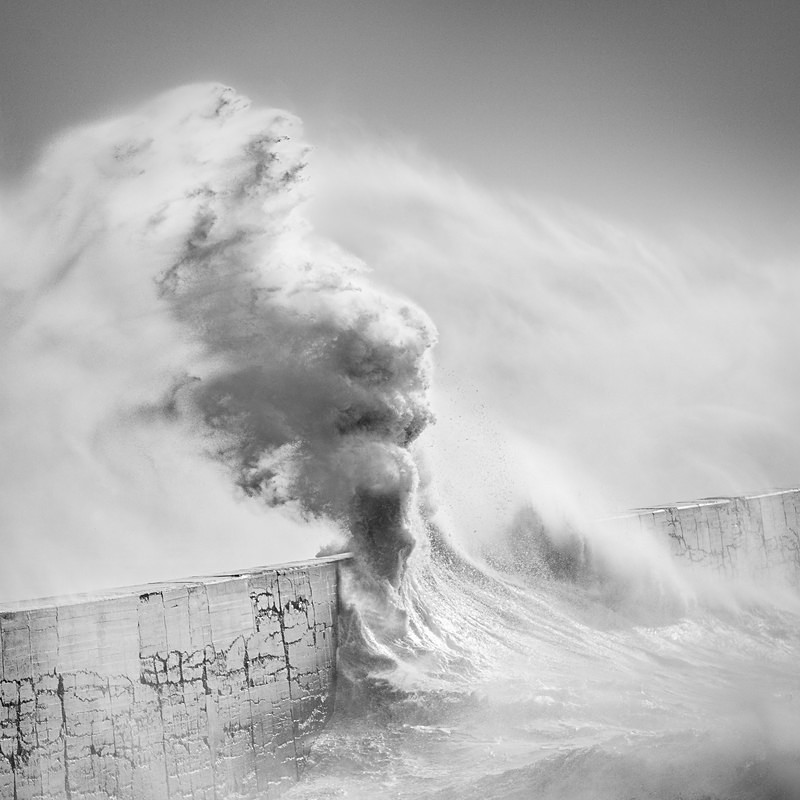
Or more stormy
Lilith by Rachael Talibard
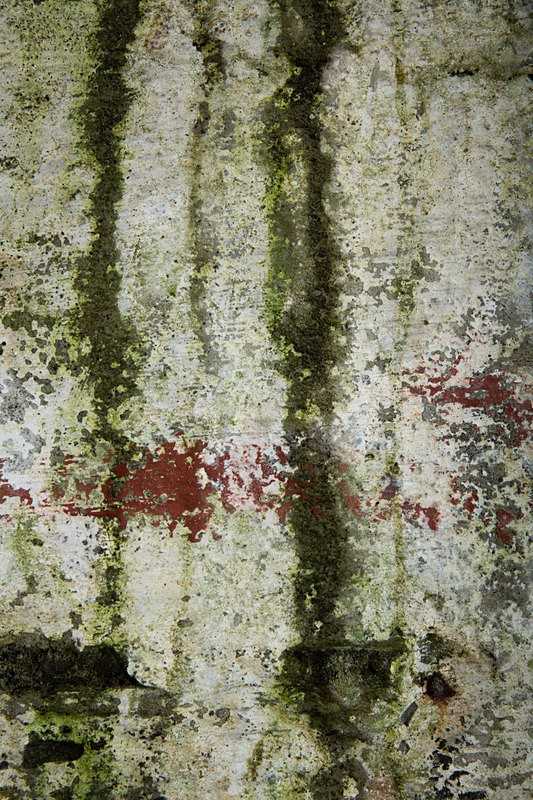
The other major style is of almost abstract images of detail from her surroundings, perhaps best exemplified by those in “Traces”, images of the walls of a derelict fish factory in Iceland
(Read about Traces: “In a forgotten corner of Iceland’s remote West Fjords stands an abandoned herring factory. In this unlikely place, beautiful works of art have formed. The concrete was mixed using sand from local beaches, and the minerals and organisms within have emerged through the structure leaving traces that are abstract yet also seem strangely to echo the landscape beyond the factory walls. Thus I feel that these photographs have two authors, myself and the sea.”)
Images such as
Vulcan by Rachael Talibard
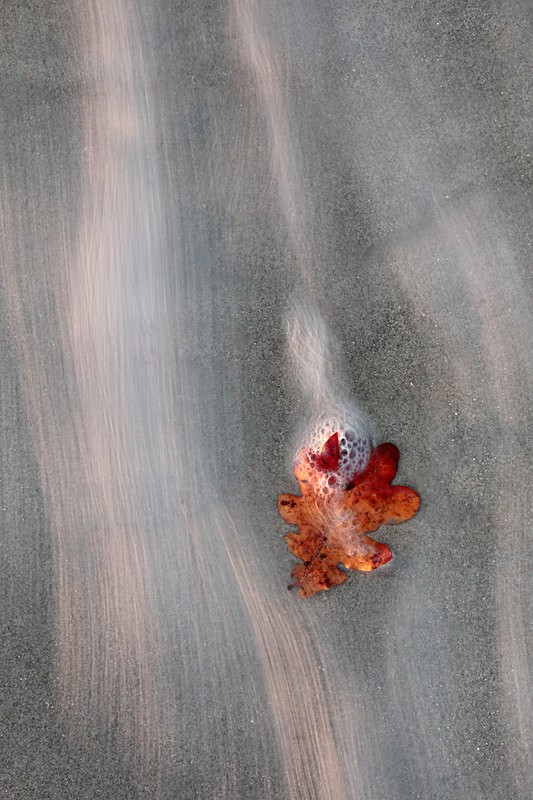
But she also finds abstract images in the sea and shore like those in “Chalk/Sand”
Magic mountains II by Rachael TalibardShoreleaf I by Rachael Talibard
Her talk:
Rachael spoke for over two hours in all and presented a great deal of material. Her talk concentrated, as the title would suggest, on coastal photography, exemplified by her portfolios “Sirens” as well as images from “Ocean”, “Coast” and many others.
In addition to describing the technical aspects of her work, from the visualisation of the planned image, through the techniques of shooting the image (often in challenging environments) to the processing of the RAW files and printing the image and her selection of paper stock for various types of image.
I learned many things from this comprehensive presentation, but will attempt to concentrate on three major learning points, as I have done for other experiences like this in the past.
Photography as Art
Rachael Talibart describes herself and colleagues in the Parhelion Group, as “artists”. She desscrbed a conversation with a visitor to an exhibition who was surprised to see the photographer described as the “artist”. She then had a brief discussion about her view of photography as art. She suggested that as photography as a technique is well suited to produce documentary representations of reality, it is often seen primarily as this rather than a art medium which may be used to represent the artist’s own expression.
She suggested that as soon as an image is presented in black and white it becomes an art form. She suggests that because humans do not see in black and white, such a representation is not a representation of our perception of the scene but is influenced by the artist’s interpretation.
She went on to describe how the black and white image can be used to assist composition and be removing potentially distracting colour, can allow other underlying attributes of the image to be better seen.
Techniques
Rachael Talibard described a number of techniques she uses in the production of her images.
Ones which I found particularly interesting and valuable suggestions were the use of black and white visualisation of the scene at the time of shooting to help composition and the focussing of attention.
Others included some Lightroom and post-processing techniques such split toning, and the use of linear gradients for vignetting. The other technique is the manipulation of individual colour channels in transforming a black and white image.
I will explore these more in later posts.
Use of video
During her presentation she had a number of slide shows, these included video clips.
The use of video is a learning theme which has interested me over the last year, but this is a subject for future posts.
I was interested to see how she interspersed still images with video clips. Her clips were generally taken with a static camera position, so they appeared “moving pictures”.
I think my interest in this was to see how the two media can be used in juxtaposition, and the final presentation justifies the use of video.
My Future Work as a Result of this Talk:
She mentioned the concept of “kindly vacancies” in composition, introduced by John Ruskin in his work “On Modern Painters”. I plan to look at this work.
Other artists she mentioned who I will research include: Warren Keelan( https://www.warrenkeelan.com/) a seascape and ocean photographer using waterproof housings for his camera to get a different perspective on the ocean than that of Talibart.
The BBC introduction to this programme describes it as:
Travelogue that follows photographer Don McCullin, now 83, documenting his country from inner cities to seaside towns, on a journey in search of his own nation. Sixty years after starting out as a photographer, McCullin returns to his old haunts in the East End of London, Bradford, Consett, Eastbourne and Scarborough. Along the way he encounters an array of English characters at the Glyndebourne Festival and Goodwood Revival and photographs a hunt and a group of saboteurs aiming to disrupt them. McCullin’s journey is punctuated by scenes in his darkroom, a place he is allowing cameras into for the first time.
Sir Don McCullin is a British photojournalist, particularly recognized for his war photography and images of urban strife. His career, which began in 1959, has specialised in examining the underside of society, and his photographs have depicted the unemployed, downtrodden and the impoverished. (Wikipaedia accessed 09/03 2019).
The documentary covered a lot of material and in order to concentrate what I regarded as the main points I have learned, I tried here to record three main things I have learned from this.
1. McCullin’s motivations
Early in the programme he said that early in his career he was “not just taking photographs, it had a statement to make. Society we were living in was very unbalanced – haves and have nots. Photography is a powerful tool”.
However he also demonstrated in the programme that he maintains a professional impartiality in his images. He attempts to become an impartial recorder of what he sees. This is best illustrated in a sequence where he visits a hunt and takes images of the members of the hunt. There are also protesters and he tries unsuccessfully to engage them in dialogue to establish their motivations, and to show these people also.
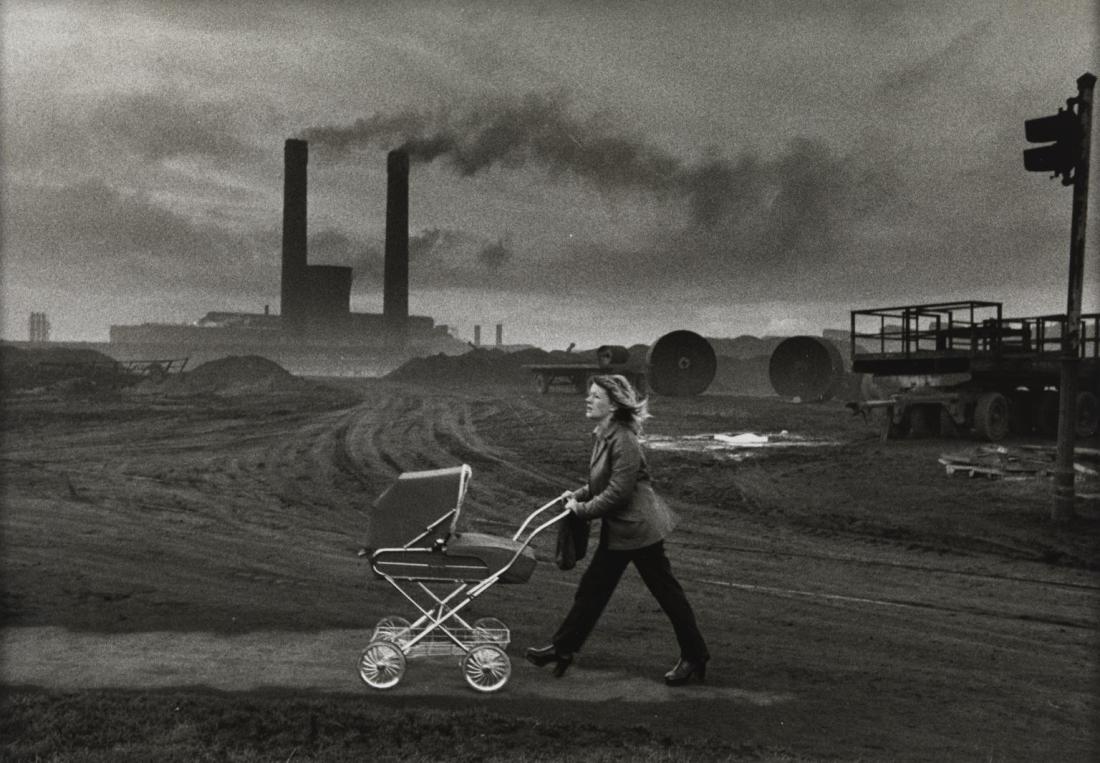
He later visited Consett, a former industrial town which he has visited to photograph in 1980. He described that time, saying “that world had to go, people deserved better”. His austere images of the 1980s show a bleak landscape, and his portrayal of the town led to a complaint by the council.
Consett, County Durham 1974. Don McCullin
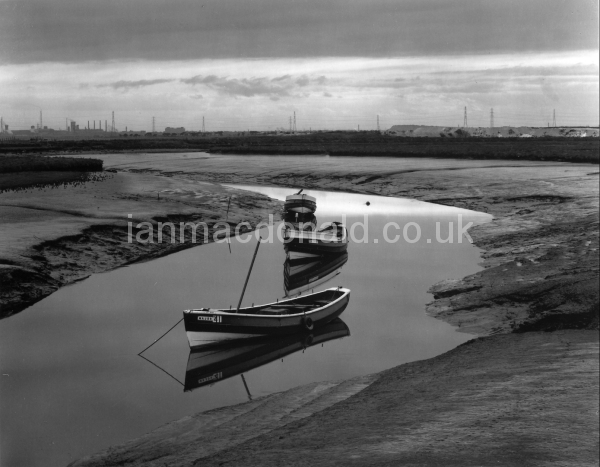
His depiction of the industrial North-East around this time, is very different from that of Ian MacDonald, from nearby Teesside who photographed the area a few years earlier. These show industry as clean and bright and the countryside around a bright and rural.
Heavy Industry – Plant. Ian MacDonald
Greatham Creek – boats. Ian MacDonald
While this might reflect the sudden decline of industry in the intervening years, however I wonder if this is more to do with the difference in perception of a local person (MacDonald) as opposed to that of McCullin who was not from that area and saw the landscape with fresh eyes.
2. McCullin’s interaction with his subjects
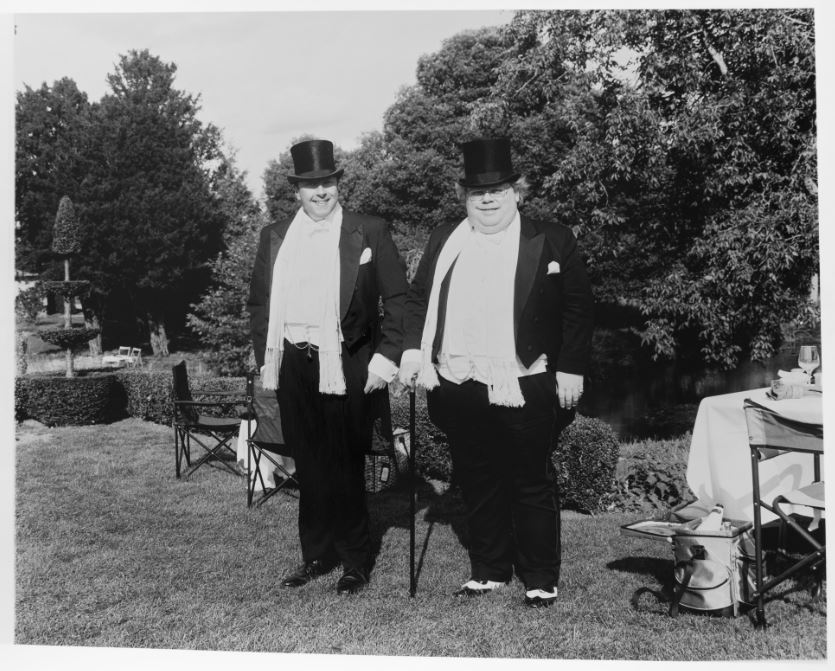
In the documentary, we see McCullin photographing people in various settings. I was interested to watch his interaction and conversation with them. To some extent this was assisted by his use of a camera with a waist level view finder, the camera did not come between him and his subject. On viewing the resulting images, while some are clearly posed like this from Glyndebourne:
Glyndebourne Opera Festival 2018. Don McCullin
others are less obviously posed.
A man eats fish and chips on Eastbourne pier, 2018. Don McCullin
Watching McCullin work, we learn more about the subject. For example why this man is eating his lunch on a very windy pier. McCullin knows more about his subjects than is obvious from the image.
My own attempts at street photography have been more discrete, not engaging the subject and trying not to obviously be taking photographs. However, a more direct approach may be necessary to get the impression of emotional connectivity on which I commented in the work of Willy Ronis, but also seen in McCullin’s work.
3. Some technical points
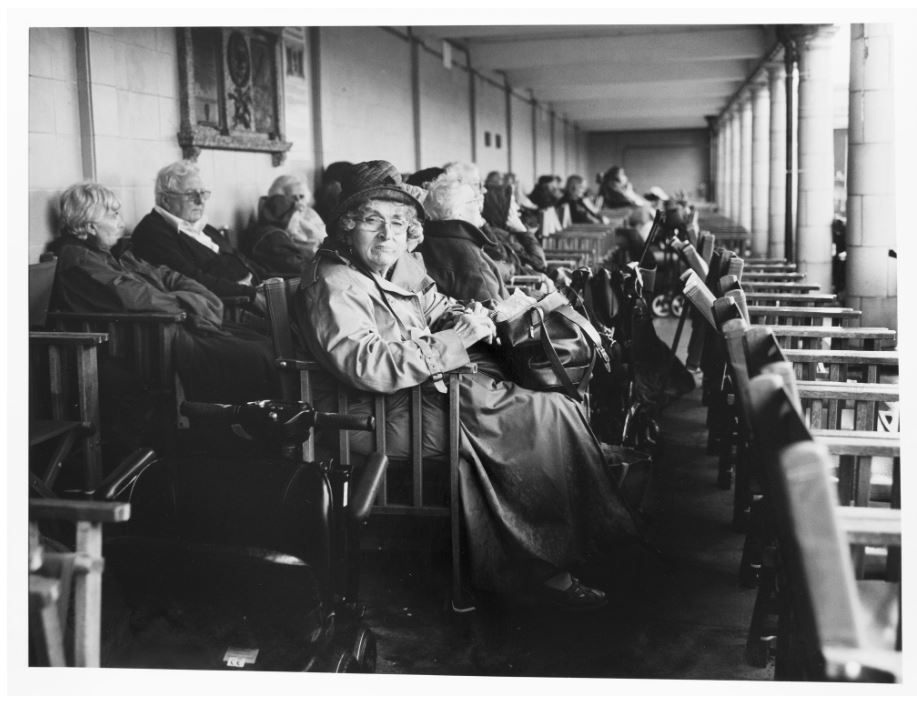
This image of an elderly lady watching a brass band engages the observer with her eyes immediately.
Eastbourne Bandstand 2018, Don McCullin
One’s gaze is directed to her face, in spite of the rest of the image having a lot of detail and being potentially quite distracting. This is probably because she is looking directly at the camera and is herself engaged in the image. My own approach to this would have involved severe cropping which would have lost the context and setting in which she was, or the use of narrow depth of field to emphasise her face. From this image I learned that that approach is not necessary and is limiting. What is necessary is that engagement with the subject that can then be portrayed in the final image.
Other aspects of McCullin’s technical approach is his use of film with medium and large format cameras. While his earlier work was in 35mm (particularly the war photography), his use of larger format enables high definition prints.
He is very committed to film – “some subjects demand film”. Although I do tend to disagree with him slightly on his statement that the photographer can “press the button on digital and its all done for you”
4. Other points
There are some other points that I intend to develop further in later posts.
These include his comment that “I cannot help taking my prints darker and darker and darker, I don’t know what makes me do it”.





 Andrew Procter