Zoom Meeting 08 January 2020 – New Year – New Work Resolutions
Led by Andrea Norrington
My notes for this meeting are in my Rocketbook notebook – and Andrea’s presentation is available on the OCA forum.
Andrea gave a presentation on study techniques with particular relevance to photographic studies. I thought that the suggestions were very useful and these included techniques for dealing with
Creative block
• repeating exercises or doing other exercises
• taking photographs generally, not necessarily of relevance to the course
• reading – of any subject matter, again not necessarily relevant to the course
Procrastination
• set a time of 25 minutes to work on a topic
• making this the first task of the day
Setting aside a regular time slot for revew and reflection – weekly or bi-weekly
As a result of this meeting my objectives are
1. Setting aside my time for regular reflection and review
2. Preparing an overall time plan for the rest of my course with projected deadlines
Prior to the meeting I briefly researched the concept of “Wabi Sabi”, with which I was previously unfamiliar. My research was fairly brief and based largely on Wikipedia (https://en.wikipedia.org/wiki/Wabi-sabi accessed 08/08/2020).
This suggested that the concept of Wabi Sabi has its origin in the Buddhist concepts of the “three marks of existence”
Impermanence
Suffering
Emptiness/absence of self nature
The characteristics of the Wabi Sabi aesthetic include
Roughness
Asymmetry
Simplicity
Economy
Modesty
Austerity
Appreciation of the integrity of natural objects and processes
Western artists who have incorporated the principles include John Connell and Jesse Richards.
I looked at some of the work by Jesse Richards, who the Wikipedia article indicates also used the concept of Mono no aware – an empathy towards things and acceptance of their impermanence.
Jesse Richards (https://www.jesserichardsfilm.com/ accessed 08/08/2020) is “a New England based filmmaker, photographer and artist. Former member of the Stuckists, founded the Remodernist Film Movement, co-founder of Cine Foundation International, founder and artistic director of Art Secession Cabal”.
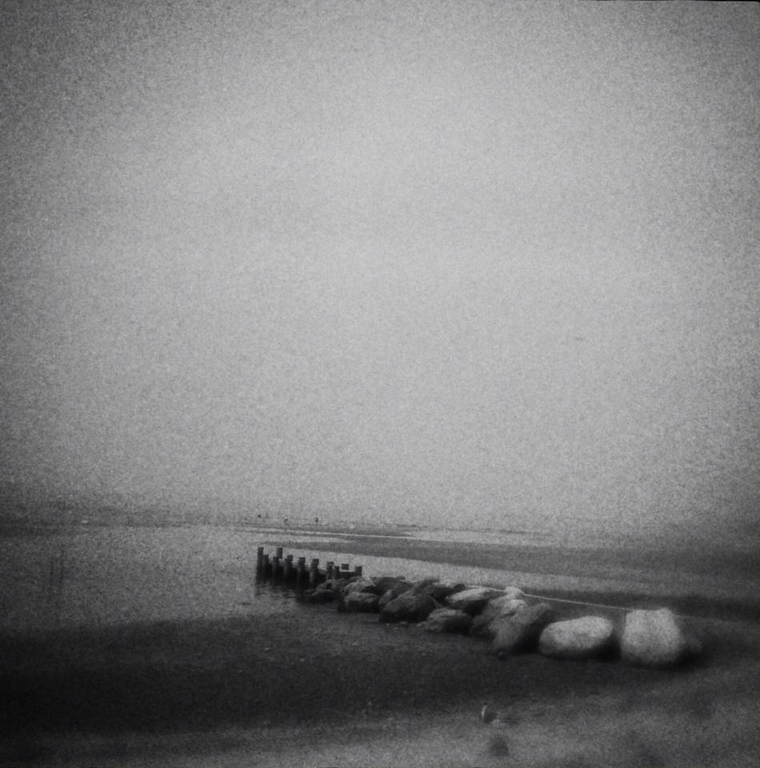
His work includes images created with “toy” cameras including pin hole cameras. I found this image particularly striking.
Harvey’s Beach, Old Saybrook, 2015. Jesse Richards
I considered that it showed aspects of Wabi Sabi in terms of both the image itself, which is imperfect and blurry and the subject matter which is a simple composition of a desolate beach.
It was this separation of whether the image or the subject shows Wabi Sabi which I found particularly interesting.
The meeting:
Robert gave a presentation expanding on the concept of “Wabi Sabi” beyond my brief reading.
He confirmed that origin of the concept from Buddhist principles of impermanence and mono no aware.
Of particular interest to me was his proposal that Wabi Sabi is an aesthetic category analogous to that of classical “beauty” which he had discussed in an earlier talk. He invited the students to suggest others. The list included
Picturesque
Sublime
Realism
Abstraction
Surrealism
Hyperrealism
This discussion was very helpful to me and I realised that there are many different frameworks against which a visual art work can be appreciated – this was something I had not really considered before and will be something I need to study more.
Robert suggested other artists to research in this area.
Objectives:
As a result of this meeting and the works discussed my objectives are
Robert gave a presentation expanding on the concept of “improbable images” as described in the course notes. This is based on the principles outlined by Vilem Flusser in “The Philosophy of Photography”.
That is, the concept of the photograph alters from that of the memento (“people who look at a photograph naively photographs represent the world”) to a more generalised unique type of image (“representation of the world no longer depends on direct experience but on interpretation of previous images or representations that already exist”).
As a result of this meeting and the works discussed my objectives are
Read Flusser’s book “The Philosophy of Photography”
Examine the works of the artists discussed
Steele-Perkins
Tomasz Windland
Re-examine Hokusai’s work
Later thoughts on the meeting
Overnight I thought more about the meeting and some of the issues Robert had raised.
Some of the images Robert showed included areas of white, lacking detail, and he emphasised the importance of these in the composition, adding a sense of ambiguity to the overall image. This reminded me of the concept of “kindly vacancies” introduced by John Ruskin in his work “On Modern Painters” and referred to by Rachael Talibard in the talk I heard her give.
Robert had made many of his images with film and he emphasised the ability of film to enable the photographer to make images other than those which are our original intention. With digital cameras we are able to review the image immediately and may discard those that do not meet our plan, whereas some of these discarded images may have features making them of significance. This to me was reminiscent of the principle employed in the “Nine Eyes of Google Street View” by Jon Rafman, whereby captured images become art works because of the selection process by the artist.
Andrea summarised the concept of the learning log in terms of what happens between doing the coursework and assignments. The write-up of the learning log is all the posts on the blog that do not directly relate to these other elements.
As a result of this meeting my objectives are
Look for and read the David Hurn book “On being a Photographer”
Apply the process described in there and summarised by Andrea of identifying topics to be covered in a project ie planning and then take images to support these topics
Use the 30 second rule to summarise learning experiences
Andrea suggested an open post to compile a bibliography for all references and sources referred to in the blog. Another student suggested the use of “Paperpile”, “Zotero” or “Evernote” to compile bibliographies as did Andrea . I recognise that I need to have a more systematic way to record these and show on my website.
For various reasons I have not been able to add to this log for a longer period than I had planned, so this review is later than the monthly reviews I had aimed for.
My work on Assignment 3 since July has not identified any new objectives for me, so in this post I will review my progress on the objectives I set out in my last post.
Skills:
Film Photography
My overall objective was to start developing and printing my own work.
I indicated in my last review that I needed to gain more experience with the behaviour of different film and papers stock, and ensure the standard of my final prints is as high as possible. I have started this in that I used two types of film and have found better results with one than the other for this particular work. I also thought there is scope for improvement in the quality of these as I have indicated in my reflection.
This is objective is ongoing and will be reviewed when I get my tutor’s feedback.
Videography
I have done no further work on this, however my other reading and reflection leads me to recognise that the meaning of an image and narrative is important to me and my appreciation of art. This area remains something I want to explore more.
Use of WordPress
I find that while it remains something of a challenge at times, I can achieve what I need with this.
Assessment and appraisal skills
This remains an ongoing task and I think will continue throughout and beyond the course. I have attended the OCA North student group meetings and feel more confident to express and opinion about other work, including that from disciplines other than photography.
I have not been able to seek the views of my tutor and/or others as to whether my assessment is reasonable and accurate, and need to do so.
Knowledge:
My objective was to gain a better understanding of other art disciplines and influence on photographic work. While like the previous objective I think this will continue throughout and beyond the course, I do think I have achieved some steps forward in this.
I offered to help organise the meetings for the OCA North Group, and this makes me consider other disciplines besides photography. In particular the planning of meetings makes me examine other artists’ work and I can consider how this relates to my own. An example of this is the planning of forthcoming meetings and planning the speakers.
However this remains an ongoing learning objective.
To gain an insight into more contemporary and historical approaches to photography
This is another ongoing objective, and I have done little since my last review of my objectives.
Attitudes:
My objective was the “Demonstration of creativity – Imagination, experimentation, invention”
I have deliberately experimented with film in my latest assignment – for reasons which I justify in my account of that. I will hopefully get feedback from my tutor about this and advice as to how to improve.
I hope that a better understanding of the creative process used by other artists will help me develop this more.
As I start Part 4 of my course after a break, these are my current objectives, however I am sure more will emerge as I progress to Parts 4 and 5.
Miranda Richmond: Proposed speaker for OCA North Group
The three students who organise meetings for this group invited others to help and I have volunteered to improve my knowledge of and involvement in the activities of the OCA more peripheral to my course.
I have found that this gives me a forum for discussing and considering other art disciplines, for example when planning speakers for forthcoming meetings.
One suggestion has been the artist, Miranda Richmond who is currently exhibiting at Dean Clough. This meant that I needed to research her work in order to be better informed as to what to get out of the next study day.
Also her entry on the gallery site http://colonyart.co.uk/artist/miranda-richmond/ (Accessed 17-11-2019)
says
“Her works are usually produced on location, which enables a direct and immediate response to the subject. “
I would be interested to hear how this immediacy relates to her works and how that might be relevant to us photographers who also produce the main part of our work on site.
I will add an update to this following the study day.
The plan for the day was:
• a presentation on his work by tutor, Andrew Conroy (photography tutor)
• general discussion
• presentation by participants of their OCA work
Presentation by Andrew Conroy
Andrew described several aspects of his work. These included a project he has been undertaking for some time about Orgreave, documenting the present state of sites of significance during the period of an active mining industry in these areas. To this end he also showed images of a series of walks he did around Barnsley including former coal mining sites. A theme here was the “re-greening” of these areas – often with little reference to their former uses.
He also described his collaborations with other artists and how his work has then been modified and adapted to create something new.
General Discussion
There was a helpful discussion about “research”, and writing, with particular relevance to the more advanced courses.
Presentation of OCA Students’ work
Several students presented their work). I presented the images I had prepared to date for Assignment 3, Decisive Moment.
Other photography students (Level 2 and 3) presented their work, and there were a set of 4 paintings by another student.
My Aims and What I Learned
I had similar aims from attending to those for previous meetings;
To gain a greater understanding of studying with the OCA
A major point I learned is that there is a librarian for the OCA who is available for advice regarding literature searches and databases of journal etc. This is something I have struggled with greatly since studying with the OCA. I am familiar from bio-medical research with various search techniques but have failed to find these for the arts discipline and resorted to general search engines such as Google, which I think does not have the academic validity of other methods.
Practice my assessment and appraisal skills
I was able to give feedback on four abstract paintings. Of note was that the student presenting the work has four very specific questions to structure the feedback around. I found that I was able to make, to me, apparently sensible and it seemed helpful comments for her. I relied to some extent also on criteria described by Grayson Perry in his book “Playing to the Gallery”, albeit I think a little tongue in cheek.
Gain a better understanding of other art disciplines and influence on photographic work
The collaborative work of Andrew Conroy demonstrated to me how other arts disciplines can use elements of photographic images to create new novel artworks, probably classifiable as “visual art” rather than any more specific discipline. However, his collaboration was not limited to visual art, but also included images as part of a work with a poem, analogous to the collaboration between Fay Godwin and Ted Hughes, Remains of Elmet.
To present my own work and get feedback on it
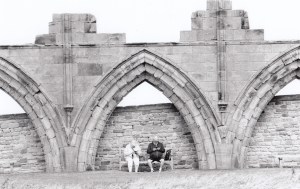
I took contact prints and prints of the six images I have shown on here.
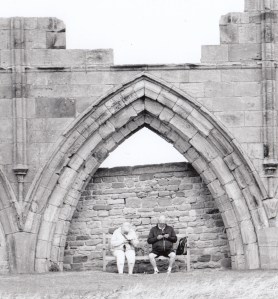
Suggestions were to crop image 2019-09-17 #02-13
2019-09-17 #02-13
2019-09-17 #02-13: Cropped
– my own thought is that cropping closer to the couple on the seat implies they are more important than the setting and pattern of the arches, and I will leave as it is for now.
There was a comment about the “tactile” quality of the prints, perhaps particularly because of size and the texture of the paper (pearl finish). This highlighted to me the significance of the uniqueness of a hand printed image.
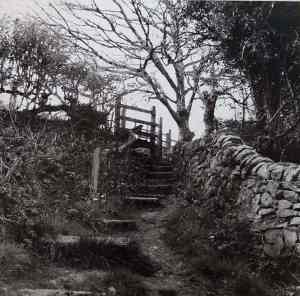
The image 2019-07-30 #22 was described as “having a lot going on” to the lower left side and I agree this does make it difficult to work out where to look at the image. Its composition does not lend itself to easy examination.
The topic for this meeting was “Portraiture”. Robert explained that although previous meetings had been around the topics of assignments he thought this more general topic was relevant to many parts of the EYV course.
Robert gave a presentation based on some theoretic aspects of portraiture drawing on examples of the styles of various artists/photographers.
These included Irving Penn, notable for his studio portraits using ambient light with reflectors.
Jean Baptiste – referred to in the notes for the course.
He also described the concept of “Rembrandt Lighting” , a style of lighting the face with one side lit, and one side in shadow. This in turn gives prominence to the nose shadow. This lighting arose because of the design of Rembrandt’s studio with a single high window, which was north facing so gave a diffused light, diffused even more on occasions by translucent paper across it.
The other concept he referred to was styles of pose for the models, including the classical style “contraposto” where the model’s weight is more on one leg than the other, leading to a curve in the body with the hip thrust out. This is exemplified in the Venus de Milo from classical times and Michaelangelo’s David.
Overall these were the key things I learned from this, but the main lesson was that formal portraits are very much a constructed image, the dress and pose of the model, together with the lighting and background establish an image the photographer wishes to create. This is in distinction to me from the candid images of people taken by street photographers. Although there is clearly an overlap, as the documentary showing Don McCullin working (which I have described elsewhere) demonstrated his rapport with the subject by which he was able to create the image he sought.
“Dave Butcher is a black and white specialist with a worldwide reputation for his landscapes and city shots. He is an Ilford Master Darkroom Printer and still exclusively uses medium format Mamiya 7 film cameras and makes traditional silver gelatine darkroom prints.”
Dave “worked for Ilford Photo Ltd. for 21 years… This included as a photographic research scientist, technical service manager, regulatory affairs manager and project management… (he) managed the Ilford photographic printing department, and setup and edited some Ilford technical newsletters.”
Dave began the workshop with an overview of the techniques he uses for printing. These included various types of toning which are techniques I have not used before. He also described the main technique he was planning to demonstrate in the workshop – that of split grade printing. This is a technique new to me, and involves making a print on multi-grade paper with two exposures using different contrast settings. In this way the high contrast exposure can ensure the black parts of the image have a dense black, while the low contrast exposure ensures an adequate range of mid-tones in the image.
In the darkroom, Dave demonstrated printing one of his images in this way and then we printed some of my negatives.
I had identified a need to improve the quality of the printing and am very happy with the greater contrast and range of tones in the final 14×11 inch prints. I have scanned these and reproduce them here, although the quality of the reproduction in this way does not show the detail as well as the actual print.
Hague Lane 2. Silver Print 28cm x 33cm
Towards Pingot Lane 2. Silver Print 28cm x 33cm
I think that my objective of improving my film processing and printing skills has been met and now I need to practice and review any further learning in this area. I have also been able to print some images which I may include in my next assignment “The Decisive Moment” and aim to submit this in this medium.
This meeting was led as usual by Robert Bloomfield and the topic was “ Languages of Light” and Robert planned to discuss Part 4 and the 4th Assignment.
There was a presentation of work by two students who were about to submit their work for the 4th assignment and had both chosen to do this on “The Beauty of Artificial Light”. There were two aspects of the discussion about these images which I found particularly interesting as they had themes which I have been considering.
The first of these was an image of someone looking at their mobile phone at night, illuminated by the light from the screen and the reflected light from outside lights. The quality of the two types of illumination was strikingly different, in particular with regard to the colour temperature of the light, the phone was a very blue/white light and had a stark quality to it, whereas the external light, although from an LED light had a warmer, softer quality as it was reflected off other surfaces. I had previously been considering how ubiquitous objects with light sources have become and how these influence our environment. I have started a consideration of this in another post and may develop it further for my assignment.
The other aspect of the student work which I found interesting was an image of a tower block with a sign across the windows. The wording was very prominent and gave a strong message in the image. However there were other aspects of the image which could be interpreted in many different ways. The incorporation of words into images is something I have considered before, and an area I need to research and consider more.
Robert gave a presentation about the concept of “Beauty” with the aim of making it a less subjective concept. He gave a historical view of the classical construct of “beauty” which equated to “perfection” and as such had a generally agreed definition and was not therefore subjective. However he then described the attack by the suffragette, Mary Richardson, on the “Rokeby Venus”, a painting by Valaquez in the National Gallery. My understanding of the rationale she gave for this was that the picture was an depiction of “beauty” but her own concept of beauty included the concept of “justice”, which she saw as missing from the contemporary treatment of women.
My own thoughts on this are that while the incorporation of other constructs besides perfection are important, there remains then an element of subjectivity as across societies, different people and groups are likely to have different understanding of concepts like “justice”, and value other constructs as defining beauty. For example in many elements of modern society, an artificial light source could only be considered to demonstrate “beauty” if it does not harm the environment.
Following the meeting I have briefly researched more about the attack on the Rokeby Venus by Mary Richardson. A description of this is at:
Richardson is quoted as saying “I have tried to destroy the picture of the most beautiful woman in mythological history as a protest against the Government destroying Mrs Pankhurst, who is the most beautiful character in modern history. Justice is an element of beauty as much as colour and outline on canvas”
There are other aspects of this painting and its subject which may have made it a target for such an attack as Richardson is quoted as saying several years later “I didn’t like the way men visitors to the gallery gaped at it all day”. Furthermore in the article, the authors cite descriptions of the painting as “’a body for Don Juanesque fantasies’ in a country (Spain) in which extreme machismo was the hallmark and women were regarded as ‘inferior, voiceless and … easy prey’”. This suggests to me that at the time of its painting the concept of beauty in that society included these aspects too. All of which shows how the subjectivity of the concept is influenced not only be an individual’s taste, but also societal values.
Other sources and writers to which Robert directed us in the meeting include Susan Sontag, “On Photography” in which she examines the development of the photograph beyond being a idealised image, and thereby a development of a set of aesthetic values by which a photograph can be judged. This is something I need to read more about.


 Andrew Procter