Why People Photograph. Robert Adams (1994) Aperture

I was directed to this book by my tutor as an introduction to the course.

It is a series of essays by the American photographer and writer Robert Adams published between 1981 and 1994. The cover notes say

“His subjects vary, but again he questions accepted prejudice, this time not only the view that art is trivial but that artists are separate. He demonstrates that many understand themselves to be bound to the world by complex and important obligations.”

I read the book from cover to cover as I would a novel. I believe I have learned a number of things from it.

What I did not learn was very much about the style and methods of the photographers discussed. However, the  writing introduced a number of photographers with whose work I am not familiar. The book is sparsely illustrated with examples of their work, so I think I must look elsewhere to get a better understanding of their styles.

The writings did however examine the context in which the photographers were working. Adams attempted to describe their motivations and drives, although this is largely by inference as the photographers themselves do not in general give any account of this. I found the chapter “Writing” expressed this well.

“Photographers are like other artists too n being reticent because they are afraid that self-analysis will get in the way of making more art….

The main reason that artists don’t willingly describe or explain what they produce is, however, that the minute they do so they’ve admitted failure. Words are proof that the vision they had is not, in the opinion of some at least, fully there in the picture.”

For this reason, I think that what the writing is telling me about is Robert Adams’s own motivations and reasons for his photography. As he himself acknowledges:

“Probably the best way to know what photographers think about their work, beyond consulting the internal evidence in that work, is to read or listen to what they say about pictures made by colleagues…”

There are many other points that I gained from reading this book. One of the challenges facing me is to understand the framing techniques used by Paul Strand in his work “Time in New England”. Adams describes “Church, Vermont 1944” as “among the greatest architectural pictures ever made”. The edge of a symmetrical building is cut off the image, and in other images he off-centres or includes large areas of apparently irrelevant framing.

I think I must re-read this section and find more of the images from this series. It is helping me to begin to understand the issues addresses in Exercise 1.4 Frame.

2018-10-05 Video Feedback with Andy Hughes: Assignment 1

2018-10-05  Assignment 1 Feedback Meeting
Call with Andy Hughes

This was the second video call with my tutor and followed me submitting my assignment “Square Mile” for his consideration.

Feedback on my assignment:
Andy told me that the technical quality of the images I had submitted was good and at the standard required for the course.
He commented particularly about the inclusion of map extracts to illustrating the location of some of the images he drew my attention to the concept of “GIS” Geographic Information Systems, and suggested I look into this more as it applies to my work. This is a concept being used extensively to describe social history and geographical concepts.

He considered that some of the images of the area around the confluence of the rivers has many of the visual aesthetics of classical English Landscape painters and suggested that I research more into this, not confining myself to photographers. In particular he mentioned John Virtue
Other artists he suggested I look at include
• Rebecca Solnit and her book “Wanderlust” with regards to walking as an activity
• The “New Topographics”, in particular Lewis Baltz
This is in relation to the tension between urbanisation and the rural environment.

The next assignment is collections – I described some initial thoughts I had about this.
As a sport diver, I am aware that the wrecks of iron and steel ships deteriorate underwater. Wrecks of wooden ships like the “Mary Rose” may be preserved for centuries in sediment which protects them from the effects of tides and weather. As a result the archaeological record of iron and steel ships is likely to be less complete than that of well preserved wooded wrecks.
Many amateur sports divers who dive these iron wrecks collect souvenirs and will have small collections of artefacts from the wrecks. In the future these may be the major remaining artefacts from many of out historic ship wrecks.
I suggested I collect images of such collections for my next assignment.
Andy suggested I look at the historic use of photography to record collections . Other artists he suggested I look at were
• Mark Dion and his work “Oceanmania”
• Michiko Kon

Further study topics
Geographic Information Systems
John Virtue – B&W Landscape painter
Rebecca Solnit “Wanderlust”
New Topographics
Lewis Baltz

Assignment 2 “Collections”
Use of photography to record collections
Mark Dion and his work “Oceanmania”
Michiko Kon

Exercise 1.1 “You can’t step into the same river twice”


This quotation, or rather the sense of it, is generally attributed to Heraclitus, a Greek philosopher of Ephesus (near modern Kuşadası, Turkey) who was active around 500 BCE. He proposed a doctrine that things are constantly changing, the flux doctrine.

The above quotation is attributed to Plato’s statement about Heraclitus’s work:

“Heraclitus, I believe, says that all things pass and nothing stays, and comparing existing things to the flow of a river, he says you could not step twice into the same river.”

(Plato Cratylus 402a, as cited in Graham, Daniel W., “Heraclitus”, The Stanford Encyclopedia of Philosophy (Fall 2015 Edition), Edward N. Zalta (ed.),

URL = <https://plato.stanford.edu/archives/fall2015/entries/heraclitus/&gt;.

Graham (2015, op.cit. above), suggests however, that an interpretation of Heraclitus’s reference to the river, “is not that all things are changing so that we cannot encounter them twice, but something much more subtle and profound. It is that some things stay the same only by changing”. He suggests that, for example, a human body only achieves constancy, by virtue of its constant metabolism. Therefore while Heraclitus believed in flux, not as destructive of constancy, rather as a necessary condition of constancy.

This is an interesting concept related to the earlier exercise of the Square Mile, in which I tried to examine how environments change over time. However while the visual appearance alters, it could be considered that, in the case of my study, Glossop as a town remained constant – only by changing over time as economic and technological developments affected it.

Hit the North: 30/06/2018

Exhibition Visit: I went alone to this as I was unable to attend an OCA Study Visit and the curator-led visit I had planned to attend was cancelled. This was unfortunate and meant that I might not have gained as much from the visit as I had hoped.

The Exhibition “celebrates northern photography across five decades”. Included are images of studio and informal portraits, rural landscapes and urban/industrial scenes.


My objectives from the visit:
• To gain an insight into more contemporary photography
• To see the work of photographers who create images in similar geographical areas to myself
• To gain some ideas for use in my “Square Mile” project
• To visit an exhibition and try to understand the range of work shown and the rationale for inclusion
• To try and study the work more systematically to develop my own assessment/appraisal skills

The Works
Daniel Meadows
The images included were made around 1972 and are of residents of Moss Side where Daniel Meadows was living at the time. He took free portraits of local residents and it is some of these which are shown.
They are black and white images in portrait formal. The subjects are against a simple dark background, the folds of the material can be seen. All are looking directly at the camera and seem to have a very “stiff” pose. This suggests to me that they are not used to having their photograph taken.
I was struck by an image of Teenager with Pram. At first sight this might appear to be a stereotypical image depicting teenage pregnancy/single mothers etc, however on closer examination it is clear that the pram contains a television and seems to be a way of transporting it!
I found these interesting images of people capturing a time and style. For me it was evocative of a period when I started taking photographs and used the same techniques.

Chris Harrison
The images shown were from his series “Under the Hood” and are studio portraits of Salford young men and boys made in 1994. They are colour images in a square format. The subjects pose against deep red drapes in what appear to me to be classical poses. These are offset by contemporary objects, such as their beer cans.
I noted that in many of the images one side of the subject’s face is in deep shadow, whereas in one the subject looks directly at the camera and is more evenly lit. In the subject’s pupil, I can see in the latter two light sources (flash and reflector ?) and only one in all the others. I am unclear as to what the photographer was trying to achieve here – I wonder if it is to show that although they have lost their hoodies, the subjects still do not show all their faces…

Tessa Bunney
The exhibition notes describe Tessa Bunney as a photographer of rural life, capturing the way landscape is shaped by humans. The images displayed are of domestic flowers of the British countryside. They are in colour in a square format. The colours are muted pastels and to me, seem reminiscent of paintings. One work is a montage of many such images, reminding me of some of the works of Andy Worhol.
What I learned from this, is that although the artist has shown images of the flowers, the story behind the images is of the domestic flower growers and changes in flower farming from small domestic production to more industrial scale, and now back to smaller farms again.

Lisa Dracup
The exhibition notes quote critic Michael Prodger as describing Lisa Dracup’s work as “not about capturing a particular moment in time but about timelessness. Her focus is less on something fleeting… and more on the long afterlife of places, plants and animals.”

The images shown are of taxidermied animals and birds. They are in a portrait format with a black background. I note that there are large areas in each image of this black background, and each subject in shown with great detail visible.
I was keen to see Lisa Dracup’s work as my thoughts about my work are that I want to depict more than the here and now, perhaps the “pre-life” rather than the “afterlife”. It is interesting to me to see how this timelessness is shown by the use of taxidermy.

Paul Floyd Blake
The images shown are from his series, “Give us a Sign” and are images of churches with signs outside, all with a humorous aspect. They are colour images in a square format. The colour enhances the visual impact of the sign, making it stand out from an otherwise, quite grey urban/suburban background.
I saw in these images how a single point of interest and the use of humour, can elevate an otherwise bland scene.

Matthew Murray
The images shown are from the series Saddleworth: Responding to a Landscape. They are large images, described as “metallic”. Many have traditional landscape compositions of woodland and moorland but they are striking because of the lighting.
I found it difficult to see how he achieved the lighting effects but have since found his description of this. “I photographed throughout day and many times throughout the night. When shooting at night I would light the landscape with artificial lighting, external lights, torches, car headlights, I wanted to interact and manipulate the landscape”. (Murray, M (2017) Matthew Murray’s atmospheric landscape images inspired by walks on Saddleworth Moor. British Journal of Photography 8765: 20-21)
Overall I found this a striking way to show the landscape of the moorland and woodland around me.

Phoebe Kielty
These are black and white images from her series “These were my Landscape”. They are of details from an urban landscape which produce almost abstract black and white patterns. While the object in the image can be seen and identifies, I found I looked at the pattern not the image.
I liked the way the detail in a landscape has been identified and the pattern created used to create an abstract appearing image.

Ian Macdonald
These are images of Cleveland taken over a several year period from the 1970s to the 1990s. They are black and white images of the industrial landscape and people of Cleveland.
I noted that the images of industry in the 1970s were highly lit and contrasty. The sites looked clean. I formed the impression that these images aimed to capture the spirit of the “white heat of the technological revolution” speech by Harold Wilson in 1963, rather than our current disillusion with industrialisation as adverse effects on society and the environment become recognised.
I noticed what might be a recognition of this in the images of traditional fishing boats and a rural landscape of the estuary, while in the distance industrial plants can be seen with chimneys and emissions which probably would not be acceptable today.
The image, Picnic at Fourth Buoy Sands, shows local people picnicking in such a setting. It reminded me of Cartier-Bresson’s image of Juvisy, France 1932 of working people having a working lunch in an apparently rural setting, but close to their urban work.


My overall thoughts and implications for my work
I set out my objectives for the visit above
• To gain an insight into more contemporary photography
My notes above summarise the insights I have gained. I think this is a start, but find it raises more questions for me than answers. I now have other sources to look at and other work from these artists
• To see the work of photographers who create images in similar geographical areas to myself
I have seen this and commented above, however have observed that time is as important as geography even over a period of 50 years. “The past is a foreign country: they do things differently there” (L P Hartley) has particular resonance for me in the light of these images.
• To gain some ideas for use in my “Square Mile” project
I have outlined above how I see these are relevant. I found most resonance with Ian Macdonald’s work and my own aspirations. However, I felt the images shown very much reflect a period in time, and my current work on “Square Mile” must deal with post-industrialisation and its consequence on the landscape.
• To visit an exhibition and try to understand the range of work shown and the rationale for inclusion
I have looked at some aspects of this, but clearly have a long way to go in this
• To try and study the work more systematically to develop my own assessment/appraisal skills
I have tried to look at each image systematically, but do tend to concentrate on my comfort zone and look at the technical aspect of the image, although I am beginning to understand elements of the intentions of the photographer.



Drosscapes

I was directed towards this concept by my tutor Andy Hughes to help me with my assignment, “Square Mile”.

Berger is Associate Professor of Landscape Architecture at Harvard, and introduced the  term “drosscape” to describe waste landscapes around urban areas (Berger 1998). He defines it as “a term to describe a design pedagogy that emphasises the production, integration and re-use of waste landscape throughout the urban world.” He suggests that processes such as de-industrialisation and technological innovation lead to waste landscapes, as structures and areas are no longer used. The processes leading to this include rapid horizontal urbanisation, as cities extend into the surrounding areas; and the creation of left-over development of previous economic regimes.

As such, Berger suggests that drosscapes are a natural component of very dynamically evolving city, and reflect healthy urban growth. He approaches these landscapes from the perspective of an urban designer and advocates that designers adapt their role to incorporate these changes into new urban design.

Although they might be considered visually unattractive, Berger suggests that they are neither intrinsically bad or good, merely an inevitable consequence of urban and technological change.


Images of Drosscapes

Berger’s book is illustrated with examples from aerial photographs, serving to document the variety of waste landscapes. The areas he studies are exclusively in the USA.

I have searched for photographers who have used images of drosscape.

Katherine Westerhout has an extensive catalogue of images of derelict buildings of various types, in the USA. Her work concentrates on the buildings themselves and the how the process of decay and degeneration affects the fabric of the building. This is exemplified by work such as Yonkers Power Station II   (Westerhout, 2011).

kw_yonkers_power_station_2
Yonkers Power Station 2. Katherine Westerhout

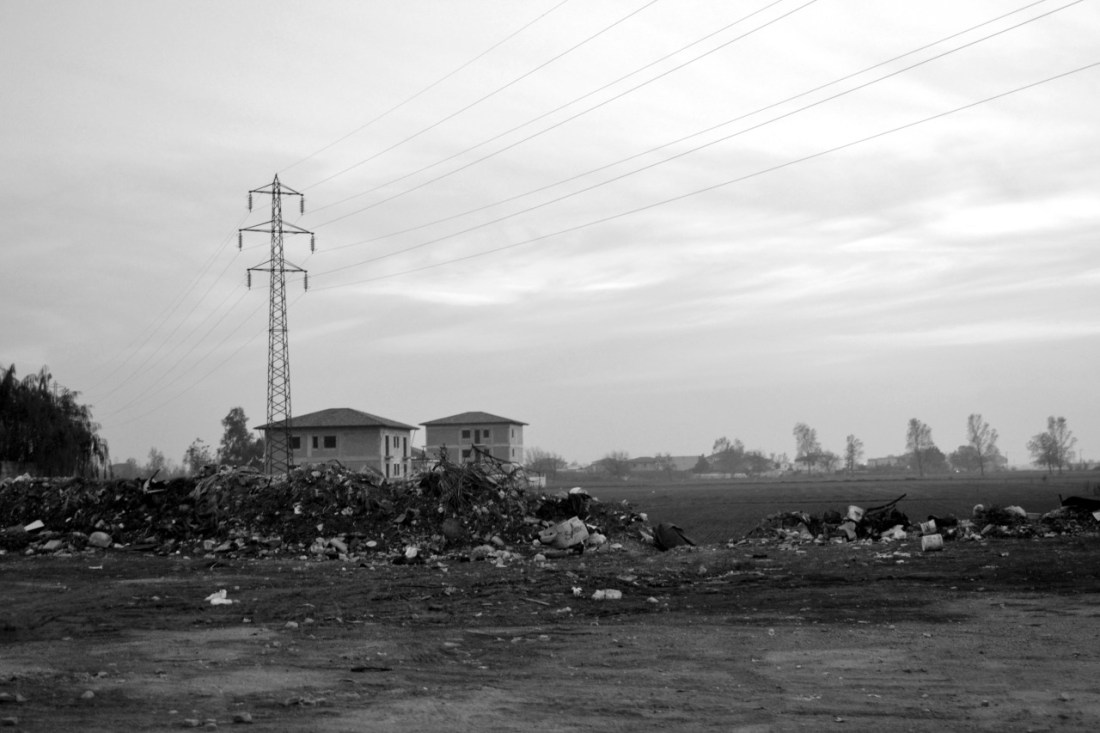
Fortuna D’Angelo uses black and white imagery to depicit drosscape in Italy in his image, Drosscape by the periphery of Naples. Casal di Principe (Italy), (D’Angelo, 2011). This image shows the derelict area adjacent to new development and rural areas.

Drosscape by the periphery of Naples. Casale di Principe (Italy) 2011
Drosscape by the periphery of Naples. Casal di Principe (Fortuna D’Angelo, 2011)

Relevance to my work – Square Mile

The classic description of drosscape refers to waste land around American cities, by the process of “rapid horizontal urbanisation”. As such that process relies on there being land around the city to allow new development into. This is not the case in the UK, particularly around Glossop.

However if I consider the process rather than the physical manifestation of it, there has been changing land use for centuries in my study area. It is this change that I aim to illustrate, even if there are not drosscapes of the type described by Berger.

The images of Westerhout, show the buildings, and their decay. They show the effect of the process of decay and as such reflect a static image of one point in the building’s history. They do not put the building into its context and surroundings. I hope to show in my images a reflection of the process of both decay and regeneration as part of the cycle of a dynamically evolving city, which in turn in Berger’s words “reflect healthy urban growth”.

This latter aspect is more in keeping with the image of D’Angelo – showing several stages of the cycle.


References:

Berger A (1998) Drosscapes: Wasting Landscape in Urban America. Princeton University Press.

D’Angelo F (2011) Drosscape by the periphery of Naples. Casal di Principe (Italy), 2011.  https://fortunadangelo.tumblr.com/

Westerhout K (2011) The East & South; The Catskills/Yonkers.   http://www.katwest.com/gallery_the_catskills_yonkers.html


OCA – North: Study Visit, 2 June 2018

This was the first meeting of this group and my first physical contact with others from the OCA. I have only just started my studies with the OCA so was unsure what to expect.

There were three elements to the day.

  • Introductions to other students and tutor, Andrew Corby
  • Presentation of the results of a survey of OCA students about what they wanted from a study group and discussion as to how to progress with future meetings
  • Presentation and critique of work brought by some of the students


What I learned and gained from the day:

The majority of students were studying photography. Many of the students are taking more advanced courses than me, but it was helpful to hear about their experiences when they were at the same stage as me.

I saw other students’ work in the development stage and began to see how that process is working for them.

Hazel Bingham showed some of her work for her Level 3 project “Neoliberalism in the City” . I was able to discuss this with her and Andrew Corby.

Relevance to my work and study:

I am at an early stage of my study with the OCA and more pre-occupied with the process and techniques of studying rather than the subject matter itself.

I learned that my confusion over communication systems is common among students as there are several systems in place. The “hangouts” groups are used by students for informal discussions and I have since located how to access these and checked that hangouts works on my computer!

I have also a better understanding of the process through which students develop their work. Having seen the work brought to the day, I have a better understanding of the physical presentation of the work as well as the intellectual process for the development of it.

Hazel Bingham gave me a link to her blog and I have been able to look at that and other examples to see what is needed in a learning log.

Andrew Corby interpreted Hazel’s work in the context of neolibralism and the appropriation of old buildings. My plans for my “Square Mile” project are to examine the the re-use of old buildings and sites and this may be of relevance. I will re-examine this as my thoughts are more developed about my project.

First meeting with my tutor

24-05-2018 Hang Out video call with Andy Hughes

We introduced selves and Andy had looked at some of my previous images I have on Flickr as background to where I am now. We also discussed differences between my previous studies in science and this in the arts. Andy emphasised similarities such as researching sources and critical reading, as well as qualitative methodologies comparable to that used in some of my previous work; I had not thought of these previously.

We agreed deadline for my first assignment – end of August.

I discussed my initial thoughts on this in terms of exploring my home of Glossop as transitional between

  • highlands of the Pennines and the Cheshire plain
  • rural and urban
  • industrial and post-industrial

Andy suggested I look at the concept of “drosscape”

He also suggested other general sources to go to for my research in terms of journals, books and websites.

“Drosscape – concept
Artist Photographer: Richard Misrach – Robert Adams – The New Topographics – and others who are part of the group, Lewis Baltz
Magazines and online journals such as FOAM, BJP, APERTURE
Also William Eggleston – the father of modern colour photography and master of the uncanny, famililar and unfamiliar spaces, spent many years exploring his home town of memphis usa
Might also be worth looking at Fay Godwin, with reference to walking, the moors, and poetry ..”

Andy’s summary of things to consider

My next immediate actions will be to explore “drosscape” and start a sketchbook of ideas for my first assignment, as well as ideas to maybe explore in future work.

Expressing my vision

My path through OCA Course in Photography 1: “Expressing Your Vision”

Exploring with my Vision….

2017-07-18 Shetland-108
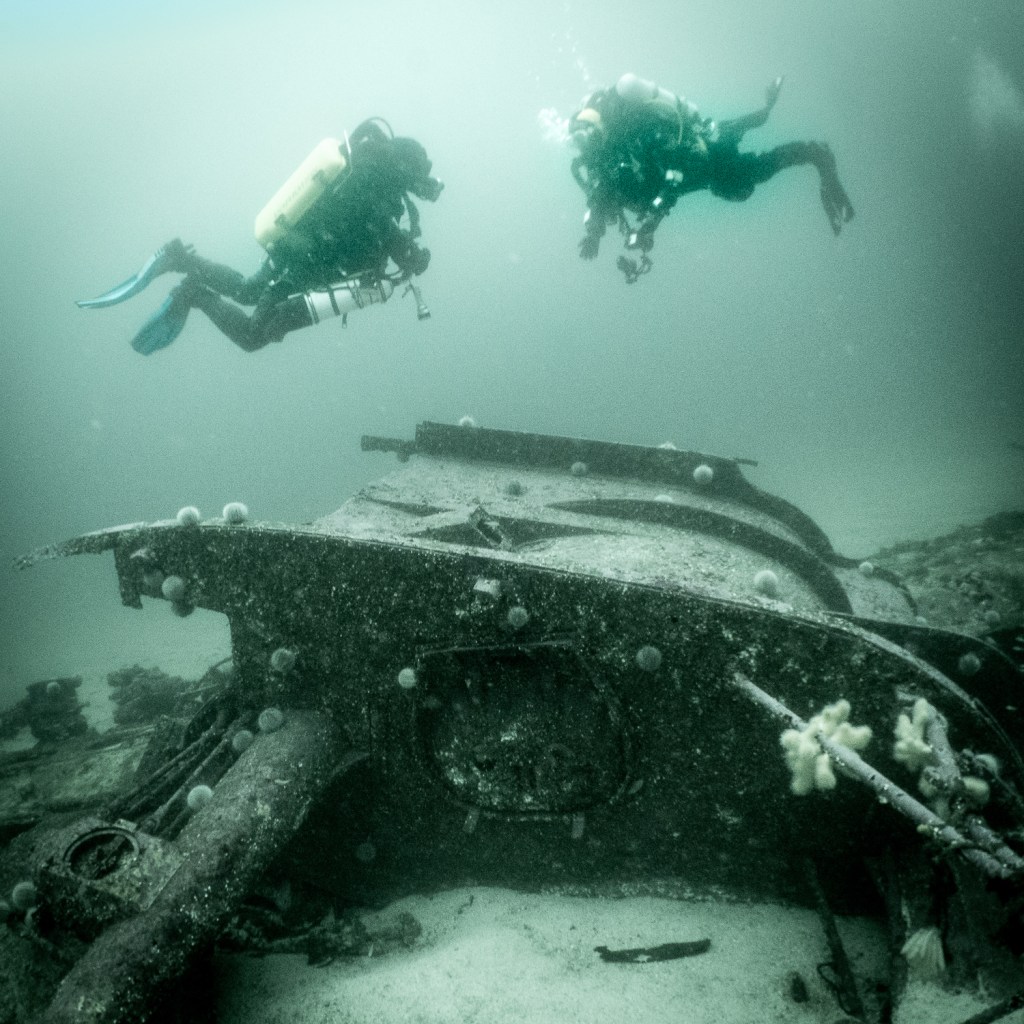
Wreck of the E49, Shetland, Andrew Procter

This website constitutes my Learning Log for the course, “Expressing your Vision” . In my posts here I try and show how I have approached and completed the coursework exercises and the assignments for the course.

How to Navigate this Site

I have created posts relating to each element of the coursework, with titles as in the course notes. These are filed under the relevant headings. Similarly there are a series of  posts for each assignment, with links to other posts on the site as necessary.

Under the “Research and Reflection” tab are a series of posts relating to other general, background work related to the course. In this section the post titled “References” contains the full reference to each work cited in the other posts on the site. These posts include a link to the “References” post. Some of the early posts do however have the full citation in the body of the text, as at the time when I made those I did not have the other system in place.

I have also added another category of post, showing my own learning objectives and how I have reviewed and achieved these or not.

The posts, however, do not reflect all the thinking and records of my research. I have working notebooks and electronic collections of images which I use.

I will incorporate these into my posts where appropriate, but do not include all this background to make this site more readable and concise.

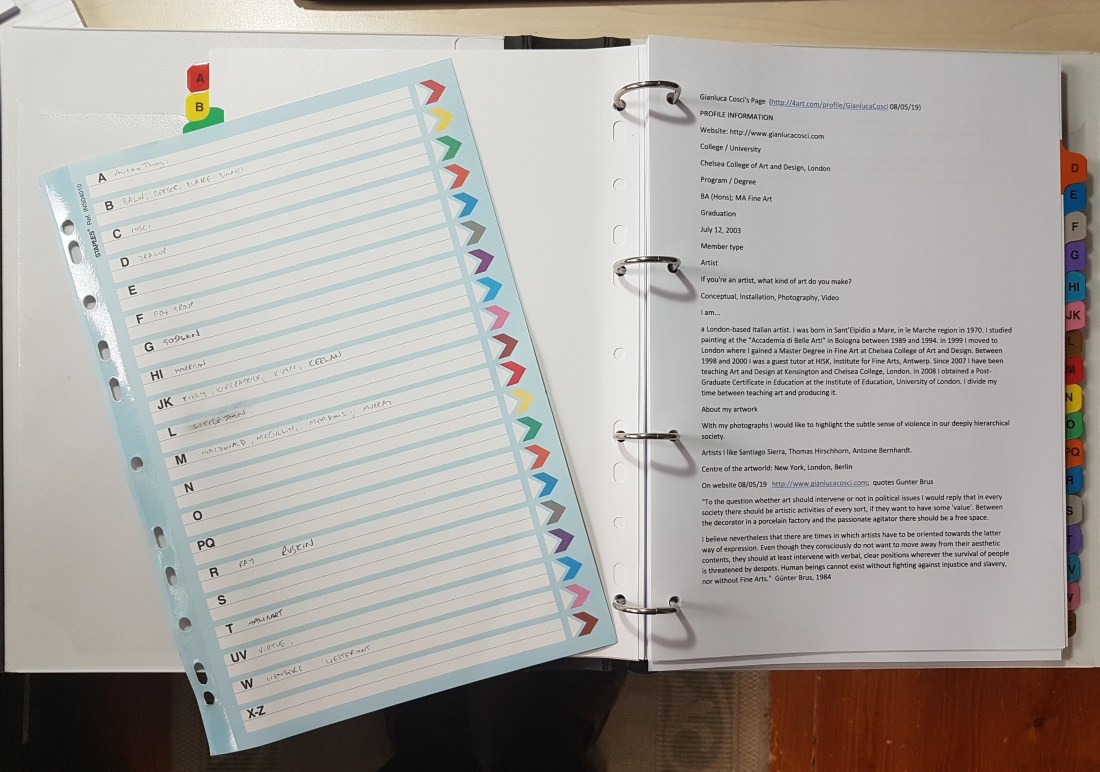
I have shown key pages from my working notebooks, where they illustrate how my ideas have developed – like this:

I will also include details of research about individual artists, where this is relevant to the points I am trying to make, but much of this is likely to remain in my folder summarising my reading and research.

Research folder
Research folder – index and sample page