Light metering
Part 4 of the course begins with a suggested exercise to complete “If you’re not completely sure how your light meter works…”
When I first started using a DSLR, I completed a course with the Jessops academy which included discussions about metering. This included the various metering modes available on the cameras – on mine these are
• Centre weighted average
• Evaluative
• Partial
• Spot
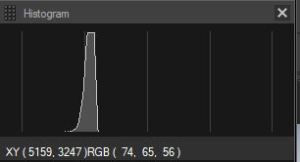
In addition we completed an exercise of photographing a white card using exposure determined by the camera – the result was a grey image.
Metering 1: White card photographed with automatic exposure control. Exposed for the white card only.
Histogram for image “Metering 1”
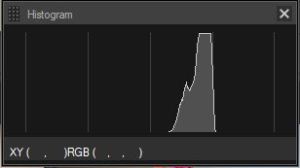
Whereas when the metering was made for a grey card and then the image of the white made at the exposure, the card appears white.
Metering 2: White card photographed with automatic exposure control. Exposed for a grey card.
Histogram for image “Metering 2
Having completed these exercises I feel I am confident with the basic skills of the use of exposure metering, and exposure lock in order to be able to expose the image for which I aim. This is of particular importance with my film cameras as I am unable to confirm the correct exposure on site and only on developing the film. For this work I use three types of exposure metering: my 35mm SLRs have through the lens metering, I also use a hand held meter (for the medium format camera) and then I often check the exposure with the meter in my DSLR.
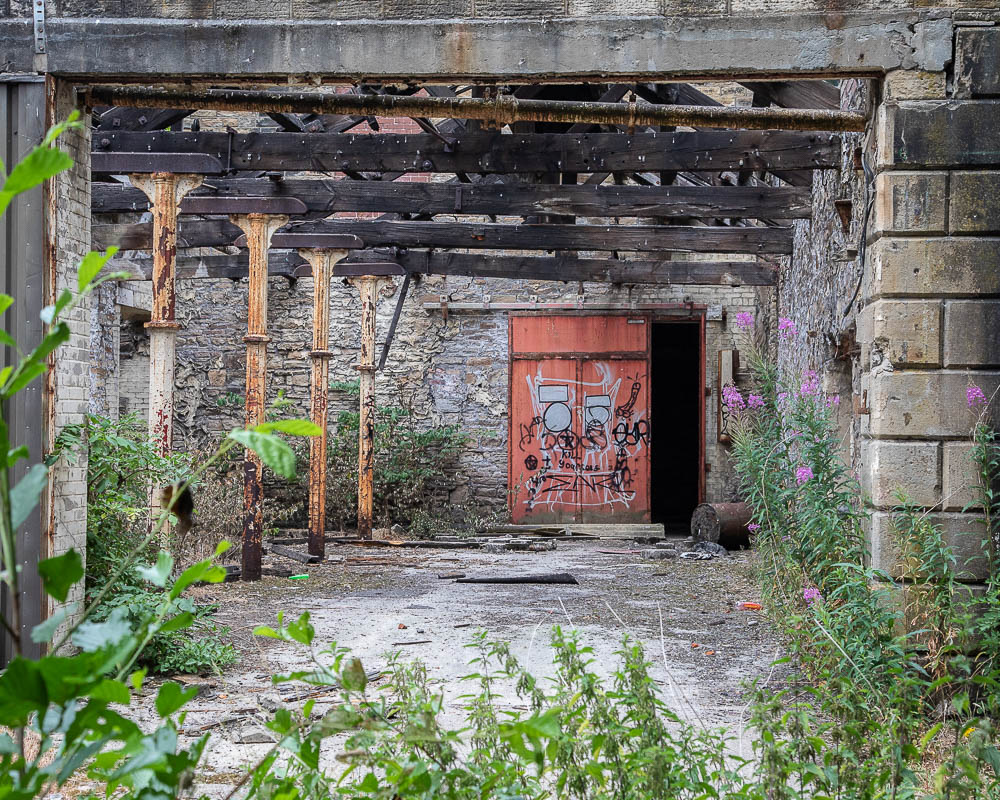
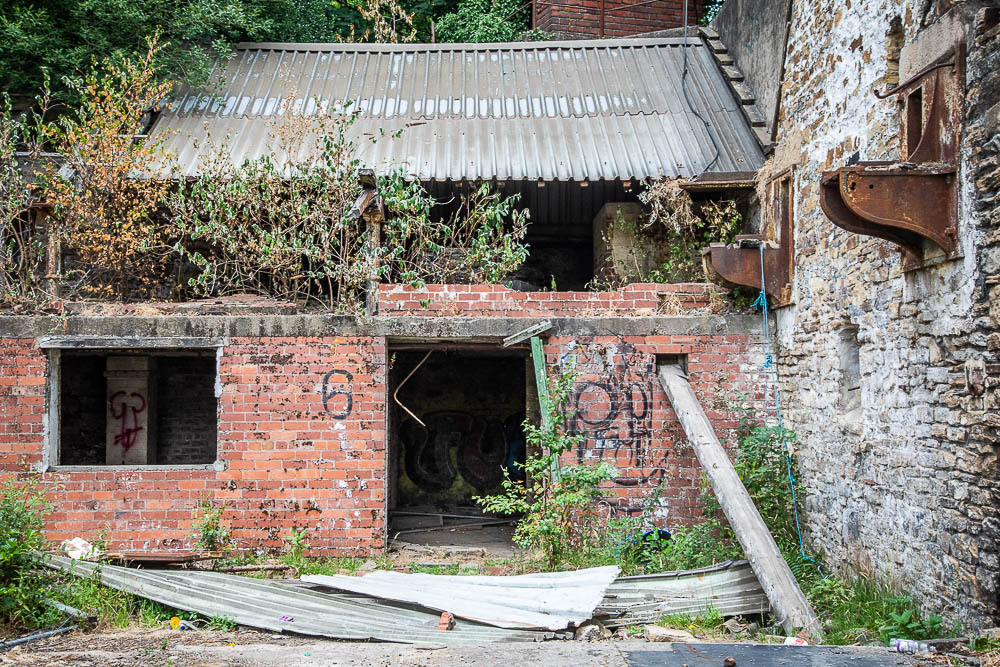
Looking around Glossop for images for my “Square Mile” assignment, I visited the derelict site of the Howard Town Mills and the Hawkshead Mill in Old Glossop, and took a number of photographs while I was there and it is only on re-examining these images and re-reading my post on Drosscapes that I realised how similar some of my images are to those I referred to in this post.
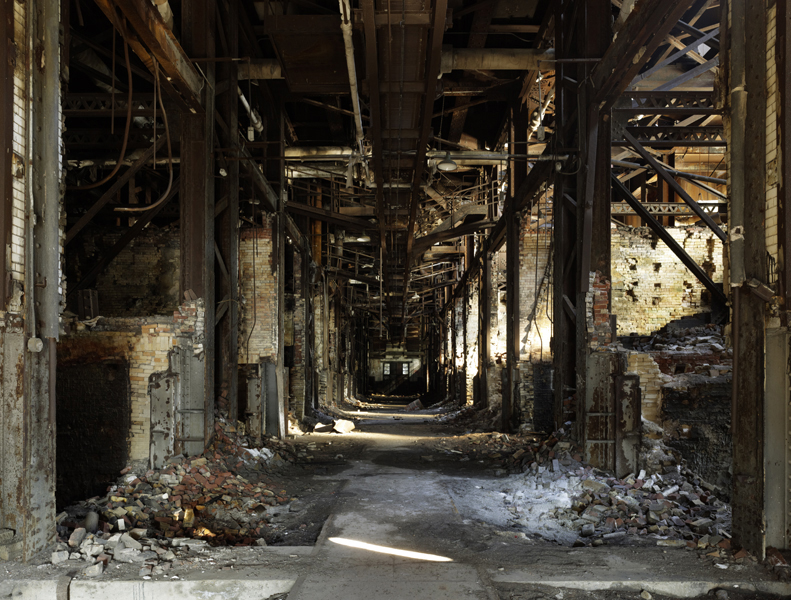
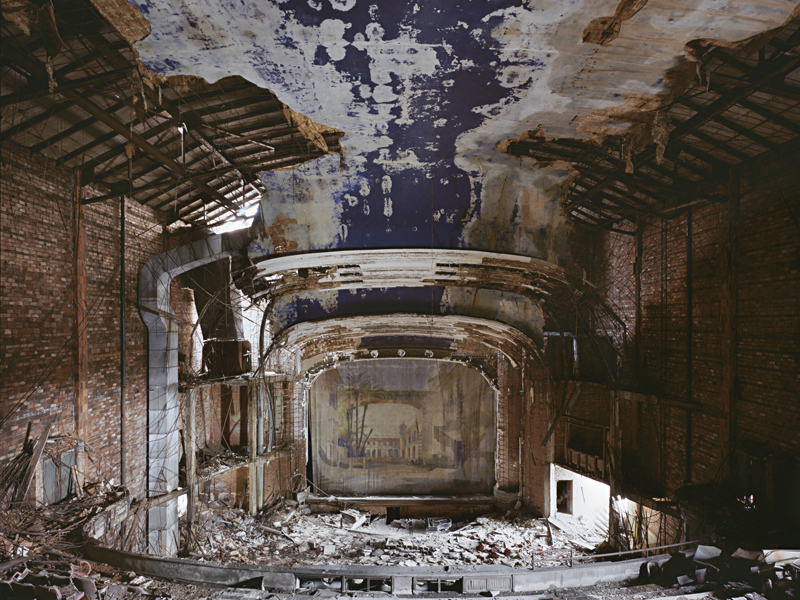
The most striking similarity is between the compostion used by Katherine Westerhout, in her images of Yonkers Power Station and Palace Theater.
Yonkers Power Station 2. Katherine Westerhout
Palace Theater Gary. Katherine Westerhout
and some of these of the derelict mills:
Howard Town Mills 2
Howard Town Mills 1
Hawkshead Mill, Old Glossop
All the images look into the derelict spaces and have strong lines of vertical and horizontal drawing the viewer into the space. I had seen Westerhout’s images before taking these, but only now have been aware of how I was influenced by them.
I include this post as an appendix to other posts I have made which relate to the psychological effects of witnessing (and maybe photographing) stressful events.
The International Classification of Diseases is developed by the World Health Organisation and describes and defines characteristic features of diseases. These are defined for research and epidemiological studies to have consistency across the world in diagnoses. Chapter V of this relates to mental disorders and describes several types of reaction to stress. Of note in the context of my studies here are:
Extracts from
International Classification of Diseases 10 (ICD-10), WHO, Geneva
F43.0 Acute stress reaction
“A transient disorder of significant severity which develops in an individual without any other apparent mental disorder in response to exceptional physical and/or mental stress and which usually subsides within hours or days. The stressor may be an overwhelming traumatic experience involving serious threat to the security or physical integrity of the individual or of a loved person(s) (e.g. natural catastrophe, accident, battle, criminal assault, rape), or an unusually sudden and threatening change in the social position and/or network of the individual, such as multiple bereavement or domestic fire. The risk of this disorder developing is increased if physical exhaustion or organic factors (e.g. in the elderly) are also present.
Individual vulnerability and coping capacity play a role in the occurrence and severity of acute stress reactions, as evidenced by the fact that not all people exposed to exceptional stress develop the disorder. The symptoms show great variation but typically they include an initial state of “daze”, with some constriction of the field of consciousness and narrowing of attention, inability to comprehend stimuli, and disorientation. This state may be followed either by further withdrawal from the surrounding situation (to the extent of a dissociative stupor – see F44.2), or by agitation and over-activity (flight reaction or fugue). Autonomic signs of panic anxiety (tachycardia, sweating, flushing) are commonly present. The symptoms usually appear within minutes of the impact of the stressful stimulus or event, and disappear within 2-3 days (often within hours). Partial or complete amnesia (see F44.0) for the episode may be present.”
F44.2 Dissociative stupor
“The individual’s behaviour fulfils the criteria for stupor, but examination and investigation reveal no evidence of a physical cause. In addition, as in other dissociative disorders, there is positive evidence of psychogenic causation in the form of either recent stressful events or prominent interpersonal or social problems. Stupor is diagnosed on the basis of a profound diminution or absence of voluntary movement and normal responsiveness to external stimuli such as light, noise, and touch. The individual lies or sits largely motionless for long periods of time. Speech and spontaneous and Purposeful movement are completely or almost completely absent. Although some degree of disturbance of consciousness may be present, muscle tone, posture, breathing, and sometimes eye-opening and coordinated eye movements are such that it is clear that the individual is neither asleep nor unconscious.”
F43.1 Post-traumatic stress disorder
“This arises as a delayed and/or protracted response to a stressful event or situation (either short- or long-lasting) of an exceptionally threatening or catastrophic nature, which is likely to cause pervasive distress in almost anyone (e.g. natural or man-made disaster, combat, serious accident, witnessing the violent death of others, or being the victim of torture, terrorism, rape, or other crime). Predisposing factors such as personality traits (e.g. compulsive, asthenic) or previous history of neurotic illness may lower the threshold for the development of the syndrome or aggravate its course, but they are neither necessary nor sufficient to explain its occurrence.
Typical symptoms include episodes of repeated reliving of the trauma in intrusive memories (“flashbacks”) or dreams, occurring against the persisting background of a sense of “numbness” and emotional blunting, detachment from other people, unresponsiveness to surroundings, anhedonia, and avoidance of activities and situations reminiscent of the trauma. Commonly there is fear and avoidance of cues that remind the sufferer of the original trauma. Rarely, there may be dramatic, acute bursts of fear, panic or aggression, triggered by stimuli arousing a sudden recollection and/or re-enactment of the trauma or of the original reaction to it.
There is usually a state of autonomic hyperarousal with hypervigilance, an enhanced startle reaction, and insomnia. Anxiety and depression are commonly associated with the above symptoms and signs, and suicidal ideation is not infrequent. Excessive use of alcohol or drugs may be a complicating factor. The onset follows the trauma with a latency period which may range from a few weeks to months (but rarely exceeds 6 months). The course is fluctuating but recovery can be expected in the majority of cases. In a small proportion of patients the condition may show a chronic course over many years and a transition to an enduring personality change (see F62.0).”
Extracts from: International Classification of Diseases 10 (ICD-10), WHO, Geneva
This quotation, or rather the sense of it, is generally attributed to Heraclitus, a Greek philosopher of Ephesus (near modern Kuşadası, Turkey) who was active around 500 BCE. He proposed a doctrine that things are constantly changing, the flux doctrine.
The above quotation is attributed to Plato’s statement about Heraclitus’s work:
“Heraclitus, I believe, says that all things pass and nothing stays, and comparing existing things to the flow of a river, he says you could not step twice into the same river.”
(Plato Cratylus 402a, as cited in Graham, Daniel W., “Heraclitus”, The Stanford Encyclopedia of Philosophy (Fall 2015 Edition), Edward N. Zalta (ed.),
Graham (2015, op.cit. above), suggests however, that an interpretation of Heraclitus’s reference to the river, “is not that all things are changing so that we cannot encounter them twice, but something much more subtle and profound. It is that some things stay the same only by changing”. He suggests that, for example, a human body only achieves constancy, by virtue of its constant metabolism. Therefore while Heraclitus believed in flux, not as destructive of constancy, rather as a necessary condition of constancy.
This is an interesting concept related to the earlier exercise of the Square Mile, in which I tried to examine how environments change over time. However while the visual appearance alters, it could be considered that, in the case of my study, Glossop as a town remained constant – only by changing over time as economic and technological developments affected it.
I was directed towards this concept by my tutor Andy Hughes to help me with my assignment, “Square Mile”.
Berger is Associate Professor of Landscape Architecture at Harvard, and introduced the term “drosscape” to describe waste landscapes around urban areas (Berger 1998). He defines it as “a term to describe a design pedagogy that emphasises the production, integration and re-use of waste landscape throughout the urban world.” He suggests that processes such as de-industrialisation and technological innovation lead to waste landscapes, as structures and areas are no longer used. The processes leading to this include rapid horizontal urbanisation, as cities extend into the surrounding areas; and the creation of left-over development of previous economic regimes.
As such, Berger suggests that drosscapes are a natural component of very dynamically evolving city, and reflect healthy urban growth. He approaches these landscapes from the perspective of an urban designer and advocates that designers adapt their role to incorporate these changes into new urban design.
Although they might be considered visually unattractive, Berger suggests that they are neither intrinsically bad or good, merely an inevitable consequence of urban and technological change.
Images of Drosscapes
Berger’s book is illustrated with examples from aerial photographs, serving to document the variety of waste landscapes. The areas he studies are exclusively in the USA.
I have searched for photographers who have used images of drosscape.
Katherine Westerhout has an extensive catalogue of images of derelict buildings of various types, in the USA. Her work concentrates on the buildings themselves and the how the process of decay and degeneration affects the fabric of the building. This is exemplified by work such as Yonkers Power Station II (Westerhout, 2011).
Yonkers Power Station 2. Katherine Westerhout
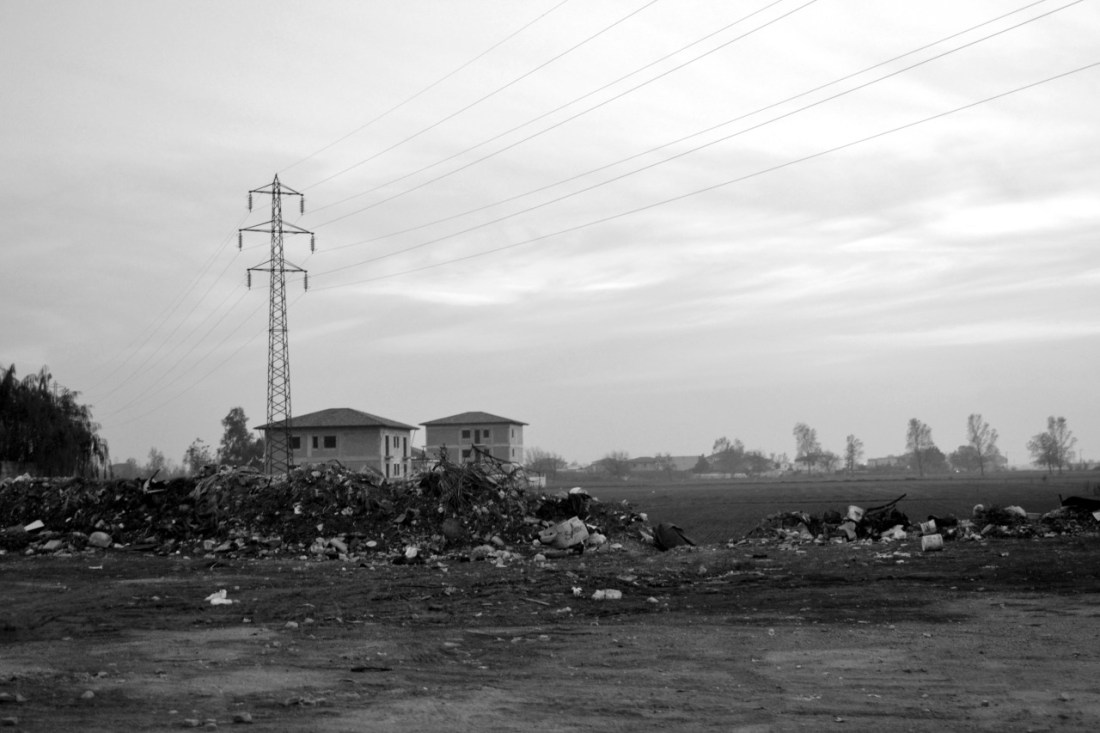
Fortuna D’Angelo uses black and white imagery to depicit drosscape in Italy in his image, Drosscape by the periphery of Naples. Casal di Principe (Italy), (D’Angelo, 2011). This image shows the derelict area adjacent to new development and rural areas.
Drosscape by the periphery of Naples. Casal di Principe (Fortuna D’Angelo, 2011)
Relevance to my work – Square Mile
The classic description of drosscape refers to waste land around American cities, by the process of “rapid horizontal urbanisation”. As such that process relies on there being land around the city to allow new development into. This is not the case in the UK, particularly around Glossop.
However if I consider the process rather than the physical manifestation of it, there has been changing land use for centuries in my study area. It is this change that I aim to illustrate, even if there are not drosscapes of the type described by Berger.
The images of Westerhout, show the buildings, and their decay. They show the effect of the process of decay and as such reflect a static image of one point in the building’s history. They do not put the building into its context and surroundings. I hope to show in my images a reflection of the process of both decay and regeneration as part of the cycle of a dynamically evolving city, which in turn in Berger’s words “reflect healthy urban growth”.
This latter aspect is more in keeping with the image of D’Angelo – showing several stages of the cycle.
References:
Berger A (1998) Drosscapes: Wasting Landscape in Urban America. Princeton University Press.




 Andrew Procter