14 August 2020: Video meeting with Andy Hughes Assignment 5

Video meeting with Andy Hughes: 14 August 2020

Feedback on Assignment 5 – Photography is Simple

I had submitted Assignment 5: Photography is Simple to my tutor and this meeting was to provide feedback on that work. In addition Andy offered advice about preparing my submission for assessment, and about my next and future modules.

Feedback on Assignment 5 and Course work for Part 5

Andy commented on some of the images I had included in Exercise 5.1 Viewpoint, in particular Image Woodhead 18 (reworked),which I had included after thinking more about it. He agreed with my final conclusions about this image and drew my attention to the content of the image which he thought was one of its strengths (i.e. the grave stones/ field and wall, and then in the distance the line of trucks and the electricity cables). He also thought the positioning of the bush in the middle of the image was a strength – rather than it being to one side as more conventional composition might suggest. I think it was this aspect of the image which initially led me to reject it.

In terms of my images chosen for Assignment 5, Andy suggested that a mixture of images in portrait and landscape formats was not so effective. He also thought that the portrait orientated images were less effective in depicting the landscape I was trying to show.

He made some suggestions about re-working this Assignment in terms of selecting landscape orientated images, and I will rework this in the light of these comments.

He also made a general comment about the way images are displayed on the website, arranged vertically. As we tend to read horizontally, he suggested ways in which the images could be shown side by side, as they would be in a gallery. He suggested this should be a consideration for my submissions for assessment.

More General Developmental Suggestions

Andy made some suggestions about other artists whose work I should study.

These included David Hockney’s video work, The four seasons (NGV Melbourne, 2017).

He also referred me to events organised by CAST, the Cornubian Arts & Science Trust; with particular reference to the presence of mining in the landscape.

In addition the work of artists during the period 1910 – 1940 such as Graham Sutherland, Paul Nash, Barbara Hepworth and Henry Moore, exemplify some non-photographers use photography in their work and the scarring of the landscape from mining and other uses.

He suggested that my sense of advocacy for the landscape is an aspect which could be further developed in future work, and considered other ways I could use other techniques to explore the landscape.

One suggestion was to look at juxtaposing map extracts with my images to explore the form of the image.

Preparing for Assessment

Andy summarised the submissions I will need to make, and made suggestions about my selection of creative work to submit.

He suggested that the 10-20 items of work would be best selected from Assignments 1 and 5, and made suggestions about selection of these.

To Do

Following this meeting there are a number of tasks I have to do, including preparation for assessment. These include.

Revise final images for Assignment 5

Research other artists

  • David Hockney’s video work, The four seasons (NGV Melbourne 2017).
  • The work of CAST, the Cornubian Arts & Science Trust
  • Graham Sutherland
  • Paul Nash
  • Barbara Hepworth
  • Henry Moore

Use of other techniques to explore the landscape/ juxtaposing map extracts with my images

References

References to the works cited in this post are found in my separate post “References”
23 July 2020: Video meeting with Andy Hughes Assignment 4

Video meeting with Andy Hughes: 23 July 2020

Feedback on Assignment 4 – Languages of Light

As I have indicated in my posts reviewing my learning objectives, I had asked for a video feedback for Assignment 4.

In addition to getting feedback on that assignment I had a few points I wanted to discuss with my tutor.

These were:

  1. I will be submitting my assignments for assessment in the next weeks and I wanted to check whether any further re-working of these is needed.
  2. While I have used the OCA format for my learning log, I have modified it a little and want to check if this is the correct format. I am also aware that some of the posts are quite long, and wondered if some of these are going off the point of the course
  3. The last point is something I have been aware of, particularly since Assignment 3. I think I can express my intentions and the aims of my work verbally, but this is not expressed as effectively visually. I believe that in general my work is not so visually strong and does not always fully express what I intend as well as I can express it in words.

We had a lengthy video call which was very helpful. Andy made a number of points.

Andy was complimentary about my learning log and documentation of the work. He said he thought I had completed the coursework thoroughly. He gave as an example the account I gave of the technical aspects of light in my write up of the assignment, and the photographs of the set up for my studio work.

We had a general discussion about “quality of light” and he referred me to a Radio 4 programme with Oliver Stone in which he described using the “golden hour” for filming. He also referred to the cultural references to light, and humans’ innate fear of shadows and darkness. As an example he referred me to look at a painting Hunt in the forest by Paolo Uccello.

One of the points Andy made in our discussions which I found very interesting was his concept that photography is “subtractive” whereas other visual arts media are “additive”; ie a painter starts with an empty canvas and adds to it to create the image, whereas a photograph shows everything in a scene, and photographers often remove elements from that in order to emphasise others aspects.

Andy referred me to the work of a number of painters with particular reference to their use of colour. These were Paul Nash, Eric Ravillious and John Piper.

With regard to the exercise, Egg or Stone, Andy referred to the concept of object orientated ontology and the writing of Timothy Moreton , and which if I understood correctly, suggests that inanimate objects exert an influence on us. Thus my choice and selection of that particular stone was influenced by the stone. I am sympathetic to this view, as I did indeed choose the stone while out walking, and chose it as a piece of gritstone. I have referred to this in my write up of the exercise, and would suggest that the course notes which say “we recommend that you choose a natural or organic object such as an egg or stone rather than a man-made object. Man-made or cultural artefacts can be fascinating to light but they’re already authored to some degree” do not address that element of choice we have in choosing even a natural object.

With regard to my next assignment Andy gave me suggestions as to sources to examine for influence. These included, Allan Sekulla, Fish Story and Between the Net and the Deep Blue Sea (Rethinking the Traffic in Photographs)

Our discussions had addressed the first two points I needed to ask about. I raised my concern that my work is not so visually strong and does not always fully express what I intend as well as I can express it in words. Andy agreed with this, but appeared to regard my recognition of this as a positive point. He said it is very common for visual artists to have this concern and my recognition of it is a good starting point for further development.

Suggested sources to research

Oliver Stone, Radio 4 Documentary

Hunt in the forest by Paolo Uccello.

Paul Nash, Eric Ravillious and John Piper

object orientated ontology and the writing of Timothy Moreton

Foam and Self Publish Be Happy

Allan Sekulla, Fish Story and Between the Net and the Deep Blue Sea (Rethinking the Traffic in Photographs)

Click to access Sekula_Allan_2002_Between_the_Net_and_the_Deep_Blue_Sea.pdf

Assignment 3 – Formative Feedback from Andy Hughes

Assignment 3: The Decisive Moment – Formative Feedback from Andy Hughes

Rather than reproduce Andy’s feedback document I will present sections from it that will enable me to recognise specific elements to maintain and those which need development.

Overall Comments

In his overall comment he wrote that of the prints I submitted, “each shows clear attempts to fulfil the brief requirements”; and that in my written analysis I had a “well-written descriptions of … how the depicted subjects relate to the decisive moment.”

This is an important message for me as I initially found the “decisive moment” a difficult concept to capture (as evidenced by my discussions of the concept at the beginning of my posts on this assignment).
Feedback on assignment
Demonstration of technical and Visual Skills, Quality of Outcome, Demonstration of Creativity
Use of traditional composition elements provided for you the basis of a series of strong images.” It is reassuring that Andy finds these “strong” images, as I was uncertain about this myself as I had had hopes of more geometric images with some of the settings.

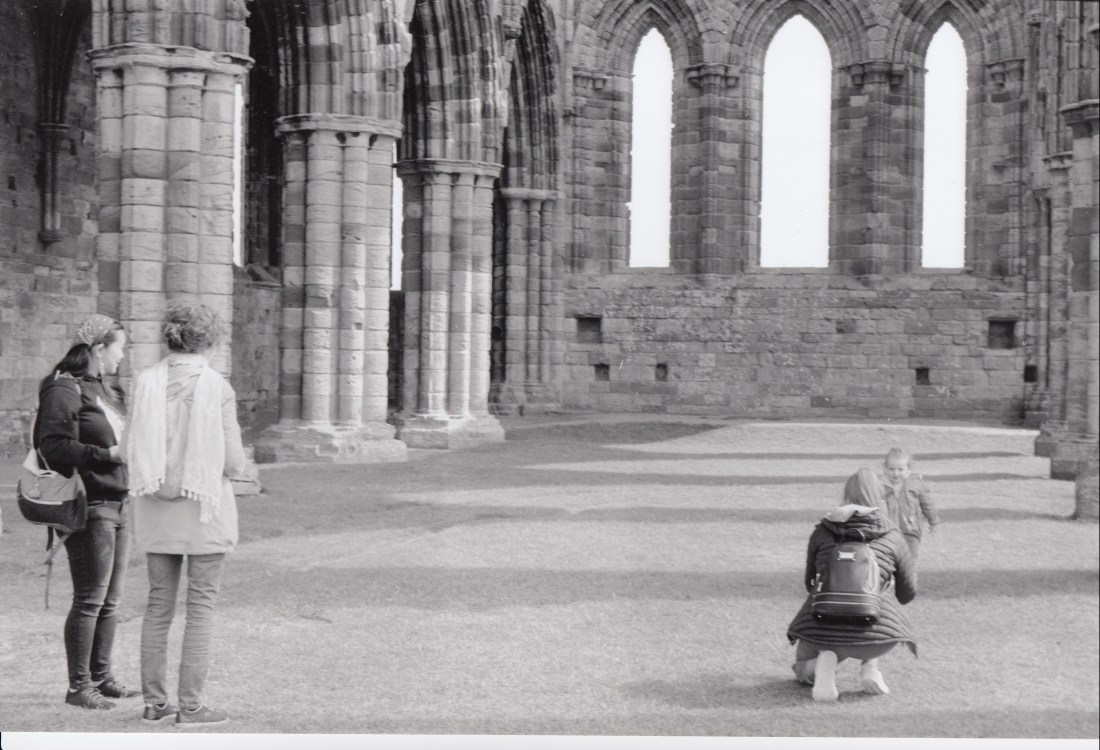
He also picked up on some technical shortcomings of which I was also aware. “There are one of two technical elements to bear in mind: #02-12 might have benefited from a faster shutter … there’s strength in the depiction but the framing is very tight to the edge with the figures.”

2019091702#12
2019-09-17 #02-12

I was aware of the tight framing, particularly of the figures to the left of the image. To me it is this image which emphasised the difficulty of working with film and the importance of anticipating the movement of the subjects. The contact sheet shows that these figures are at the edge of the negative – I have a distinct recollection of wanting to catch the image of the child as he ran to (?) mother and pressed the shutter instinctively but had not paid enough attention to the others in the frame!
I chose to use film in order
to gain an insight into the work of Cartier-Bresson, and the significance of the timing of releasing the shutter in the creation of this image.” In the creation of this image I think I gained that insight!!

Andy also added that it “would be good to have added a little more specification (film stock and camera settings etc.)” I will bear this in mind for the future – however again things seemed to happen so quickly that I could not make notes of my camera settings before the next shot presented itself! (unlike digital where this is recorded automatically).
Coursework
Demonstration of technical and Visual Skills, Demonstration of Creativity

Given what I have commented on above, Andy’s comment that “Coursework seems more expressive in terms of subject matter; this is probably due to familiarity with the DSLR” is not surprising!

I plan to continue working with film and making my prints, however the nature of the next assignment (Languages of Light) lends itself to working in colour so I will be using digital cameras for that. I recognise that there is much I can do in black and white relevant to the topic, but taking a medium which prevents me using colour and the changes in colour temperature and balance means I am missing learning opportunities.

Andy referred to my incorporation of my objectives pages into my learning log “There’s some great elements across the site which reveals good planning and strong structure going forward. Objectives page sets goals with subject specific areas to tackle in terms of practical and thinking elements.”

I am pleased about this as I have added this to the suggested OCA template – but it works for me and I have incorporated it from other learning portfolios with which I am familiar. (eg https://portfolioonline.zendesk.com/hc/en-gb/articles/115000949949-The-Personal-Development-Plan-PDP accessed 27.05.2020).

Andy also makes a positive comment about my incorporation of other art forms.
It’s good to see an ability to connect other art forms and relay back and forth between your interests and subject matter… It’s clear that you’re starting to connect other art forms to your method and approach to research.

Again I am pleased that he is supportive of this as a specific objective of mine is

to gain a better understanding of other art disciplines and influence on photographic work”. It was an area with which I have not been familiar or entirely comfortable.

He also suggested “It might be worth using a notebook for annotations and sticking in small prints, cutting etc”. This is a theme he has mentioned in the past and I am still struggling with, but doing some work on.

He has directed me to other sources – particularly for contemporary artists.

Overall:
Strengths
“Good notes and supporting commentary” – I am pleased that the level of discussion I have written is satisfactory and I will aim to continue to work at this level

New experiences gained by attending events, shows and talks etc.” I have made an effort to seek these experiences, so clearly need to continue.
Areas for development
Consider technical elements and keep a record.” I will aim to record more technical details for my images.

Look at contemporary work” This will be a focus for my choice of events, shows and talks etc which I attend.
My next steps before submission:

I found capturing these images very much more time consuming using film rather than digital, and I am not sure I will have time to re-shoot any. However I think there are some that could be stronger and I will attempt to get a couple more – now I have more confidence that these are suitable.

The printing of some could be improved in terms of contrast and I had to cut the border off one, as there was some fogging due to a failed safelight. Again if I have time I will reprint them.

Feedback from my tutor and others

My Tutor’s Comments

I have had written feedback from my tutor (9/2/2019) about this submission and my course work to date.

He was positive about the technical aspects of the work, and considered the research “fundamentally sound”.

He suggested areas for further development of the theme of the project as he suggested that my work reflects a “photographic expression of the dominant ideology by which public institutions shape our understanding of history, knowledge, and the natural world” and that there is potential to “consider further the ‘normal’ archeological and scientific methods of collecting, ordering, and exhibiting objects”.

Regarding the coursework he suggested adding more detail to the entries about the exercises.

The other elements he commented on and suggested are to expand the range of entries in my learning log to add further experiences/conversations or events. He also suggested I try and expand my thinking across other arts disciplines. He gave me some suggestions for journals and artists’ work to look at including “Oceanmania by Mark Dion.


Feedback from other students

I also posted a link to my site on the student discussion forum and invited any comments from fellow students.

Overall these were positive about the technical aspects of the images. Some colleagues suggested removing some artefacts and replacing with others to create stronger links.


Action Points:

Overall my actions from this feedback are going to be:

Assignment 2:

  • Find out the process by which I submit my assignment for assessment
  • Expand the background discussions into a greater examination of how photography is used in the collecting ordering and exhibition of objects
  • Review the final images and see if there is scope for improvement in quality – where the backgrounds are obvious
  • Expand my thinking and argument about what is needed to establish these as a series

Coursework and other elements

  • Expand my entries regarding the coursework
  • Expand my entries to my learning log to include other experiences
  • Gain a better understanding of other disciplines and influence on photographic work
  • Examine the work by Mark Dion, and the publications in Provoke magazine

2018-10-05 Video Feedback with Andy Hughes: Assignment 1

2018-10-05  Assignment 1 Feedback Meeting
Call with Andy Hughes

This was the second video call with my tutor and followed me submitting my assignment “Square Mile” for his consideration.

Feedback on my assignment:
Andy told me that the technical quality of the images I had submitted was good and at the standard required for the course.
He commented particularly about the inclusion of map extracts to illustrating the location of some of the images he drew my attention to the concept of “GIS” Geographic Information Systems, and suggested I look into this more as it applies to my work. This is a concept being used extensively to describe social history and geographical concepts.

He considered that some of the images of the area around the confluence of the rivers has many of the visual aesthetics of classical English Landscape painters and suggested that I research more into this, not confining myself to photographers. In particular he mentioned John Virtue
Other artists he suggested I look at include
• Rebecca Solnit and her book “Wanderlust” with regards to walking as an activity
• The “New Topographics”, in particular Lewis Baltz
This is in relation to the tension between urbanisation and the rural environment.

The next assignment is collections – I described some initial thoughts I had about this.
As a sport diver, I am aware that the wrecks of iron and steel ships deteriorate underwater. Wrecks of wooden ships like the “Mary Rose” may be preserved for centuries in sediment which protects them from the effects of tides and weather. As a result the archaeological record of iron and steel ships is likely to be less complete than that of well preserved wooded wrecks.
Many amateur sports divers who dive these iron wrecks collect souvenirs and will have small collections of artefacts from the wrecks. In the future these may be the major remaining artefacts from many of out historic ship wrecks.
I suggested I collect images of such collections for my next assignment.
Andy suggested I look at the historic use of photography to record collections . Other artists he suggested I look at were
• Mark Dion and his work “Oceanmania”
• Michiko Kon

Further study topics
Geographic Information Systems
John Virtue – B&W Landscape painter
Rebecca Solnit “Wanderlust”
New Topographics
Lewis Baltz

Assignment 2 “Collections”
Use of photography to record collections
Mark Dion and his work “Oceanmania”
Michiko Kon

First meeting with my tutor

24-05-2018 Hang Out video call with Andy Hughes

We introduced selves and Andy had looked at some of my previous images I have on Flickr as background to where I am now. We also discussed differences between my previous studies in science and this in the arts. Andy emphasised similarities such as researching sources and critical reading, as well as qualitative methodologies comparable to that used in some of my previous work; I had not thought of these previously.

We agreed deadline for my first assignment – end of August.

I discussed my initial thoughts on this in terms of exploring my home of Glossop as transitional between

  • highlands of the Pennines and the Cheshire plain
  • rural and urban
  • industrial and post-industrial

Andy suggested I look at the concept of “drosscape”

He also suggested other general sources to go to for my research in terms of journals, books and websites.

“Drosscape – concept
Artist Photographer: Richard Misrach – Robert Adams – The New Topographics – and others who are part of the group, Lewis Baltz
Magazines and online journals such as FOAM, BJP, APERTURE
Also William Eggleston – the father of modern colour photography and master of the uncanny, famililar and unfamiliar spaces, spent many years exploring his home town of memphis usa
Might also be worth looking at Fay Godwin, with reference to walking, the moors, and poetry ..”

Andy’s summary of things to consider

My next immediate actions will be to explore “drosscape” and start a sketchbook of ideas for my first assignment, as well as ideas to maybe explore in future work.