Project 3: The Decisive Moment Part 2
The course notes direct me to the work of Paul Graham for a consideration of an alternative approach to the issue of the “decisive moment”.
“Paul Graham (born 1956) is an English fine-art and documentary photographer whose work has been exhibited, published and collected internationally.
Graham has won the Deutsche Börse Photography Prize, the Hasselblad Award, the W. Eugene Smith Grant, fellowships from Winston Churchill Memorial Trusts, John Simon Guggenheim Memorial Foundation, and won the inaugural Paris Photo-Aperture Foundation PhotoBook Awards prize for best photographic book of the past 15 years.” (Tate, s.d.)
On reviewing Graham’s images on the Tate website I came across this:
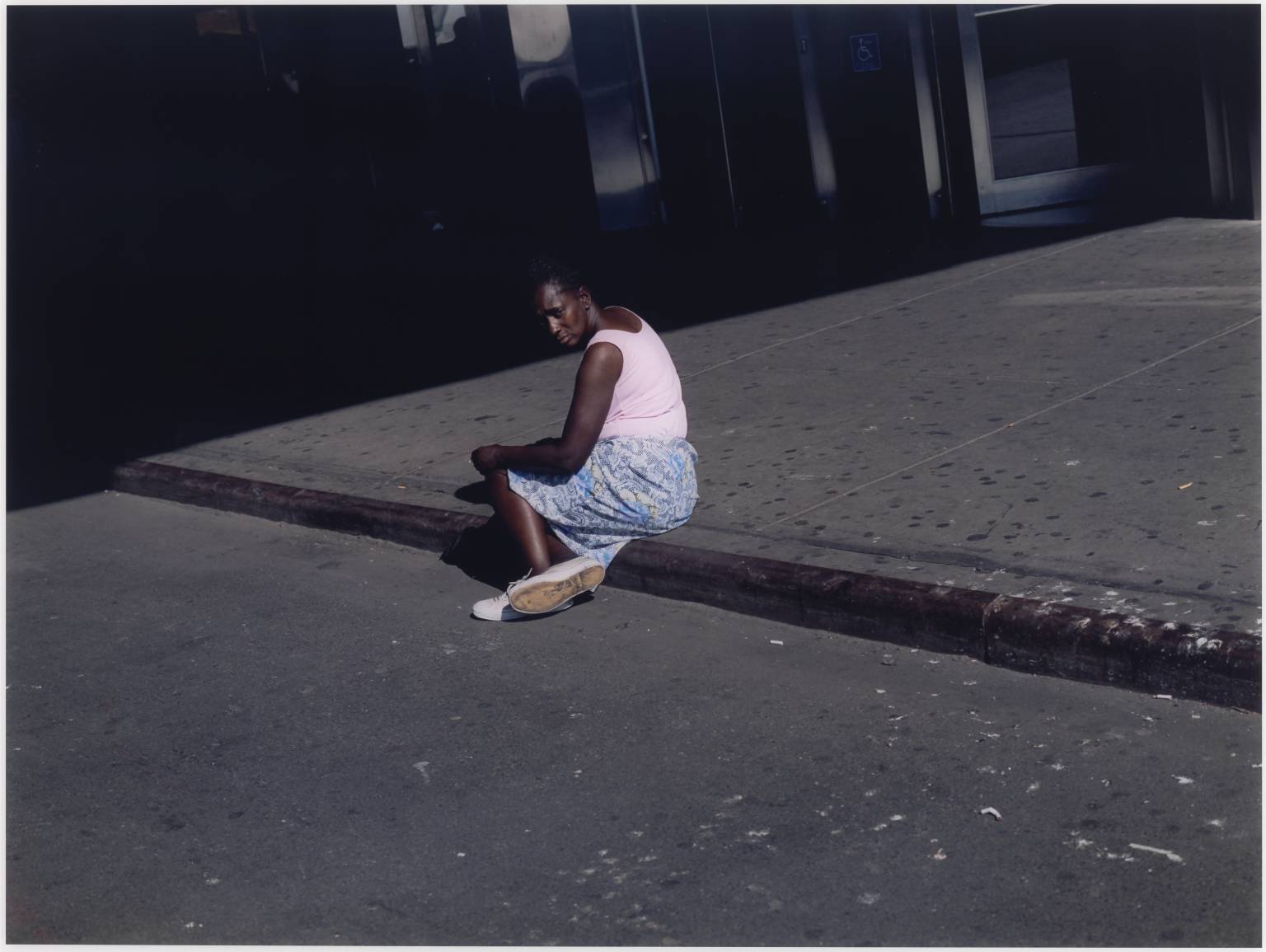
In order to better assess this image in the light of those of HCB, I converted it into black and white.
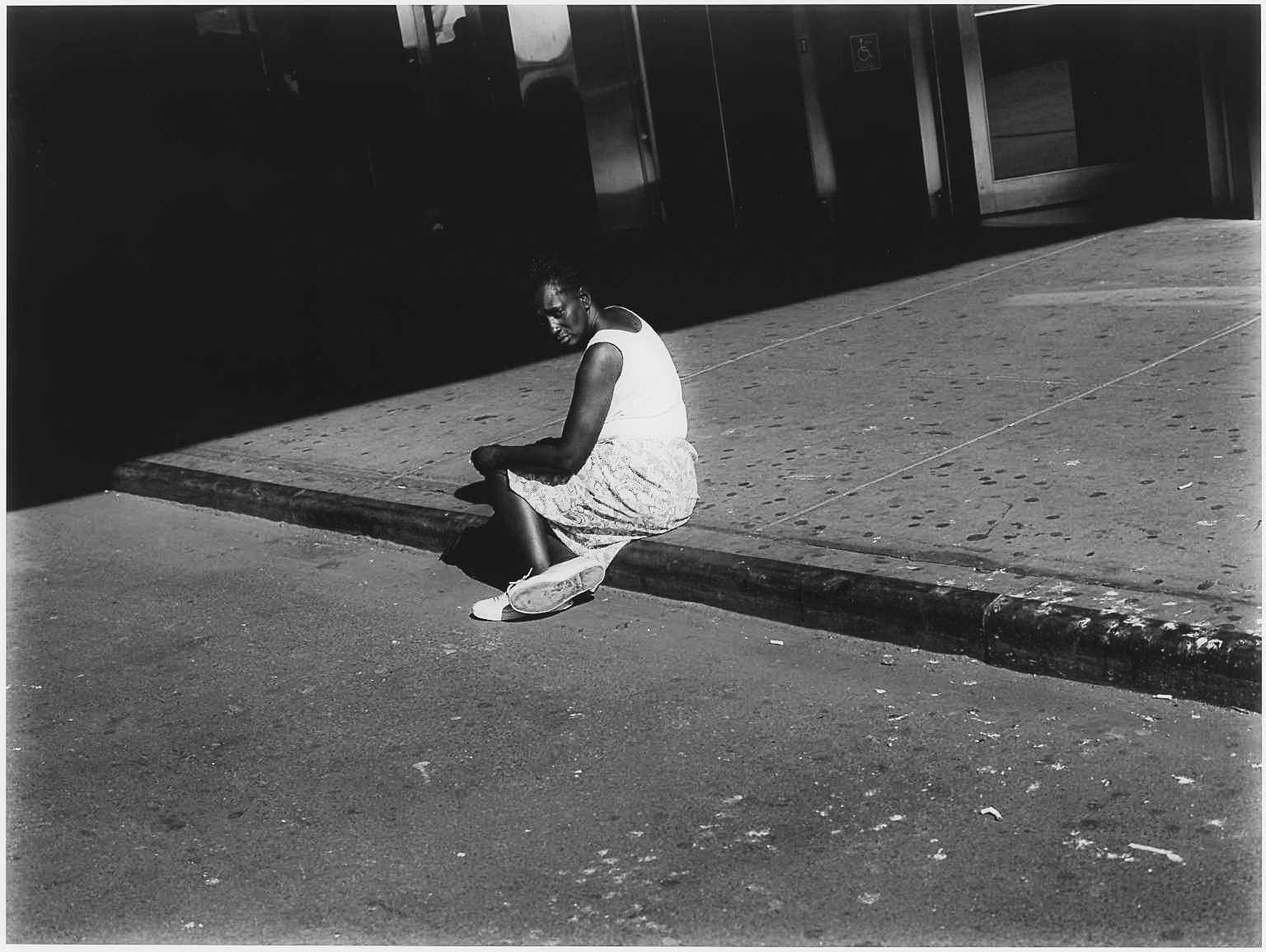
I think it shares many features with the images of HCB. I note the strong geometric composition with a diagonal line on which the subject sits. Similarly the subject herself is sitting in a posture apparently unstaged and natural, and the photographer has captured her expression which is the striking aspect of the image. Her head is positioned, apparently carefully, in the image against the dark background. I find her expression and geometric framing very reminiscent of HCB and his principles for producing images of the “decisive moment”.
I also reviewed the images in the photobook “The Present” (Paul Graham Archive, s.d.)
Similar to my comments on the earlier image, I find it hard to agree with Pantall’s assertion that these are images of “a street with moments so decisively indecisive that we don’t really know what we are looking at or looking for.” (Pantall, s.d.)
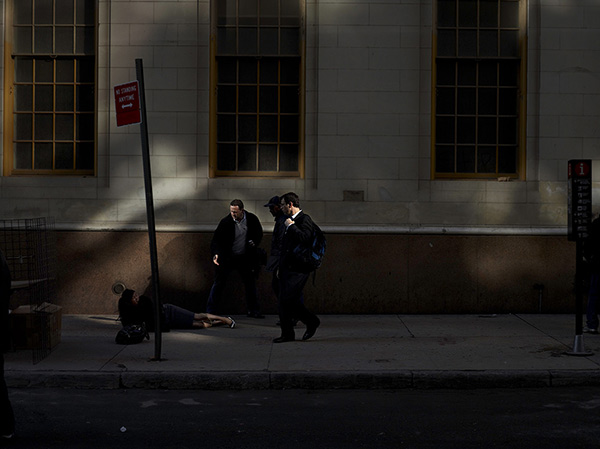
This image of a woman who has fallen on the sidewalk has a formal compositional plan with the bold line on the wall behind the subjects. The woman is positioned in the image so her body is divided by the pole, but her head is clearly adjacent to a grill on the wall behind. The heads of the passers-by are carefully positioned to maximise the illumination and the woman herself has “conveniently” fallen into a pool of light. The photographer here captures the gesture of the outreached hand of the man apparently trying to help her up. This sensitive gesture, is at odds with Pantall’s descriptions of urban life as represented by Graham.
“There are a fair few hostile glances in The Present, and a fair bit of blindness, disability, poverty and wealth. The people are… not glamorous or striking or eccentric, but rather they’re harried, harassed and distant; no relationships were struck in the making of this book. These people could be anywhere; they stride purposefully along streets that hold no attractions to jobs that hold no attractions, their faces set into grimaces of urban stress.”
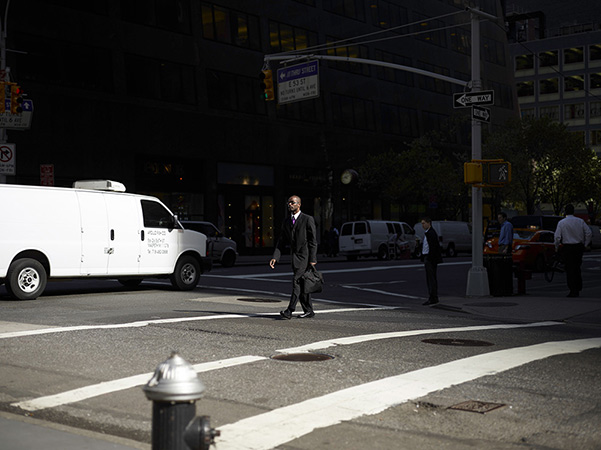
People do indeed “stride purposefully” but in many cases they are captured in a moment which has much in common with the images of HCB in terms of the carefulness and style of the composition and the directions of their gaze. This is exemplified by these.

Zouhair Ghazzal (Ghazzal, s.d.) writing about the work of HCB also emphasises the importance of gesture is these images.
“Cartier-Bresson’s most well known relics reveals the importance of bodily gestures in each one of them.”
and he considered that the work of HCB relied “instead on the juxtaposition of bodily gestures with symmetries created by light and space.”
He also considers that because of this there is a tendency in the observer to look for meaning in the image. “Hence that sudden urge, when confronted with a Cartier-Bresson image, to narrate it”. Although he considers that “An image does not narrate: it rather creates an unbridgeable abyss between itself-as-frame and the rest of the unframed world”.
Ghazzal also considers the work of other photographers, working after HCB. He considers that many do not incorporate the principle into their work.
“Some of the top photographers of the last few decades, which willy-nilly did not base their photography on the decisive moment, would argue that the latter’s major weakness was precisely its sole reliance on gestures.”
However he also suggests that it is not solely the reliance on gesture which underpins this but the nature of modern urban environments. He argues modern cites either in America or Europe or the Middle East, have expanded “indefinitely, and create(ed) for the most part urban landscapes that are so monotonous and dull, that no decisive moment would be able to capture.”
Hsu, in his review (Hsu, s.d.) of the re-issue of the work by HCB, (Cartier-Bresson and Simon, 2014) , considers that the term “decisive moment” itself may be part of the problem here.
“Cartier-Bresson’s moments include not only the dynamic coordination of form, but also acts of looking that consider gesture, expression and a transient connection with his subjects. Paradoxically, the popularity of the term ‘decisive moment’ may have done Cartier-Bresson a form of disservice; while his individual photographs are very much about the ‘simultaneous recognition’ of significance and form,”
The Decisive Moment was originally published in the United States by Simon and Schuster in 1952, and simultaneously published in France by Verve as Images à la Sauvette (“images on the fly”, or “images on the run”). This French title emphasises the way the image is captured – rather than the content of the image of a particular moment.
The principles of how HCB captured his images is considered by Suler (Suler, s.d.) .
Suler also comments on the original French title of the book “In 1952 Cartier-Bresson published Images à la Sauvette, which roughly translates as “images on the run” or “stolen images.” The English title of the book, The Decisive Moment, was chosen by publisher Dick Simon of Simon and Schuster. In his preface to the book of 126 photographs from around the world, Cartier-Bresson cites the 17th century Cardinal de Retz who said, “Il n’y a rien dans ce monde qui n’ait un moment decisif” – “There is nothing in this world that does not have a decisive moment.”
Suler also describes what he believes are 10 principles of the decisive moment image.
These are:
1. A sophisticated composition in which the visual coalescence of the photographed scene capitalizes on the principles of Gestalt psychology to create a “prägnanz” atmosphere of balance, harmony, simplicity, and unity.
2. A sophisticated background to the subject that interacts both visually and psychologically with the subject in a synergistically meaningful figure/ground relationship.
3. The visual as well as psychological anticipation of completion and closure, which often surfaces as a visual gap, interval, or suspension of some kind.
4. An element of ambiguity, uncertainty, and even contradiction that rouses the viewer’s curiosity about the meaning or outcome of the scene depicted.
5. The capture of a unique, fleeting, and meaningful moment, ideally one involving movement and action.
6. A precisely timed, unrepeatable, one-chance shot.
7. An unobtrusive, candid, photorealistic image of people in real life situations.
8. A dynamic interplay of objective fact with subjective interpretation that arouses meaning and emotion about the human condition.
9. The overarching context of a productive photography session – or “good hour” – that starts with tension, then culminates in a personal and artistic realization that is the DM image.
10. The DM photo as a product of a unique set of technical, cognitive, and emotional skills developed from extensive training and experience in photography, as well as from a psychological knowledge of people.
It seems to me that these principles fall into distinct independent groups:
A: The compositional elements of the image produce “balance, harmony, simplicity, and unity” (1) with “meaningful figure/ground relationship” (2) and may incorporate “a visual gap, interval, or suspension of some kind” (3). Overall the effect of this composition is to create “an element of ambiguity, uncertainty, and even contradiction”.
B. The image is captured at a “unique, fleeting, and meaningful moment” (5) in “a precisely timed, unrepeatable, one-chance shot” (6) using “an unobtrusive, candid, photorealistic image of people in real life situations” (7)
C: The final image “arouses meaning and emotion about the human condition” (8)
The remaining two principles appear to me to replicate the other principles outlined. A “productive photography session… culminat(ing) in a personal and artistic realization” (9) is surely necessary for all photographic endeavours. The “technical, cognitive, and emotional skills” (10) needed are used to achieve the earlier 8 points.
Applying this to the images of Paul Graham, I would suggest that the images which I showed earlier achieve that compositional technique. They are taken also taken at a particular unrepeatable moment. Most of all they comment on the human condition in modern urban environment, as Pantall recognises (quoted above).
References
References to the works cited in this post are found in my separate post “References”


 Andrew Procter