I considered representing my artefacts as objects from historical collections (which they are).
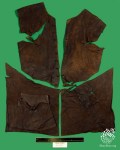
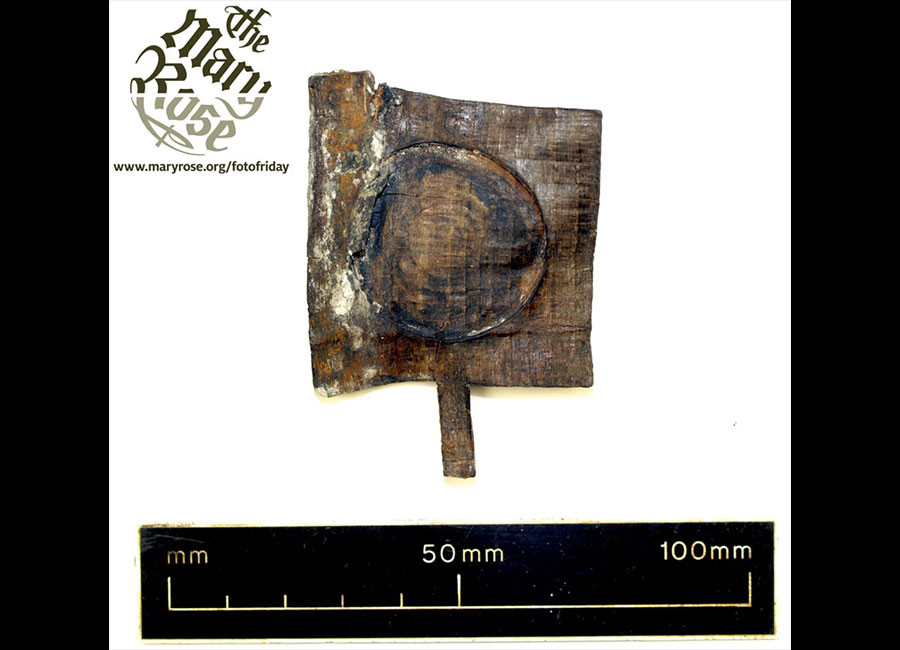
Examples of how such objects may be displayed include the images from the Mary Rose Collection. Some of these are shown below.
Leather Jerkin. Image reproduced with permission of the Mary Rose Trust
Candleholder and candles. Image reproduced with permission of the Mary Rose Trust
Tally Stick. Image reproduced with permission of the Mary Rose Trust
These images show the objects catalogued (with reference numbers included) and a scale bar to show their size. They are against a neutral background and show the detail of the objects.
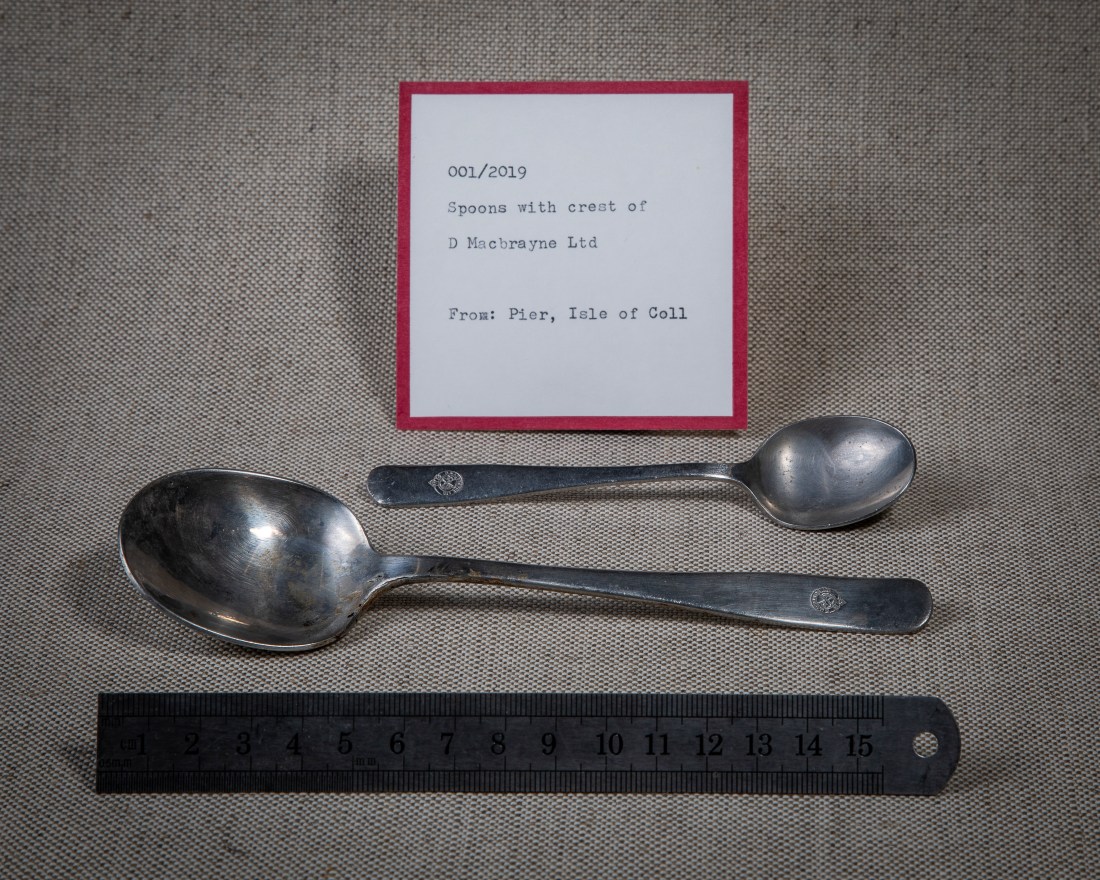
I tried to replicate this with images of some of the objects I have. I have made catalogue labels and typed these on an old typewriter to attempt to model the appearance of an old collection. These are show below.
Jar from Milford HavenSpoons from Pier, Isle of Coll
Technical Information
Again, I chose a focal length of lens adequate to fill the frame, but show the object from a distance comparable to that which someone would view this as an exhibit in a museum. I have used an aperture to maintain a depth of field to have the object, scale bar and label in focus. I have used flash lighting as these were indoors and I wanted control of the lighting to best demonstrate the features of the objects.
Critique
Technically, these images appear to me to meet the aim I had set myself. They show the objects in a similar way to those from the Mary Rose collection. There are some shadows, but these highlight the detail especially on the spoons. My main concern regarding these images is the composition – I have had difficulty positioning the elements in a satisfactory arrangement the horizontal and vertical elements are not all in line, and this could warrant further work.
The other critique I have of these images and this approach is that depicting these objects in this way implies that we know more about them than we do. That they are catalogued and recorded systematically. However the fundamental aspect of them that I am trying to capture is that they have been removed from their background and origins, and we have therefore lost the contextual information to make sense of them.
For this reason I have tried another approach.
I began by considering that the amateur diver collects artefacts as souvenirs or trophies. Extending the concept of trophy I considered depicting these objects in a manner analogous to the trophies of big game and other hunters.
There are two approaches to this which I examined:
The first is the formal portraiture of the hunter with his trophy and I found examples of early depictions of these.
The historical image by Mollard, shows a pair of hunters with their catch.
Baron Louis-Adolphe Humbert de Molard: The Hunters. Paper negative, 185 x 235 mm, C1848
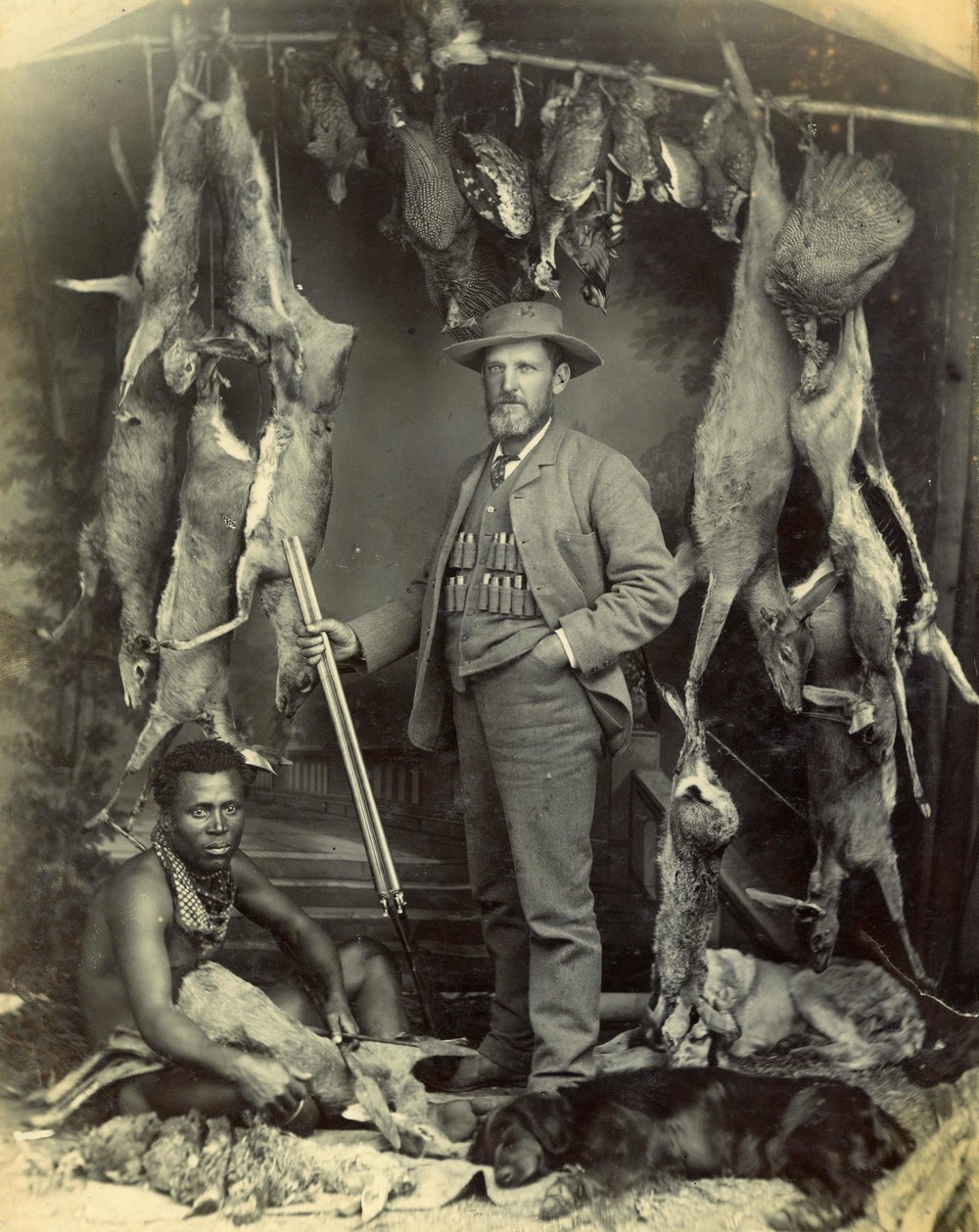
A later image by Barnett of a African big game hunter also shows the game and from his stance and bearing, we infer the pride he has in his achievement.
BARNETT, J. Unidentified big game hunter with his servant, dogs and trophies in Africa, circa 1900.
One approach I have considered was to replicate this type of image with the diver holding his “trophy”. I have had offers from subjects who are willing to sit for such portraits, but have not yet had the opportunity to do this.
The trophies of hunters have often been displayed in houses and form an iconic aspect of the grand country house. This feature of interior design continues to be employed by contemporary designers – even if the owners of the house did not shoot the animal themselves. Thus taxidermy heads may be used to create a impression of the classic country house and I show an example below.
Interior design by Dig Haushizzle: dig-haushizzle.co.uk
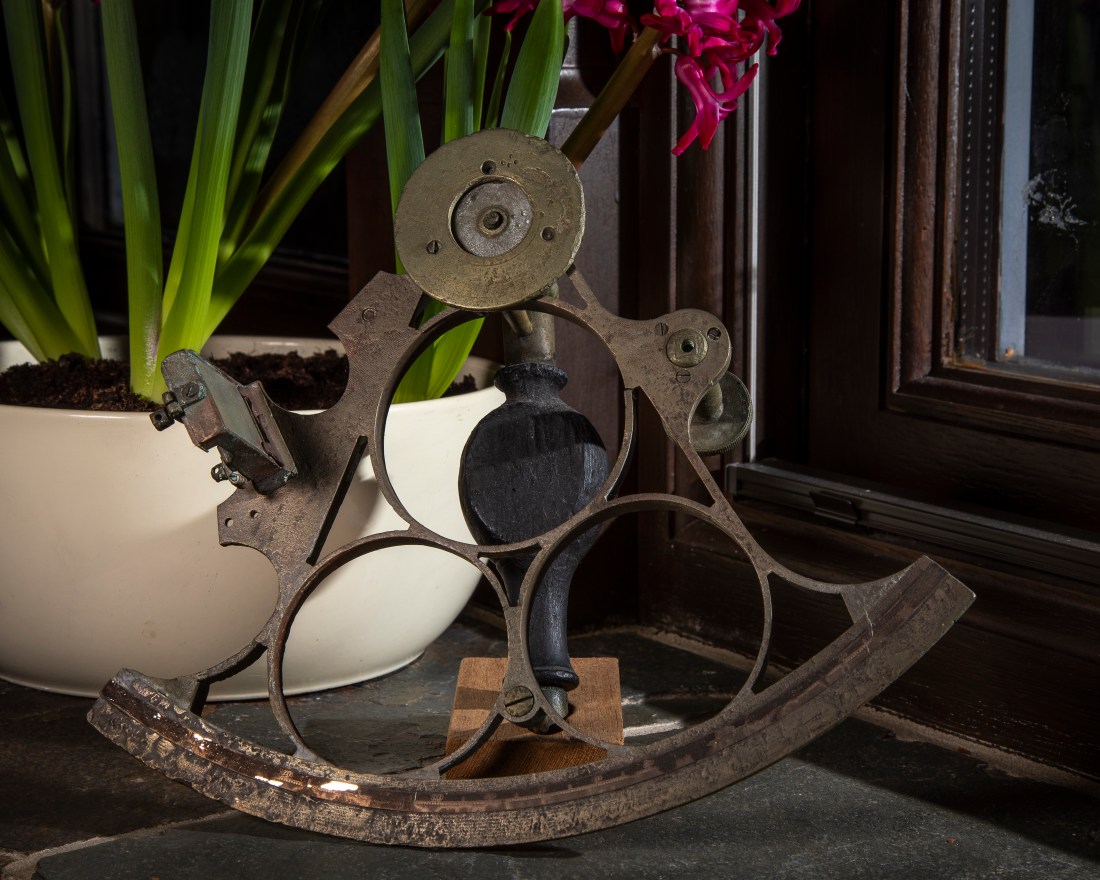
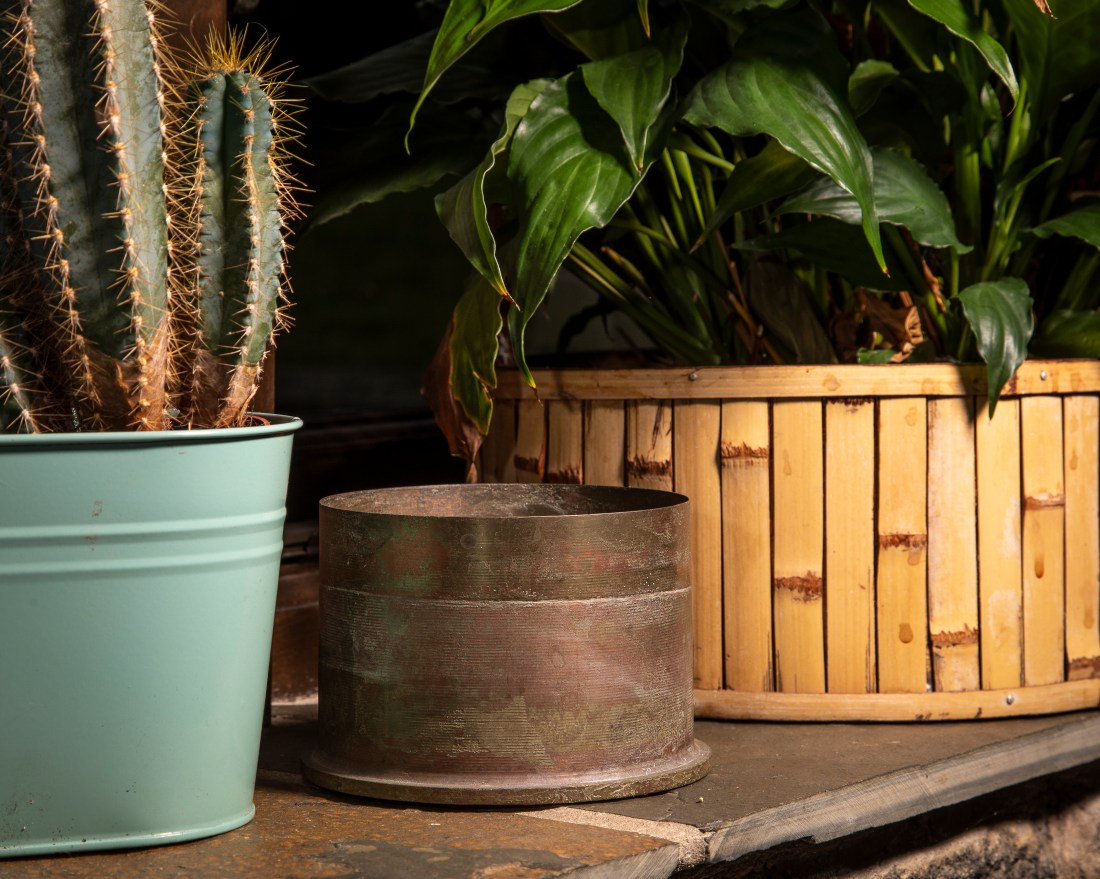
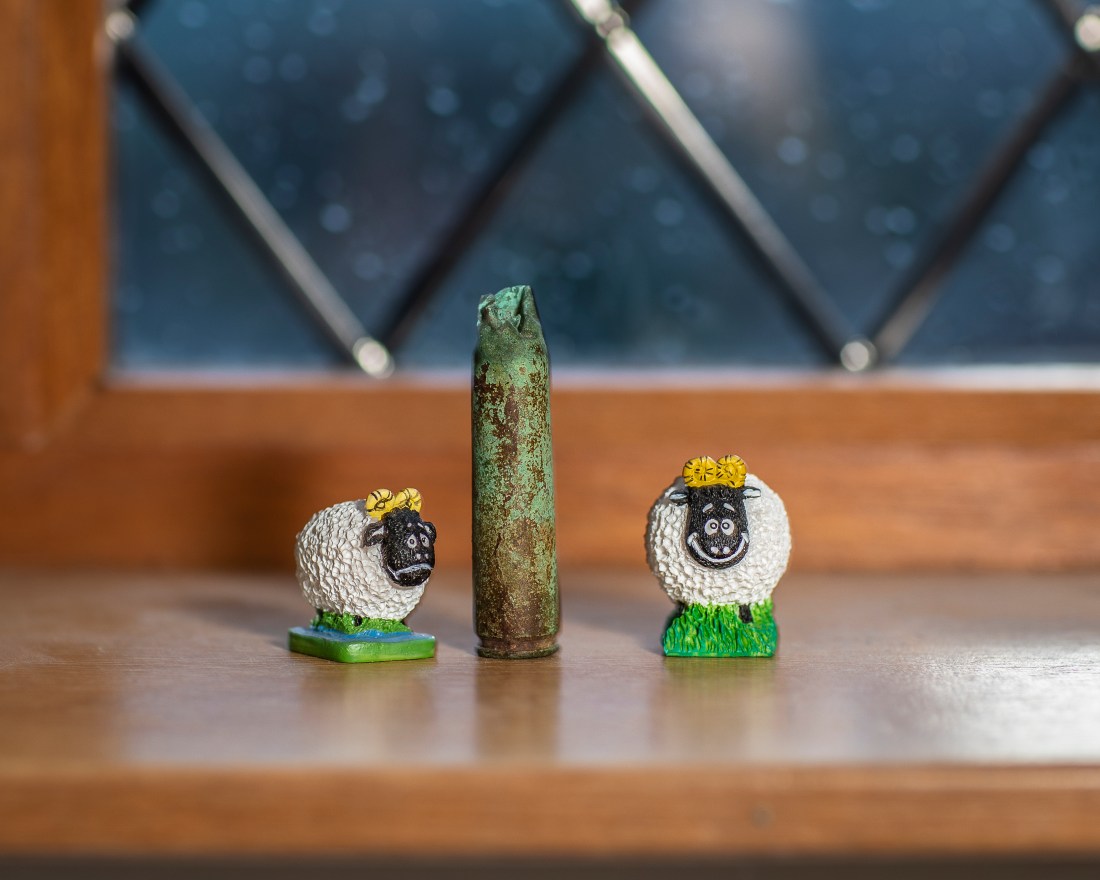
I have tried showing the artefacts as they are displayed in the divers’ homes, and examples are below.
Ornament 1Plant pot holderOrnament 2
This approach has the advantage of showing how out of context the artefacts are – how they have lost their connection with their origins and are now reduced to objects of interior design.
Technical Information
These are images of artefacts in the divers’ homes in the position where they are normally displayed. They were all on window sills so back lit. I chose to use flash to supplement the ambient light to better display the objects.
I have chosen viewpoints at a distance where they might normally be viewed, so have selected a focal length of lens to match this. This gives the object itself a relatively “normal” perspective. In the images of “ornament 1” and “plant pot holder”, I used an aperture to give a depth of field sufficient to have the surrounding objects in focus as I considered these to be show the important context in which the objects are displayed. In “Ornament 2” I have used a larger aperture and thereby have shallow depth of field to render the detail of the window out of focus and allow the observer to concentrate on the artefact and surrounding two objects.
The images have been shot in RAW and processed in Lightroom, to crop to a 10×8 landscape format for each which is consistent and frames the objects and their surroundings appropriately. I made minor adjustments of exposure only.
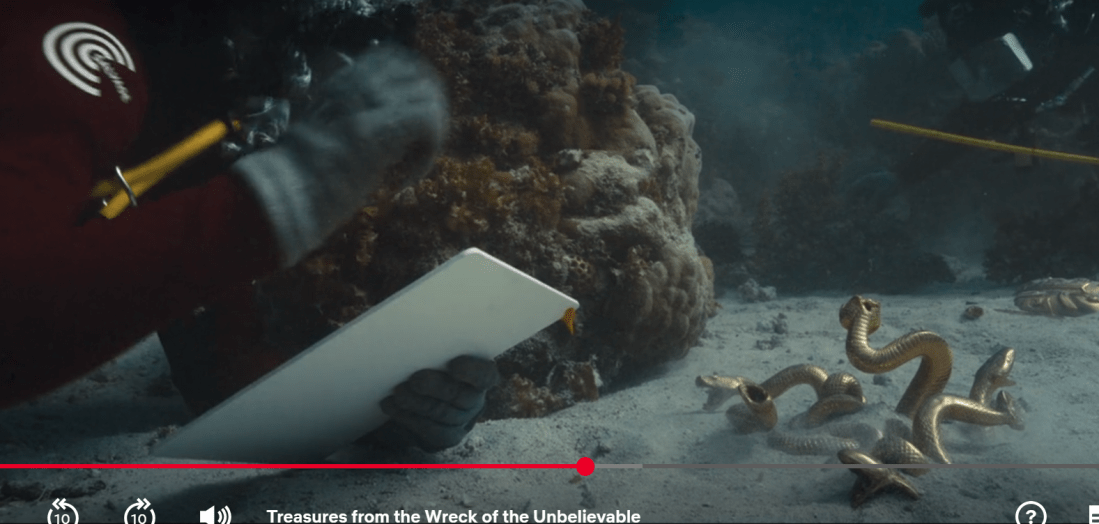
The exhibition by Damien Hirst “Treasures of the Unbelievable” was an exhibition of objects supposedly recovered from a wreck off the East African coast (https://news.artnet.com/art-world/damien-hirst-review-918074). The exhibition included film and photographs explaining the back story to these objects, and their “recovery” is described in Hirst’s film of the same name (https://www.netflix.com/title/80217857). While the works in the exhibition and the style are not a direct influence on my project, this series of works by Hirst demonstrates the importance of context in interpreting and explaining the significance of objects.
The objects look as if they have been recovered from a shipwreck, they are covered in coral and encrustations. However they are given meaning by the elaborate descriptions of the discovery and recovery of the wreck and its “history” which was set out in other elements of the exhibition and the subsequent “documentary” film.
People look at Lion Woman of Asit Mayor by Damien Hirst. Photo by Miguel Medina AFP Getty Images.
Screenshot from “Treasures of the Unbelievable” Dir. Sam Hobkinson
The “Lion Woman of Asit Mayor” is covered with encrustations, like a real recovered artefact. The film includes scenes showing the “excavation” of the wreck, and the same attention to detailed recording as would be made in an archaeological survey.
The importance of this work to my project is that these objects were never underwater, but are given meaning by the context Hirst has created. The objects I will photograph, were underwater and are from real wrecks but many have now lost their contextual information and background and tell us little.
Shipwrecks as archaeological sites provide valuable insights into the past. They have been considered as “time capsules” containing objects being used at the time of the sinking. Because of the precipitous nature of the sinking there was often no opportunity to remove objects and they remain as they were while in use at that time.
One such example is the wreck of the Mary Rose; flagship of Henry VIII’s Vice Admiral of the Fleet. The Mary Rose sank in the Solent on 19 July 1545 with the loss of hundreds of lives. Despite attempts at salvage by Venetian salvors, much of the Mary Rose sank into the soft sediments of the seabed and was eventually covered by hard mud and protected from erosion. Following the re-discovery of the wrecksite in the 1960’s the wreck was systematically excavated and mapped until it was raised in 1982. The wreck has revealed a remarkable collection of objects and a substantial part of the hull as well as the bodies of the men who died during the sinking.
Wooden wrecks like the Mary Rose may be preserved for many years allowing such recovery. This is illustrated by the recent discovery of the wreck of a Greek vessel in the Black Sea, which is thought to have sunk 2400 years ago (https://www.bbc.co.uk/news/world-europe-45951132 accessed 09/01/2019). However iron and steel wrecks are not preserved in seawater and decay much more rapidly. Reports of the condition of the Titanic indicate it is decaying due to a combination of several factors including the effects of ocean currents, chemical reactions between sea water and the iron and steel, and the effect of marine organisms. (eg https://news.nationalgeographic.com/news/2010/08/100818-titanic-3-d-expedition-shipwreck-science-collapsing/)
Similarly the less high profile, but popular dive site, the wreck of the Thesis in the Sound of Mull, Scotland, is similarly decaying. Following a major collapse of the bow of the wreck a few years ago, a survey in 2015 by the Scottish maritime archaeology project, SAMPHIRE, concluded this was due to the “fragile and highly corroded nature of the surviving elements of the bow structure” (http://blogs.wessexarch.co.uk/samphire/2015/07/06/defending-the-thesis/).
The artefacts recovered by projects such as the Mary Rose Trust provide an insight into the functioning of the ancient ship and life on board at that time. However if the iron and steel wreck decay as they appear to do, there will not be a similar archaeological record for these.
Amateur divers regularly dive the wrecks of iron and steel vessels in relatively shallow, coastal waters. Some of them do this as part of systematic investigations of the wreck, but most are informal almost “sightseeing” trips to the wreck. These latter divers often take objects from the wrecks as souvenirs and build up small, unsystematic collections. For many wrecks these collections may soon be all that remain as the iron and steel decay.
Wreck Policies and Legislation
There is legislation regarding the removal of objects from wrecks. Under the Merchant Shipping Act 1995, all wreck material regardless of size or significance must be reported to the Receiver of Wreck if it is recovered from within UK territorial waters or recovered outside the UK and brought within UK territorial waters. Reporting requires completion of a Report of wreck and salvage form which is then sent to the Receiver of Wreck within 28 days of the recovery of the object.
The National Governing body for Sport Diving, The British Sub-Aqua Club, BSAC) has a policy to remind divers about the legal position, “Respect our Wrecks” ( https://www.bsac.com/advice-and-support/respect-our-wrecks/respect-our-wrecks-policy/). This BSAC policy also however promotes that divers should explore wrecks but not damage or disturb them and take photos rather than souvenirs. Because many wrecks have an important history, reporting finds to the Receiver of Wreck, enables such information to be passed to archaeological experts.
Archaeological Interpretation
The systematic exploration of an archaeological site depends on the careful recording of where precisely each object was found. In this way the spatial relationship of one object to another is recorded and from that spatial information, function may be inferred.
An example of this is that of a shaving mirror recovered from the Mary Rose.
Shaving mirror: “This tiny mirror was found in a chest outside the carpenter’s cabin, alongside a razor and a shaving brush, so we believe it to be a shaving mirror. Although none of the mirroring itself has survived, fragments of glass were also recovered.” Image and caption reproduced with permission of the Mary Rose Trust
This was found in a chest outside the carpenter’s cabin, possibly indicating who it belonged to and their social status. There was no glass in the mirror when found, but fragments found nearby indicating that this object, which in itself does not look like a it, was indeed a mirror. Alongside it was a razor and shaving brush indicating it was likely to be a shaving mirror rather than some other type. This wealth of knowledge about a small, apparently unassuming object has only been pieced together by knowing the spatial context of the object and what surrounded it.
The objects recovered by amateur divers as “souvenirs” lack this context and therefore are unable to contribute to knowledge about their use or the wrecksite more generally. It is the lack of contextual information about the objects in these collections and their isolation and separation from their origins which I want to try and capture in my Project. By so doing I hope to highlight the importance of recording and declaring finds to the Receiver of Wreck so that an effective record of this aspect of nautical history can be recorded.
“On OCA photography courses you’ll often be asked to submit a series for an assignment. Like the examples in Project 2, a series should reflect a single coherent idea, even though the individual photographs will be unique. For this assignment you’ll make a collection of photographs using a combination of lens techniques that you’ll decide for yourself. Your tutor will evaluate the series in terms of its technical skill but also on how well the assignment works as a whole.”
Brief:
“Create a series of between six and ten photographs from one of the following options, or a subject of your own choosing:
Crowds
Views
Heads
Use the exercises from Part Two as a starting point to test out combinations of focal length, aperture and viewpoint for the set. Decide upon a single format, either vertical or horizontal. You should keep to the same combination throughout to lend coherence to the series.”
My Choice of Subject
As an enthusiastic amateur sport diver I am aware that many divers have small collections of objects they have found on ship-wrecks and recovered to the surface. I have decided to choose my own subject for this project and photograph objects from such collections. The background to this and the reason I consider it important I will explain in my next post.
I used a different camera for these exercises. As I was on holiday for a few days in Venice I did not take my DSLR but used a compact camera with integral zoom lens and shooting modes including aperture, exposure and full manual as well as automatic. The images are shot in RAW and edited in Lightroom. I have done minimal post processing, only minor adjustments of exposure in places, and slight cropping.
The focal length of the zoom is indicated in the caption to the image.
I took a number of images during my brief visit to Venice – the ones that relate to this exercise are shown in the contact sheets at.
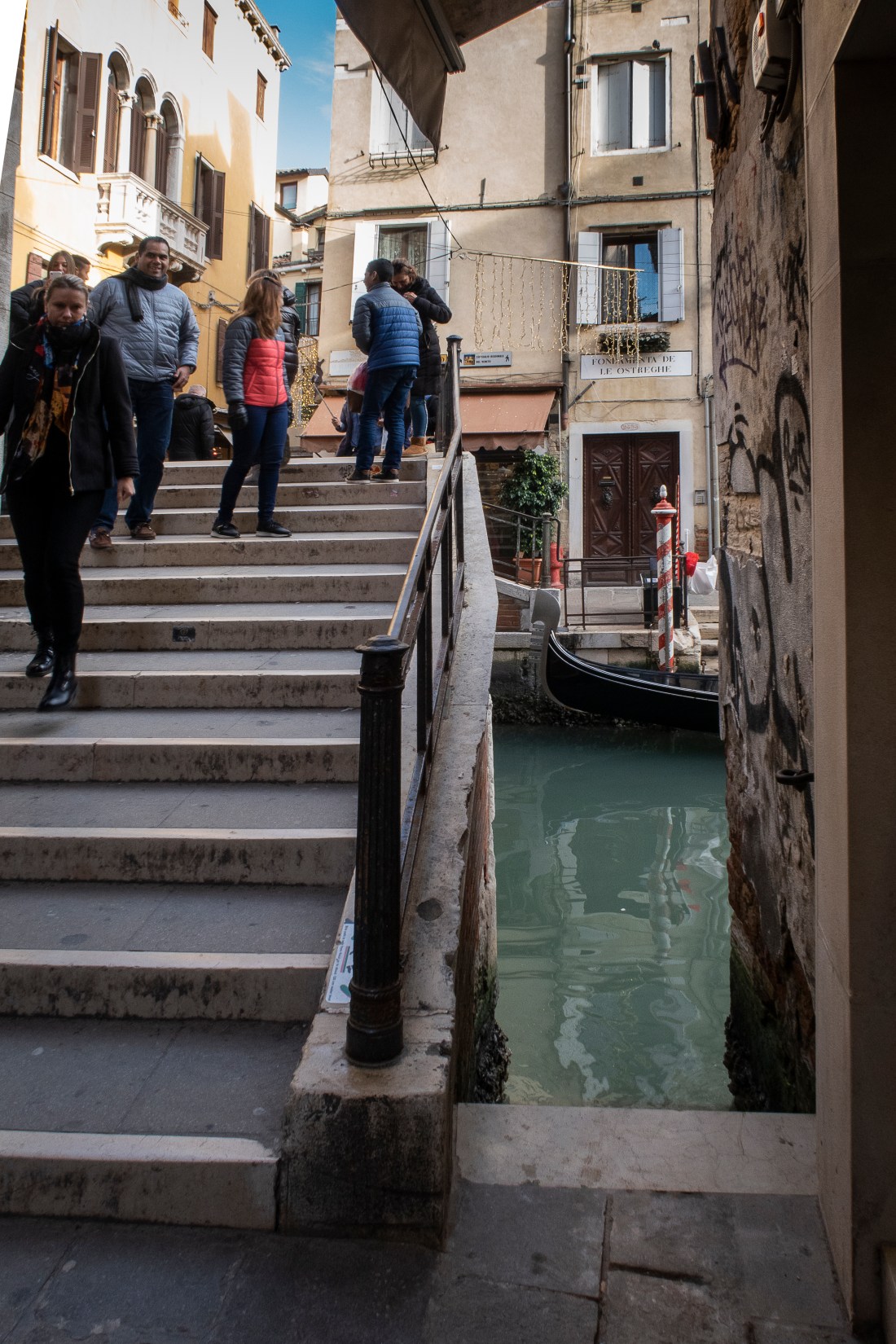
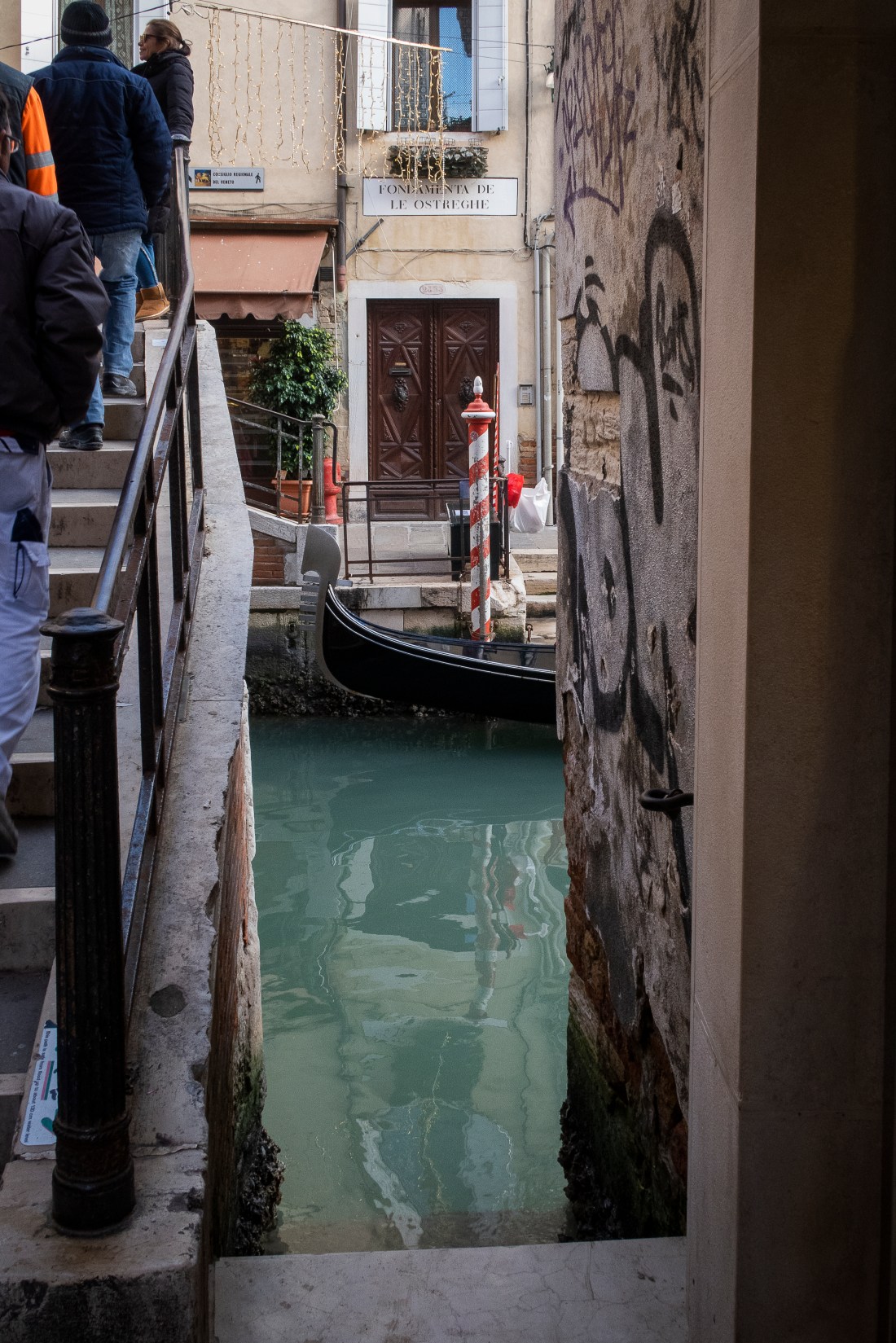
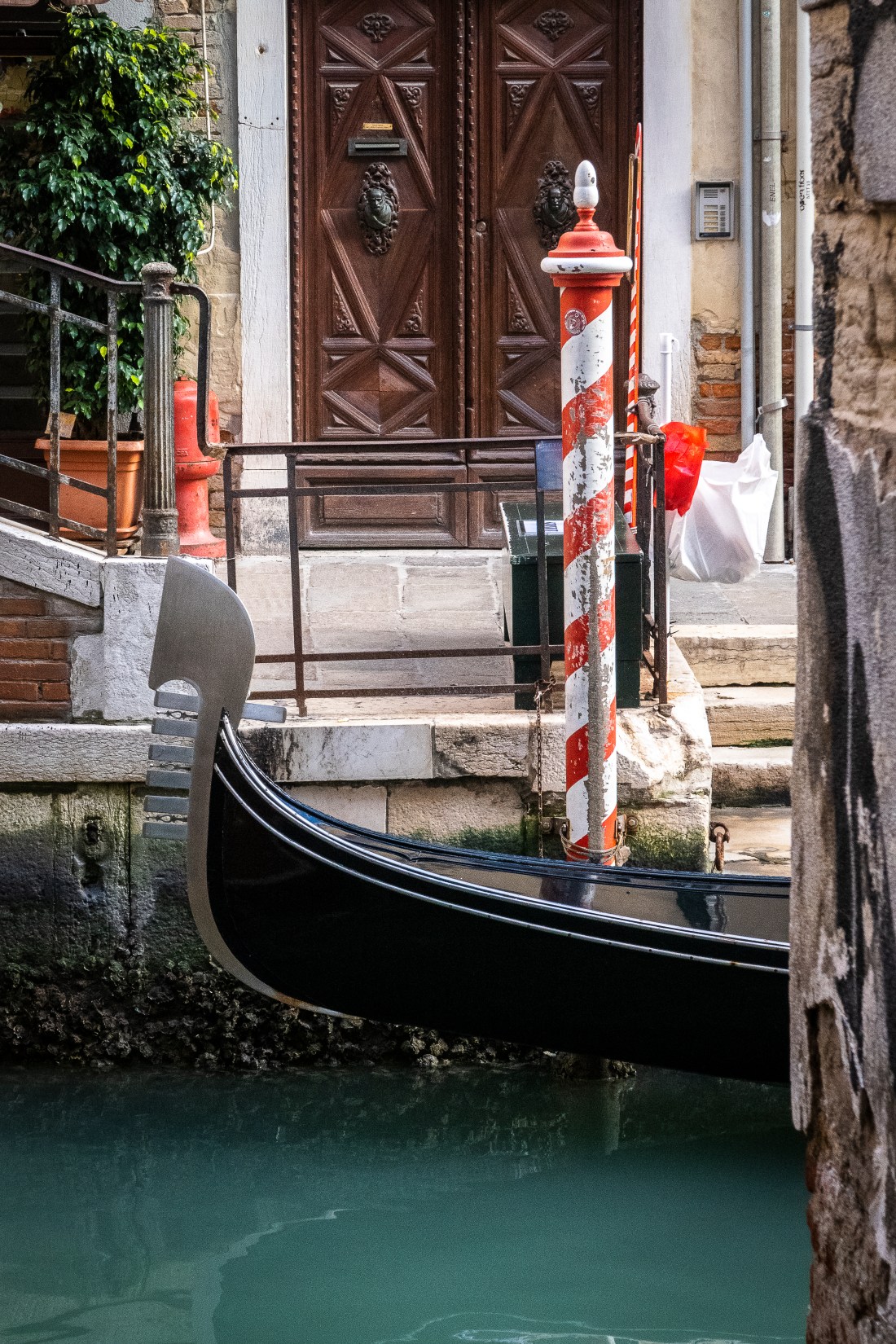
Exercise 2.1 Find a scene that has depth. From a fixed position, take a sequence of five or six shots at different focal lengths without changing your viewpoint… Which shot in the sequence feels closest to the angle of view of your normal vision?
Calle delle Ostreghe, Venice 8.8mmCalle delle Ostreghe, Venice 13.3mm
Calle delle Ostreghe, Venice 36.8mm
The images show a busy bridge over a small canal. At wide angle the people on the bridge dominate the image and it feels bustling and busy, whereas the at maximum zoom the image seems tranquil and peaceful. The middle one is closest to normal vision. Although in this setting it is difficult to determine what is normal, as one’s attention can be focussed in life to small details and ignore the bustle.
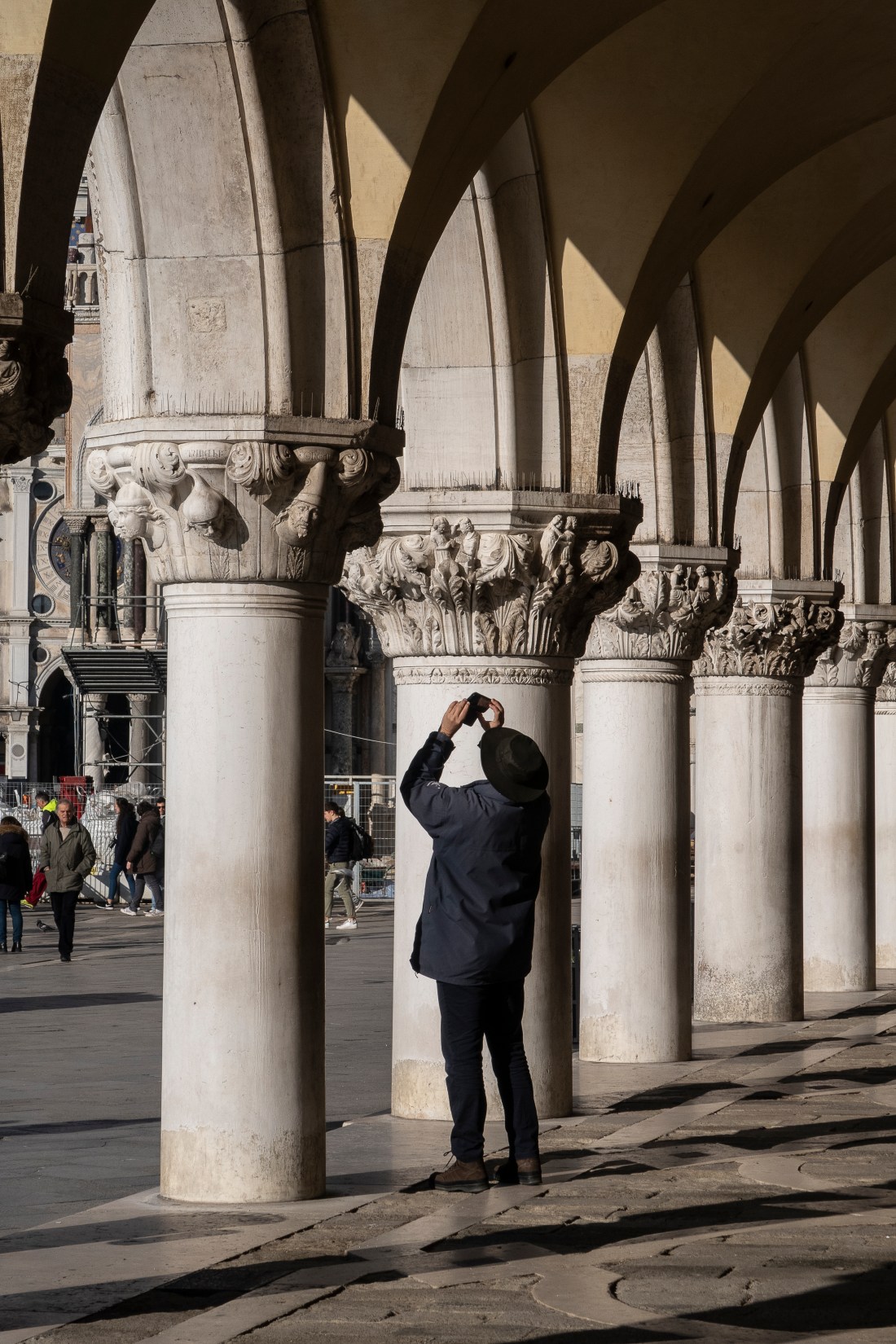
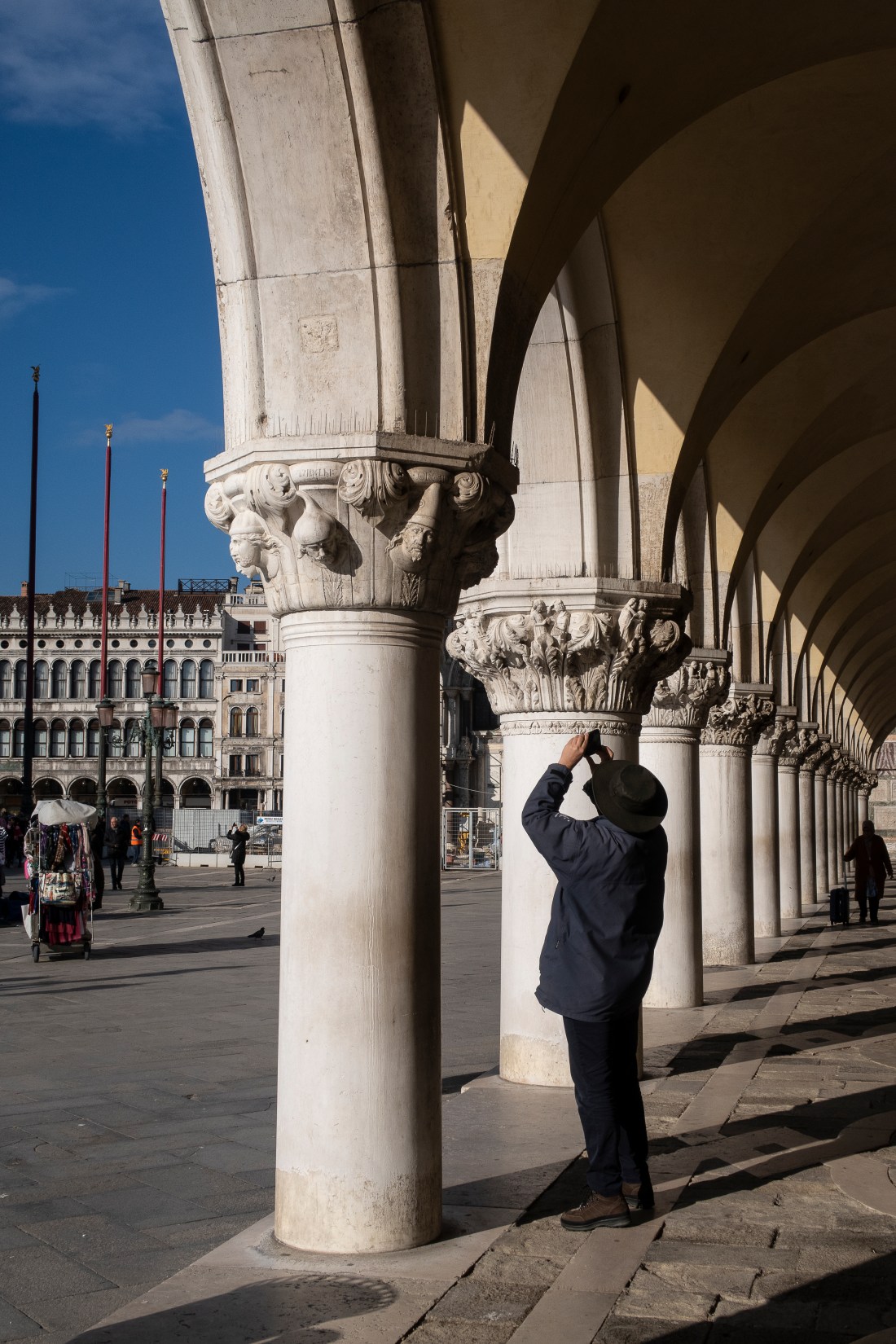
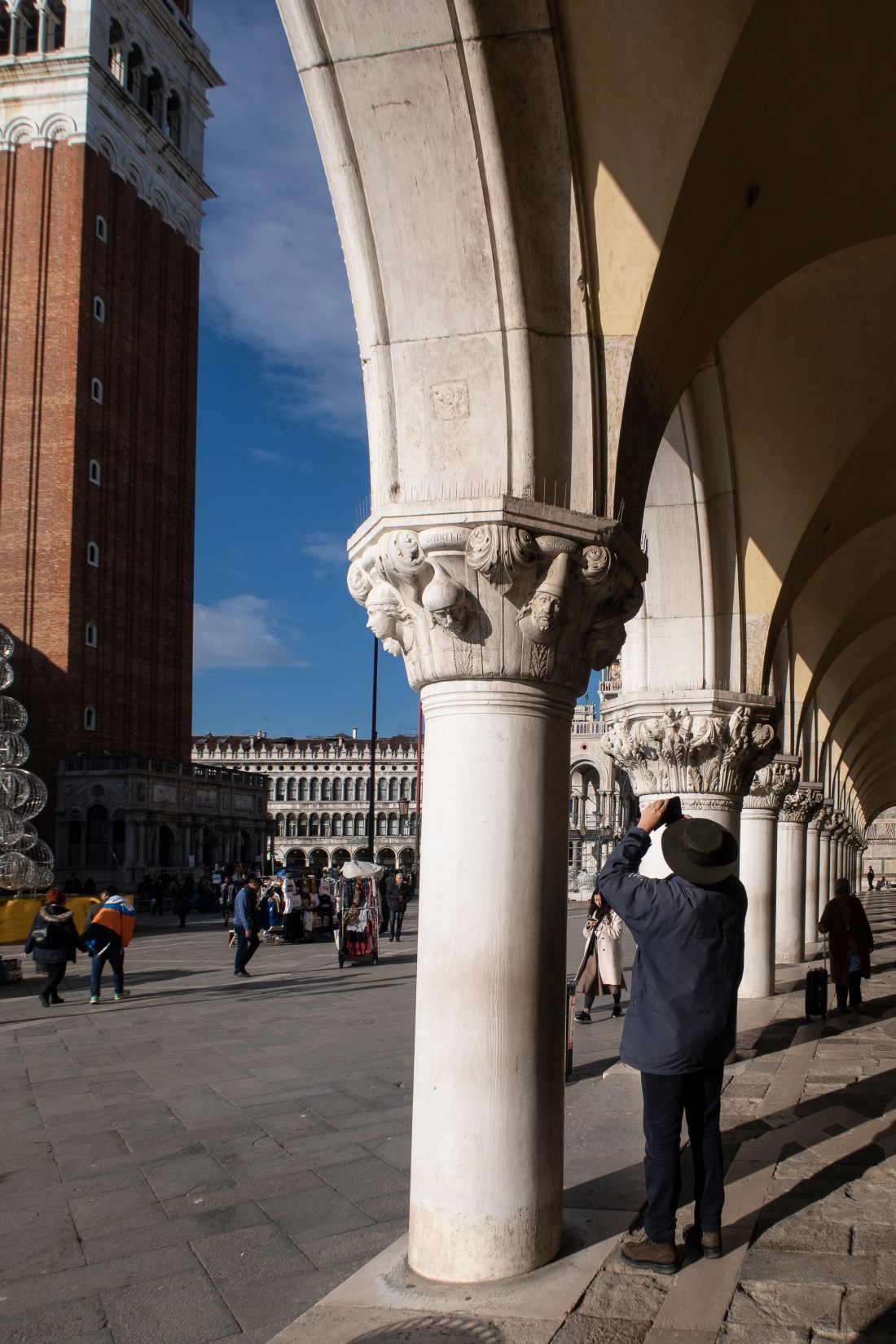
Exercise 2.2 Select your longest focal length and compose a portrait shot fairly tightly within the frame in front of a background with depth. Take one photograph. Then walk towards your subject while zooming out to your shortest focal length. Take care to frame the subject in precisely the same way in the viewfinder and take a second shot.
These images are not a portrait, but show a tourist taking a picture of a detail in the columns near San Marco. Far away from the subject and using a zoom, we concentrate on the subject and his attention; he could be anywhere in any mediaeval colonnade. Whereas closer with a wider angle lens we can see his surroundings, and at the widest angle iconic buildings are included indicating this is an image of Venice. We concentrate on that and the photographer is just another tourist.
As I indicated above, I took many other images while in Venice. All of these are in the contact sheets below.
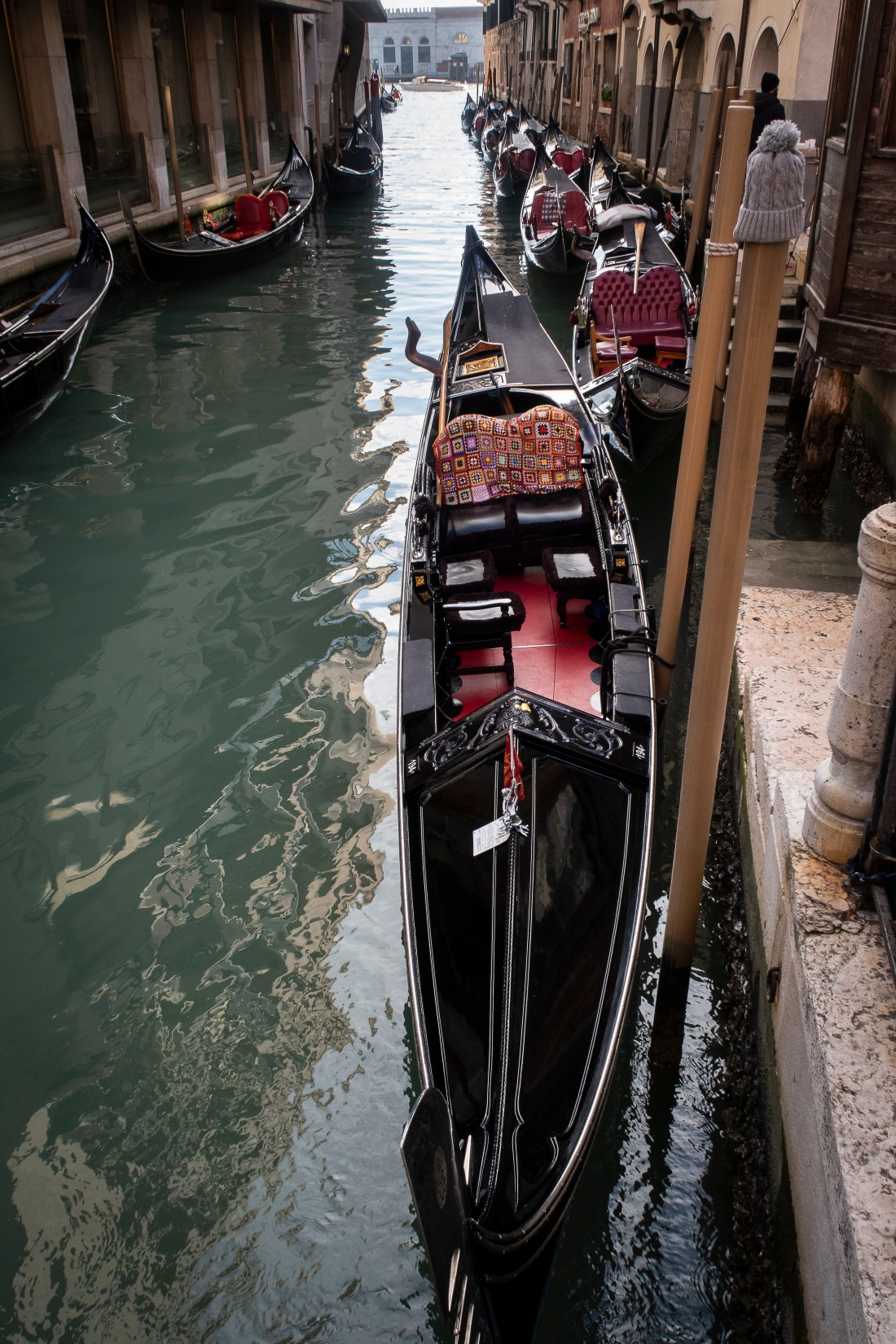
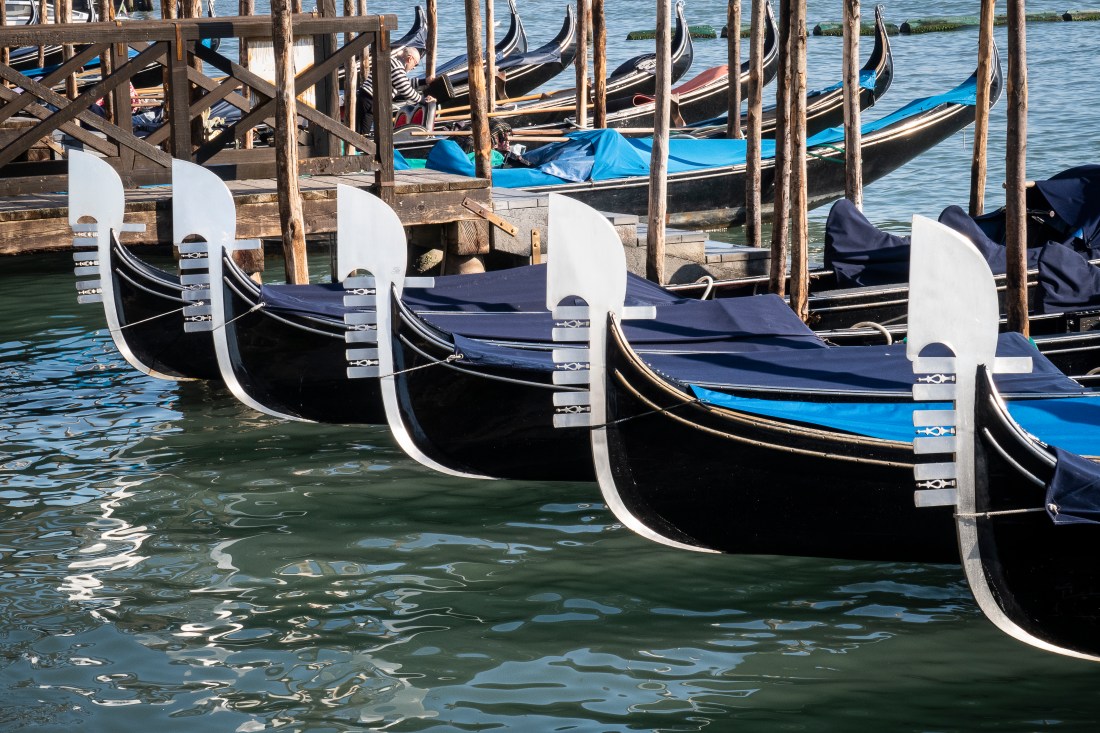
Of these images I have used this effect of the altered perspective afforded by the use of wide-angle or telephoto focal length to compose the image I sought for my “holiday pictures”.
This shows the use of a wide angle to show the whole of the foreground gondola while putting it into a context with a wide background shot of other gondolas and the buildings in the middle and far distance.
Gondola Venice Focal length 11.0mm
In this image I have used a longer focal length to flatten the perspective and make the receding line of the bows of the gondolas all appear a similar size to make the pattern I sought.
http://davidcampany.com/thomas-ruff-the-aesthetics-of-the-pixel/ http://jmcolberg.com/weblog/2009/04/review_jpegs_by_thomas_ruff/
These reviews consider the work of Thomas Ruff in his book JPEGS (2009). In this book Ruff takes archival images and enlarges them to a level at which the pixel structure of the digital image is obvious. In this way he aims to explore the nature of the photographic image in the digital era.
Company, in his review, draws an analogy between the pixels of the digital image and the grain of photographic film. He notes that “Analogue photography developed an aesthetics of grain quite early on, especially through reportage.” Of necessity such photography relied on fast film speed and associated with this was more prominent granularity of the negative. Pixilation is not the only factor distorting the digital image, a granularity can occur with fast ISO and associated reduction in resolution.
While film photography is often referred to as analogue to distinguish it from photography with electronic digital cameras, at a molecular level the film is also digital: a molecule of the photosensitive coating either reacts to the light, or it does not. I would argue that the grain of film and the pixilation and other artefacts represent the limits of the technique and they are analogous to the brush strokes of a painter. It is the role of the photographer to work with these technical limitations to create the aesthetic effect envisaged, in the same way as a painter might use prominent of less prominent brush strokes.
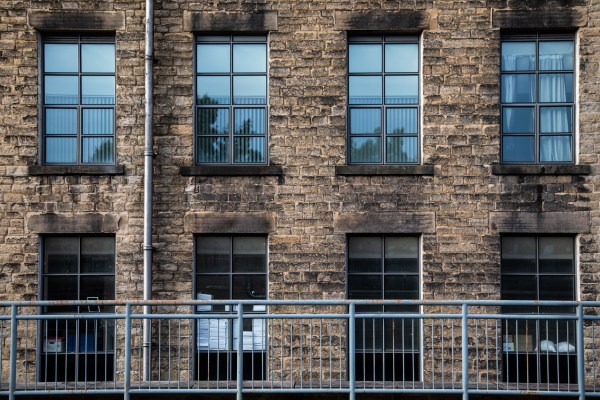
Wren Nest Mill, GlossopWren Nest Mill, Glossop
These two versions of the Image of Wren Nest Mill differ in the pixels forming the image, however removing the fine detail from the larger image allows the viewer to concentrate on the areas of colour and composition of the image and I would argue maintains a major factor which contributes to the appeal of the image (to me).
I was directed to this book by my tutor as an introduction to the course.
It is a series of essays by the American photographer and writer Robert Adams published between 1981 and 1994. The cover notes say
“His subjects vary, but again he questions accepted prejudice, this time not only the view that art is trivial but that artists are separate. He demonstrates that many understand themselves to be bound to the world by complex and important obligations.”
I read the book from cover to cover as I would a novel. I believe I have learned a number of things from it.
What I did not learn was very much about the style and methods of the photographers discussed. However, the writing introduced a number of photographers with whose work I am not familiar. The book is sparsely illustrated with examples of their work, so I think I must look elsewhere to get a better understanding of their styles.
The writings did however examine the context in which the photographers were working. Adams attempted to describe their motivations and drives, although this is largely by inference as the photographers themselves do not in general give any account of this. I found the chapter “Writing” expressed this well.
“Photographers are like other artists too n being reticent because they are afraid that self-analysis will get in the way of making more art….
The main reason that artists don’t willingly describe or explain what they produce is, however, that the minute they do so they’ve admitted failure. Words are proof that the vision they had is not, in the opinion of some at least, fully there in the picture.”
For this reason, I think that what the writing is telling me about is Robert Adams’s own motivations and reasons for his photography. As he himself acknowledges:
“Probably the best way to know what photographers think about their work, beyond consulting the internal evidence in that work, is to read or listen to what they say about pictures made by colleagues…”
There are many other points that I gained from reading this book. One of the challenges facing me is to understand the framing techniques used by Paul Strand in his work “Time in New England”. Adams describes “Church, Vermont 1944” as “among the greatest architectural pictures ever made”. The edge of a symmetrical building is cut off the image, and in other images he off-centres or includes large areas of apparently irrelevant framing.
I think I must re-read this section and find more of the images from this series. It is helping me to begin to understand the issues addresses in Exercise 1.4 Frame.
Brief:
Take a good number of shots, composing each shot within a single section of the viewfinder grid.
evaluate the whole frame, not just the part you’ve composed
Select six or eight images that you feel work individually as compositions and also together as a set. you might like to present them as a single composite image.
I took these shots in the evening as the sun was setting – some of the locations were therefore quite dark.
I have had the camera set to Automatic as directed in the original brief at the beginning of this section. As a result many of the images appeared unsatisfactory to me as they lacked detail in many areas of the frame.
(My reflection: as this is an exercise in Form rather than Content, I wonder if my initial assessment of the images is that they do not reflect the content of what I was taking, rather than forcing me to concentrate on the overall form of the image, and the elements of the composition.
However notwithstanding this concern, I felt it appropriate to adjust the images in Lightroom to achieve a more satisfying end result. I have not cropped these except to correct horizontal orientation as I had not held the camera level for all.
Examples of pre- and post- processing images are shown here.
Gate, Blackshaw Clough
Swineshaw Reservoir
Swineshaw Reservoir
One impression on looking at these images side by side is that the un-processed image has larger blocks of shapes, rather than a lot of detail. The detail gives a more (to me) striking image – especially the second pair (“Swineshaw Reservoir”), but the unprocessed one is a more abstract image, reduced to major component elements.
The images I shot for this exercise (post-processing) are in contacts sheets here.
The images I have chosen which I think work as individually and together include these
Blackshaw Clough, near Swineshaw Reservoir
Gate, Blackshaw Clough
Gate Blackshaw Clough
Gate, Lower Blackshaw
Swineshaw Reservoir
Gate, Swineshaw Reservoir
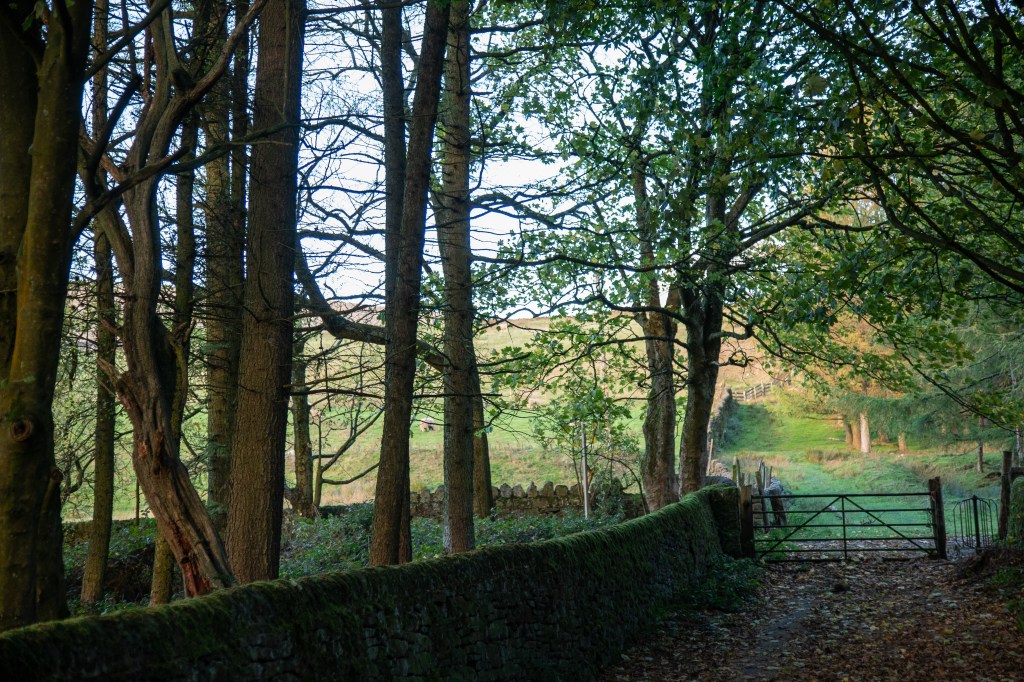
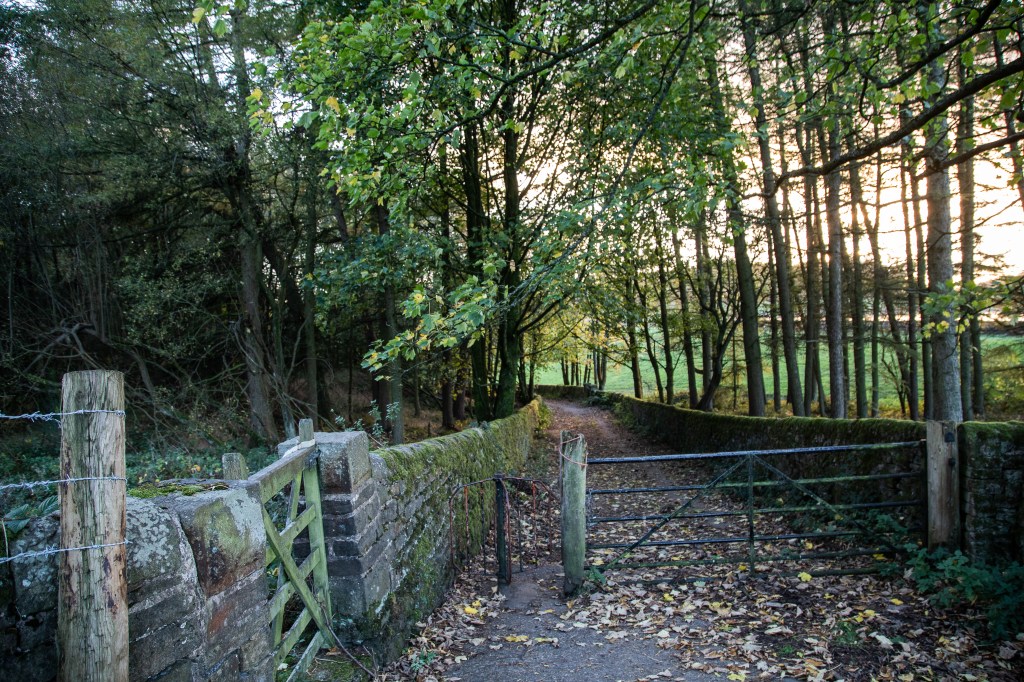
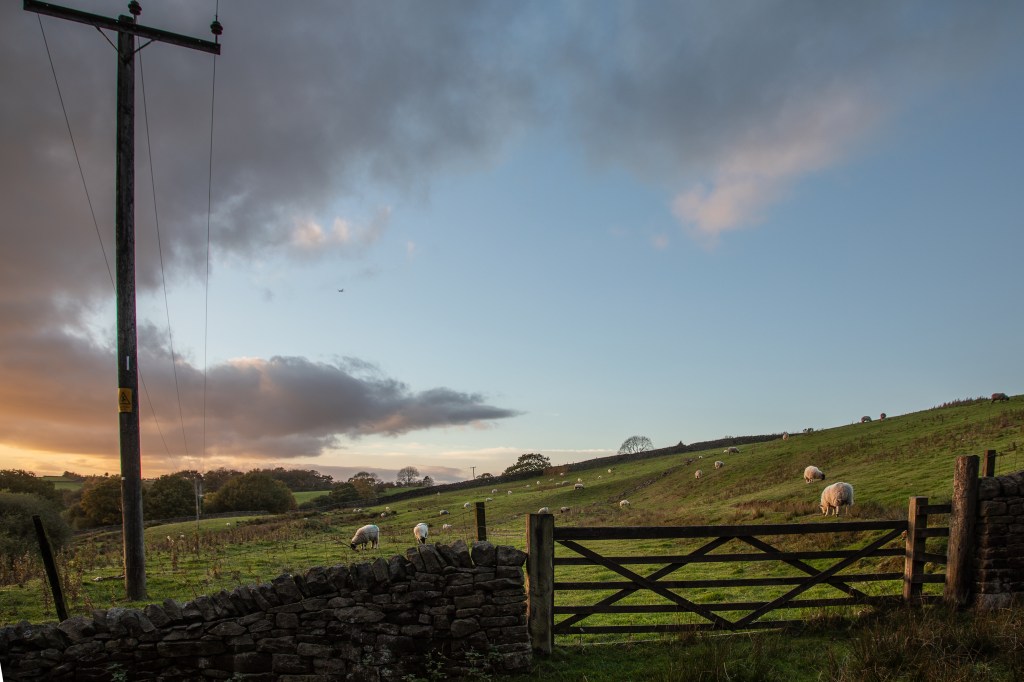
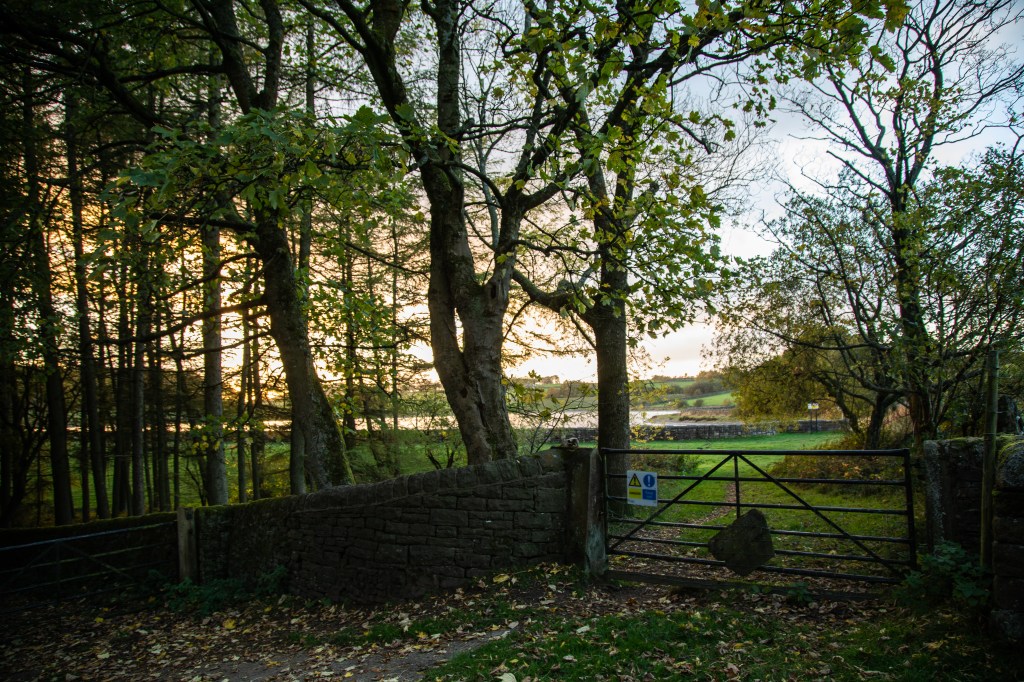
Again, I am struck by how I have concentrated on the content here, as many of these include a gate, although the gate is crucial to the composition to draw the eye into the frame and explore the image. In each image the gate acts as it does in the real world as a divide between distinctive areas with different features. The Blackshaw Clough gate separates the darker woodland from the lighter fields and in the images it is not always possible to see all of what is on the other side.
Other images I took during this exercise also lend themselves to presenting together.
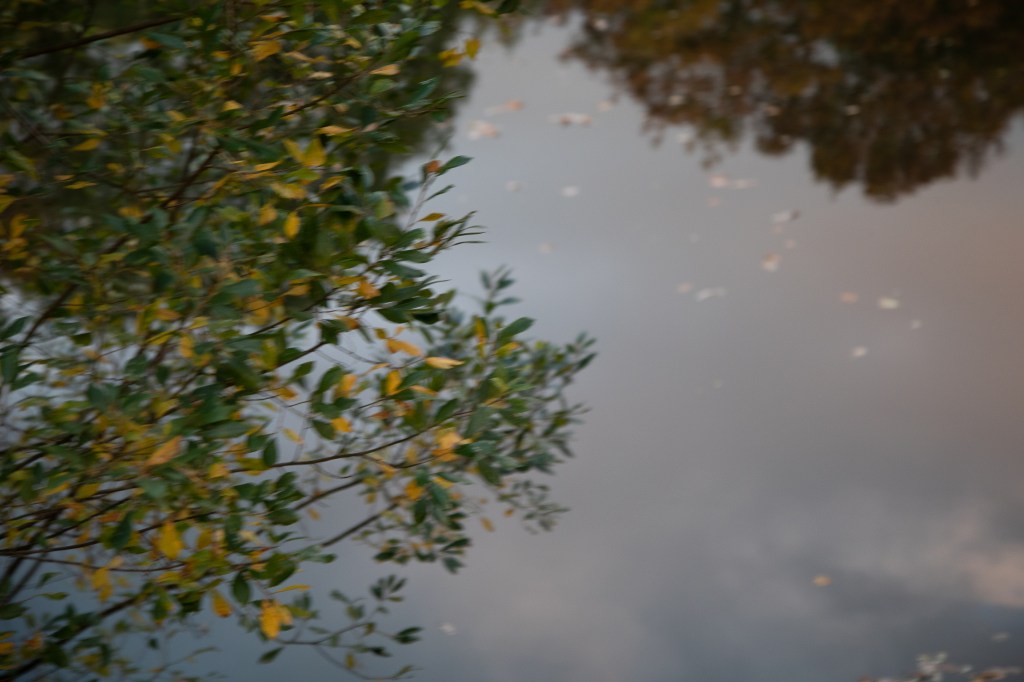
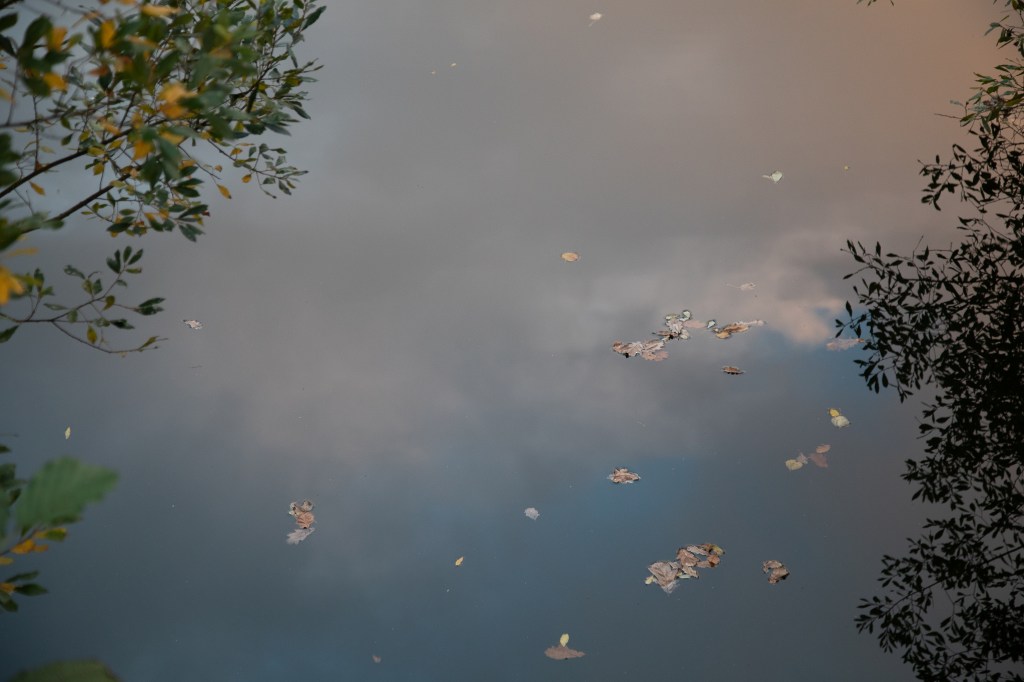
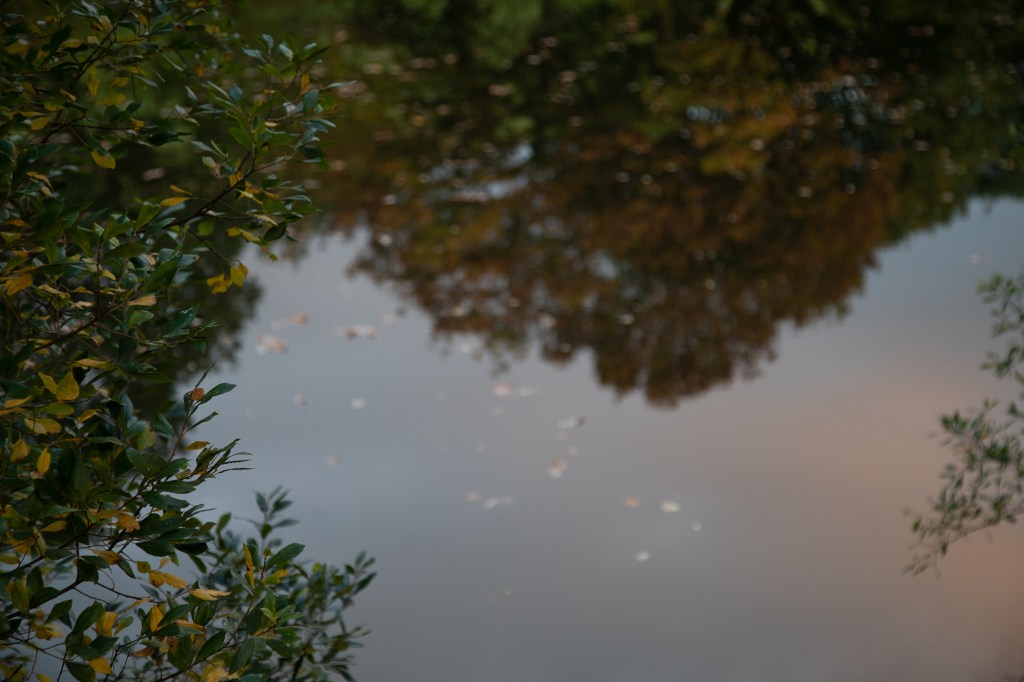
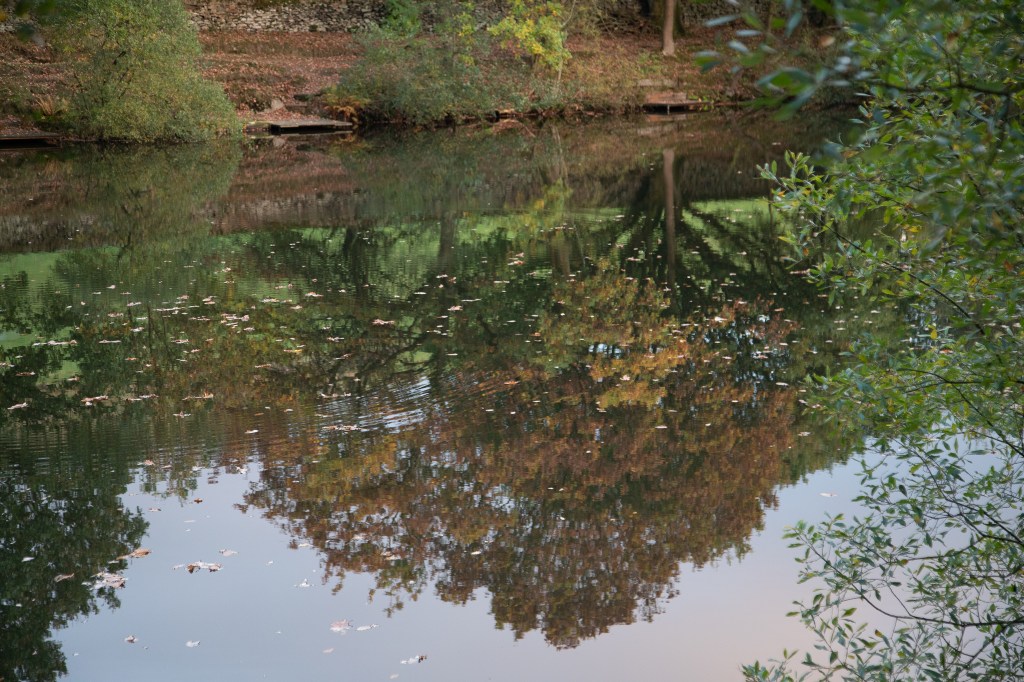
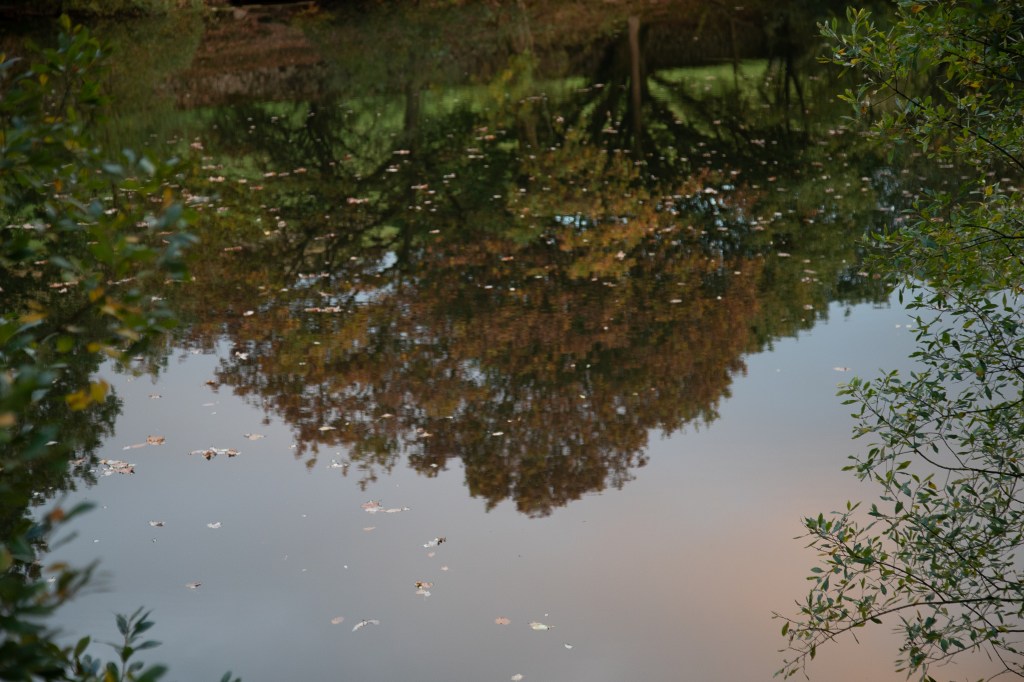
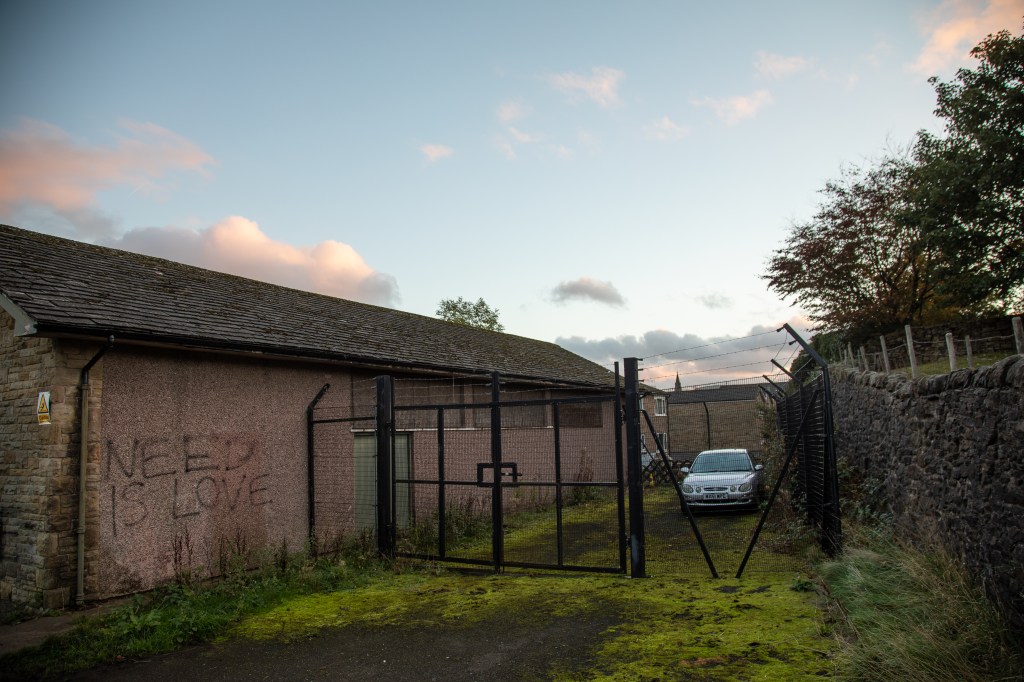
The three images on the lower row here all include a reflection of a tree, and together form a pleasing inverted triangle, similar to the overall shape of the tree.
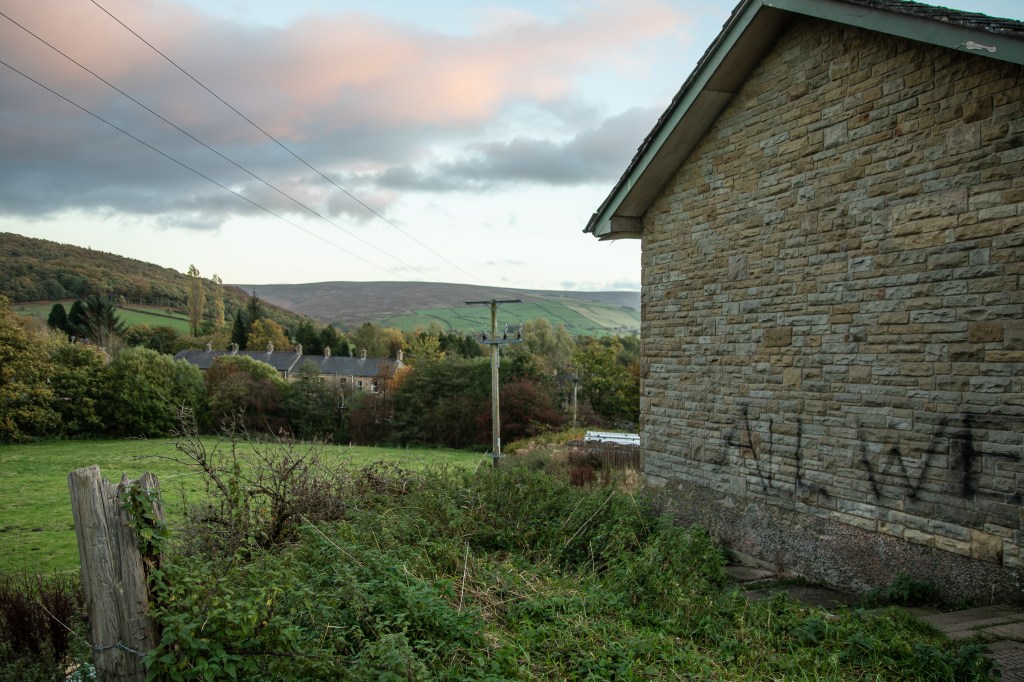
In this series diagonal lines from one image are picked up in the adjacent image, on the top row, the right hand end of the roof, continues as the line of the top of the cloud; in the lower ones the angle of the roof continues from one to the other, effectively suggesting a curve.
Digressing into content for a moment, the graffiti builds up the overall message from one frame to another, the first “All we..” continued in the second as “need is love”; the left hand image on the lower row shows the whole statement, and the last the phrase “need is love|”” again.
2018-10-05 Assignment 1 Feedback Meeting
Call with Andy Hughes
This was the second video call with my tutor and followed me submitting my assignment “Square Mile” for his consideration.
Feedback on my assignment:
Andy told me that the technical quality of the images I had submitted was good and at the standard required for the course.
He commented particularly about the inclusion of map extracts to illustrating the location of some of the images he drew my attention to the concept of “GIS” Geographic Information Systems, and suggested I look into this more as it applies to my work. This is a concept being used extensively to describe social history and geographical concepts.
He considered that some of the images of the area around the confluence of the rivers has many of the visual aesthetics of classical English Landscape painters and suggested that I research more into this, not confining myself to photographers. In particular he mentioned John Virtue
Other artists he suggested I look at include
• Rebecca Solnit and her book “Wanderlust” with regards to walking as an activity
• The “New Topographics”, in particular Lewis Baltz
This is in relation to the tension between urbanisation and the rural environment.
The next assignment is collections – I described some initial thoughts I had about this.
As a sport diver, I am aware that the wrecks of iron and steel ships deteriorate underwater. Wrecks of wooden ships like the “Mary Rose” may be preserved for centuries in sediment which protects them from the effects of tides and weather. As a result the archaeological record of iron and steel ships is likely to be less complete than that of well preserved wooded wrecks.
Many amateur sports divers who dive these iron wrecks collect souvenirs and will have small collections of artefacts from the wrecks. In the future these may be the major remaining artefacts from many of out historic ship wrecks.
I suggested I collect images of such collections for my next assignment.
Andy suggested I look at the historic use of photography to record collections . Other artists he suggested I look at were
• Mark Dion and his work “Oceanmania”
• Michiko Kon
Further study topics
Geographic Information Systems
John Virtue – B&W Landscape painter
Rebecca Solnit “Wanderlust”
New Topographics
Lewis Baltz
Assignment 2 “Collections”
Use of photography to record collections
Mark Dion and his work “Oceanmania”
Michiko Kon












 Andrew Procter