Library Webinar 27 May 2020 – Referencing Software

Library Webinar 27 May 2020 – Referencing Software

Led by:
Matthew Parfitt – UCA Epsom Campus
Ian Badger – UCA Canterbury Campus

Objectives and Content
Overview of types of referencing software
Creating Paperpile account
Using Paperpile
Adding references
Creating bibliography
Other features

My reaction to this session
I have previously recognised that I need to have a more structured and systematic approach to recording work which I reference in my research for this course. Because of my previous research experience (PhD thesis and post-doctoral research in bio-medical science) I am aware of the need for a system for this and that need will continue throughout this undergraduate course. I have therefore identified this as a learning and developmental need.

Matthew and Ian gave an introduction to Paperpile, the reference managing software supported by the UCA/OCA. They also mentioned Zotero, which is a locally held database, rather than a web-based system.

During the course of the webinar, I was able to set up a Paperpile account and explore the basic functions they described.

As this software has support from the UCA/OCA library, it is my intention to use this and incorporate it into my learning log.

Light metering

Light metering
Part 4 of the course begins with a suggested exercise to complete “If you’re not completely sure how your light meter works…”

When I first started using a DSLR, I completed a course with the Jessops academy which included discussions about metering. This included the various metering modes available on the cameras – on mine these are
• Centre weighted average
• Evaluative
• Partial
• Spot

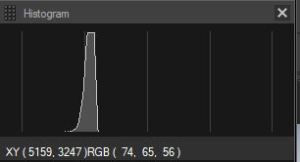
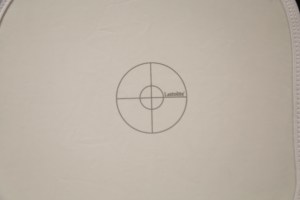
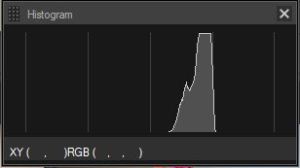
In addition we completed an exercise of photographing a white card using exposure determined by the camera – the result was a grey image.

Whereas when the metering was made for a grey card and then the image of the white made at the exposure, the card appears white.

Having completed these exercises I feel I am confident with the basic skills of the use of exposure metering, and exposure lock in order to be able to expose the image for which I aim. This is of particular importance with my film cameras as I am unable to confirm the correct exposure on site and only on developing the film. For this work I use three types of exposure metering: my 35mm SLRs have through the lens metering, I also use a hand held meter (for the medium format camera) and then I often check the exposure with the meter in my DSLR.

OCA North Meeting: 12 January 2020


OCA North Meeting, Halifax 12 January 2020

Venue: Fletcher’s Mill, Dean Clough, Halifax

The plan for the day was:

  • a presentation on her work by Miranda Richmond
  • general discussion
  • presentation by participants of their OCA work

I have previously read a little about Miranda Richmond’s background and work, and have described this in my log.

Presentation by Miranda Richmond
Miranda described several aspects of her work. These included her work produced during a recent residency on Iona. She also described her influence by her late husband the artist, Miles Richmond; and in turn his influences including Bomberg. She described this as “English Constructivism”.

She referred to a principle advocated by Miles to “find a subject that is too big for you”. My understanding was that by doing this it forced you to look at the entirely of the subject. Thereby it may be possible to get a sense of the “essence” (my term) of the subject rather than focus on small details.

Miranda also brought along her sketch books and it was helpful to see how work produced in the field was translated into a sketch. I have tried using sketch books in the past and found difficulty in that I try to produce a “finished” image. I saw that this is not the purpose but rather to capture key points to develop further later.

General Discussion
There was a general discussion about future meetings, the direction of the group and the possibility of an exhibition.

Presentation of OCA Students’ work
Several students presented their work from the textiles courses.
My Aims and What I Learned
I had similar aims from attending to those for previous meetings.
Practice my assessment and appraisal skills
Gain a better understanding of other art disciplines and influence on photographic work

Seeing the work of Miranda Richmond and hearing her describe her approach and the background to it, enabled me to understand a little better what an artist is trying to show by more abstract images.

New Objectives

To find out more about the work of Miles Richmond and Bomberg, as well as the school of “English Consructivism”.

To try and use sketch books again to help my visual skills

“The Corridor” by Jill Chaloner


IMG_0001c
The Corridor. Jill Chaloner

I receive the British Journal of Psychiatry each month. The editors “are always looking for interesting and visually appealing images for the cover of the Journal”.

B J Psychiatry 2020, 216(1) cover

I received the January 2020 copy while working on Part 4 of this course “Languages of Light”. The cover has a reproduction of a painting, The Corridor by Jill Chaloner.

Chaloner is described in the Journal as “an East Anglian artist trained at the Norfolk Painting School who previously worked as a Consultant Psychiatrist in the NHS for 20 years”. (B J Psychiatry (2020) 216(1): A2).

She describes the painting:
This painting arose out of memories of working and training in several old asylums, Claybury, Bexley and Warley hospitals among others. Also at the back of my mind was a paper I read in the yellow Journal more than 30 years ago entitled “The Corridor People”. It was a study of patients whose main activity was daily wandering in the main hospital corridor and who were not in receipt of any other “therapy”. It was argued that their seemingly purposeless activity could in fact be part of a healing process. In my picture though the human figures seem to inhabit deep darkness, bright light is never far away hinting at the possibility of transformation.

Like Chaloner, I trained and worked in an old asylum, Bexley Hospital. The subjects of the painting and their situation has a resonance for me. In terms of how Chaloner depicts this, I was struck by the use of bright light and deep shadow. This is not only visually appealing and adds to the interest of the image, but is also here used as a metaphor for chronic mental illness and recovery.

I include this post in my consideration of my assignment as an additional way artists use light – as a metaphor.

Zoom Meeting 08 January 2020: New Year – New Work Resolutions

Zoom Meeting 08 January 2020 – New Year – New Work Resolutions
Led by Andrea Norrington

My notes for this meeting are in my Rocketbook notebook – and Andrea’s presentation is available on the OCA forum.

Andrea gave a presentation on study techniques with particular relevance to photographic studies. I thought that the suggestions were very useful and these included techniques for dealing with
Creative block
• repeating exercises or doing other exercises
• taking photographs generally, not necessarily of relevance to the course
• reading – of any subject matter, again not necessarily relevant to the course
Procrastination
• set a time of 25 minutes to work on a topic
• making this the first task of the day
Setting aside a regular time slot for revew and reflection – weekly or bi-weekly
As a result of this meeting my objectives are
1. Setting aside my time for regular reflection and review
2. Preparing an overall time plan for the rest of my course with projected deadlines

Zoom Meeting 29 December 2019 – Wabi Sabi


Zoom Meeting 29 December 2019 – Wabi Sabi

Led by Robert Bloomfield

My notes for this meeting and my reading before it, are from my Rocketbook notebook

19-12-29 Zoom Wabi Sabi  Wabi Sabi Reading


Before the meeting:

Prior to the meeting I briefly researched the concept of “Wabi Sabi”, with which I was previously unfamiliar. My research was fairly brief and based largely on Wikipedia (https://en.wikipedia.org/wiki/Wabi-sabi  accessed 08/08/2020).

This suggested that the concept of Wabi Sabi has its origin in the Buddhist concepts of the “three marks of existence”

  • Impermanence
  • Suffering
  • Emptiness/absence of self nature

The characteristics of the Wabi Sabi aesthetic include

  • Roughness
  • Asymmetry
  • Simplicity
  • Economy
  • Modesty
  • Austerity
  • Appreciation of the integrity of natural objects and processes

Western artists who have incorporated the principles include John Connell and Jesse Richards.

I looked at some of the work by Jesse Richards, who the Wikipedia article indicates also used the concept of Mono no aware – an empathy towards things and acceptance of their impermanence.

Jesse Richards (https://www.jesserichardsfilm.com/  accessed 08/08/2020) is “a New England based filmmaker, photographer and artist. Former member of the Stuckists, founded the Remodernist Film Movement,  co-founder of Cine Foundation International, founder and artistic director of Art Secession Cabal”.

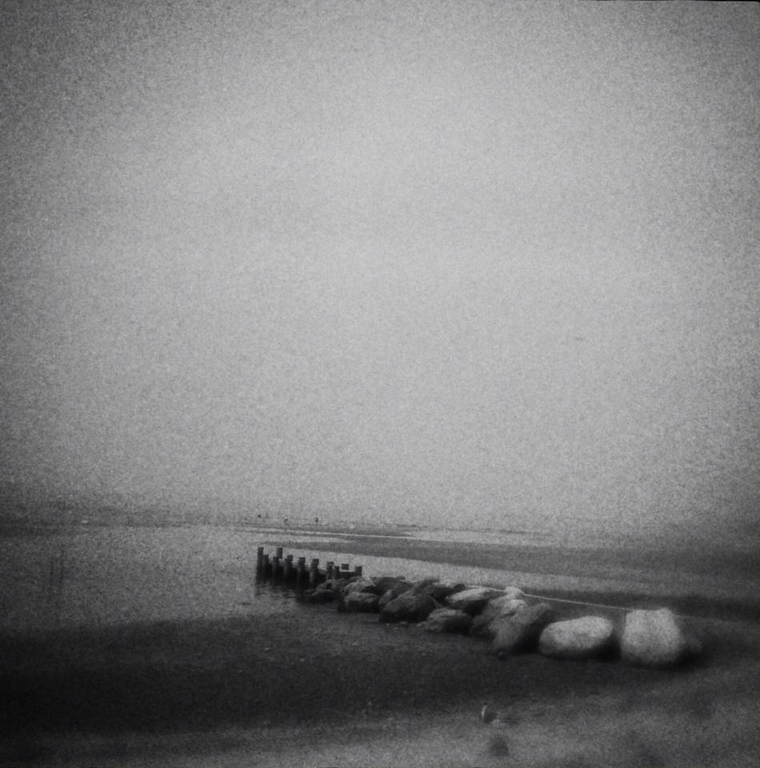
His work includes images created with “toy” cameras including pin hole cameras. I found this image particularly striking.

Harvey's Beach, Old Saybrook, 2015
Harvey’s Beach, Old Saybrook, 2015. Jesse Richards

I considered that it showed aspects of Wabi Sabi in terms of both the image itself, which is imperfect and blurry  and the subject matter which is a simple composition of a desolate beach.

It was this separation of whether the image or the subject shows Wabi Sabi which I found particularly interesting.


The meeting:

Robert gave a presentation expanding on the concept of “Wabi Sabi” beyond my brief reading.

He confirmed that origin of the concept from Buddhist principles of impermanence and mono no aware.

Of particular interest to me was his proposal that Wabi Sabi is an aesthetic category analogous to that of classical “beauty” which he had discussed in an earlier talk. He invited the students to suggest others. The list included

  • Picturesque
  • Sublime
  • Realism
  • Abstraction
  • Surrealism
  • Hyperrealism

This discussion was very helpful to me and I realised that there are many different frameworks against which a visual art work can be appreciated – this was something I had not really considered before and will be something I need to study more.

Robert suggested other artists to research in this area.


Objectives:

As a result of this meeting and the works discussed my objectives are

  1. Read more about aesthetics and categories
  2. Examine the works of artists discussed
    1. Edward Hopper
    2. Wolfgang Tillmans
    3. Daido Moriyama


Zoom Meeting 26 November 2019 – Improbable Images

Zoom Meeting 26 November 2019 – Improbable Images
Led by Robert Bloomfield

My notes for this meeting are from my Rocketbook notebook

26-11-19 Zoom Mtg Improbable IMAGES

Robert gave a presentation expanding on the concept of “improbable images” as described in the course notes. This is based on the principles outlined by Vilem Flusser in “The Philosophy of Photography”.

That is, the concept of the photograph alters from that of the memento (“people who look at a photograph naively photographs represent the world”) to a more generalised unique type of image (“representation of the world no longer depends on direct experience but on interpretation of previous images or representations that already exist”).

As a result of this meeting and the works discussed my objectives are

  1. Read Flusser’s book “The Philosophy of Photography”
  2. Examine the works of the artists discussed
    1. Steele-Perkins
    2. Tomasz Windland
    3. Re-examine Hokusai’s work

Later thoughts on the meeting

Overnight I thought more about the meeting and some of the issues Robert had raised.

  1. Some of the images Robert showed included areas of white, lacking detail, and he emphasised the importance of these in the composition, adding a sense of ambiguity to the overall  image. This reminded me of the concept of “kindly vacancies”  introduced by John Ruskin in his work “On Modern Painters” and referred to by Rachael Talibard in the talk I heard her give.
  2. Robert had made many of his images with film and he emphasised the ability of film to enable the photographer to make images other than those which are our original intention. With digital cameras we are able to review the image immediately and may discard those that do not meet our plan, whereas some of these discarded images may have features making them of significance. This to me was reminiscent of the principle employed in the “Nine Eyes of Google Street View” by Jon Rafman, whereby captured images become art works because of the selection process by the artist.

Part 4: The Languages of Light

Part 4 The Languages of Light

In preparation for a forthcoming Zoom Meeting (Improbable Images – 26/11/19) I noted that this topic from Part 5 is titled differently from that in my notes.

The course notes I have been working from are version:

EYV Manual cg_ph4eyv_240117_red,

whereas “Improbable images” features in the newer version of the course notes:

EYV Manual cg_ph2eyv_180618_red_0.

Robert Bloomfield who is leading the Zoom meeting has advised me to use the later version because the images and exemplars have been updated and there are some useful case studies at the back.

I plan to follow the sequencing and numbering of exercises from the later version of the notes for Parts 4 & 5.


The notes for Part 4 begin “The assignment will ask you to select one of the exercises from Part Four to work up to an assignment submission, so please read the assignment brief before going any further.

Assignment 4: Languages of Light
Brief:
Revisit one of the exercises on daylight, artificial light or controlled light from Part Four (Ex 4.1, Ex 4.2 or Ex 4.3) and develop it into a formal assignment submission.”

The exercises are:
Exercise 4.1: Daylight:
Taking the photography of Mann, Atget or Schmidt or a photographer of your own choosing as your starting point, shoot a number of photographs exploring the quality of natural light.”

Exercise 4.2: Artificial Light
“Capture ‘the beauty of artificial light’ in a short sequence of shots”

Exercise 4.3: Egg or stone
“Use a combination of quality, contrast, direction and colour to light an object in order to reveal its form.”

My initial thoughts on this are that I will probably choose to do the “Daylight” or “Artificial Light” exercises as my Assignment submission as I have already developed a studio-lit sequence for my submission for Assignment 2. This is a learning experience and I think I will learn more if I use a different technique for this assignment.


Zoom Meeting 20 November 2019 – Learning logs

Zoom Meeting 20 November 2019 – Learning logs
Led by Andrea Norrington

My notes for this meeting are in my Rocketbook notebook

ZOOM MTG 20-11-19 LEARNING LOGS

Andrea summarised the concept of the learning log in terms of what happens between doing the coursework and assignments. The write-up of the learning log is all the posts on the blog that do not directly relate to these other elements.

As a result of this meeting my objectives are

  1. Look for and read the David Hurn book “On being a Photographer”
  2. Apply the process described in there and summarised by Andrea of identifying topics to be covered in a project ie planning and then take images to support these topics
  3. Use the 30 second rule to summarise learning experiences
  4. Andrea suggested an open post to compile a bibliography for all references and sources referred to in the blog. Another student suggested the use of “Paperpile”, “Zotero” or “Evernote” to compile bibliographies as did Andrea . I recognise that I need to have a more systematic way to record these and show on my website.

Review of My Objectives: 18 November 2019

Review of My Objectives: 18 November 2019

For various reasons I have not been able to add to this log for a longer period than I had planned, so this review is later than the monthly reviews I had aimed for.

Since I last reviewed my objectives in July I have submitted Assignment 3, and am just about to start work on Part 4, The Language of Light.

My work on Assignment 3 since July has not identified any new objectives for me, so in this post I will review my progress on the objectives I set out in my last post.

Skills:

Film Photography

My overall objective was to start developing and printing my own work.

I have attended a printing workshop, and learned the technique of split-grade printing. This has also given me confidence to print larger images. As a result I have been able to complete Assignment 3 using 35mm film and hand-printed large prints.

I indicated in my last review that I needed to gain more experience with the behaviour of different film and papers stock, and ensure the standard of my final prints is as high as possible. I have started this in that I used two types of film and have found better results with one than the other for this particular work. I also thought there is scope for improvement in the quality of these as I have indicated in my reflection.

This is objective is ongoing and will be reviewed when I get my tutor’s feedback.

Videography

I have done no further work on this, however my other reading and reflection leads me to recognise that the meaning of an image and narrative is important to me and my appreciation of art. This area remains something I want to explore more.

Use of WordPress

I find that while it remains something of a challenge at times, I can achieve what I need with this.

Assessment and appraisal skills

This remains an ongoing task and I think will continue throughout and beyond the course. I have attended the OCA North student group meetings and feel more confident to express and opinion about other work, including that from disciplines other than photography.

I have not been able to seek the views of my tutor and/or others as to whether my assessment is reasonable and accurate, and need to do so.

Knowledge:

My objective was to gain a better understanding of other art disciplines and influence on photographic work. While like the previous objective I think this will continue throughout and beyond the course, I do think I have achieved some steps forward in this.
I offered to help organise the meetings for the OCA North Group, and this makes me consider other disciplines besides photography. In particular the planning of meetings makes me examine other artists’ work and I can consider how this relates to my own. An example of this is the planning of forthcoming meetings and planning the speakers.

However this remains an ongoing learning objective.

To gain an insight into more contemporary and historical approaches to photography

This is another ongoing objective, and I have done little since my last review of my objectives.

Attitudes:

My objective was the “Demonstration of creativity – Imagination, experimentation, invention”

I have deliberately experimented with film in my latest assignment – for reasons which I justify in my account of that. I will hopefully get feedback from my tutor about this and advice as to how to improve.

I hope that a better understanding of the creative process used by other artists will help me develop this more.

As I start Part 4 of my course after a break, these are my current objectives, however I am sure more will emerge as I progress to Parts 4 and 5.